




 USD
USDZcash Falls After Orchard Counterfeiting Vulnerability Disclosure

Developers Patch Critical Shielded-Pool Bug After AI-Assisted Review
TL;DR
- Zcash disclosed a critical Orchard vulnerability that could have allowed undetectable counterfeit ZEC.
- ZEC fell sharply after the disclosure, wiping out billions in market value.
- Developers patched the flaw, but Shielded Labs said cryptography alone cannot prove whether exploitation occurred.
Trade smarter on Jupiter, Solana’s leading DEX built for fast execution and deep liquidity.
Swap tokens at competitive rates, route across multiple liquidity sources automatically, and access perpetuals, DCA, and advanced trading tools — all in one place!
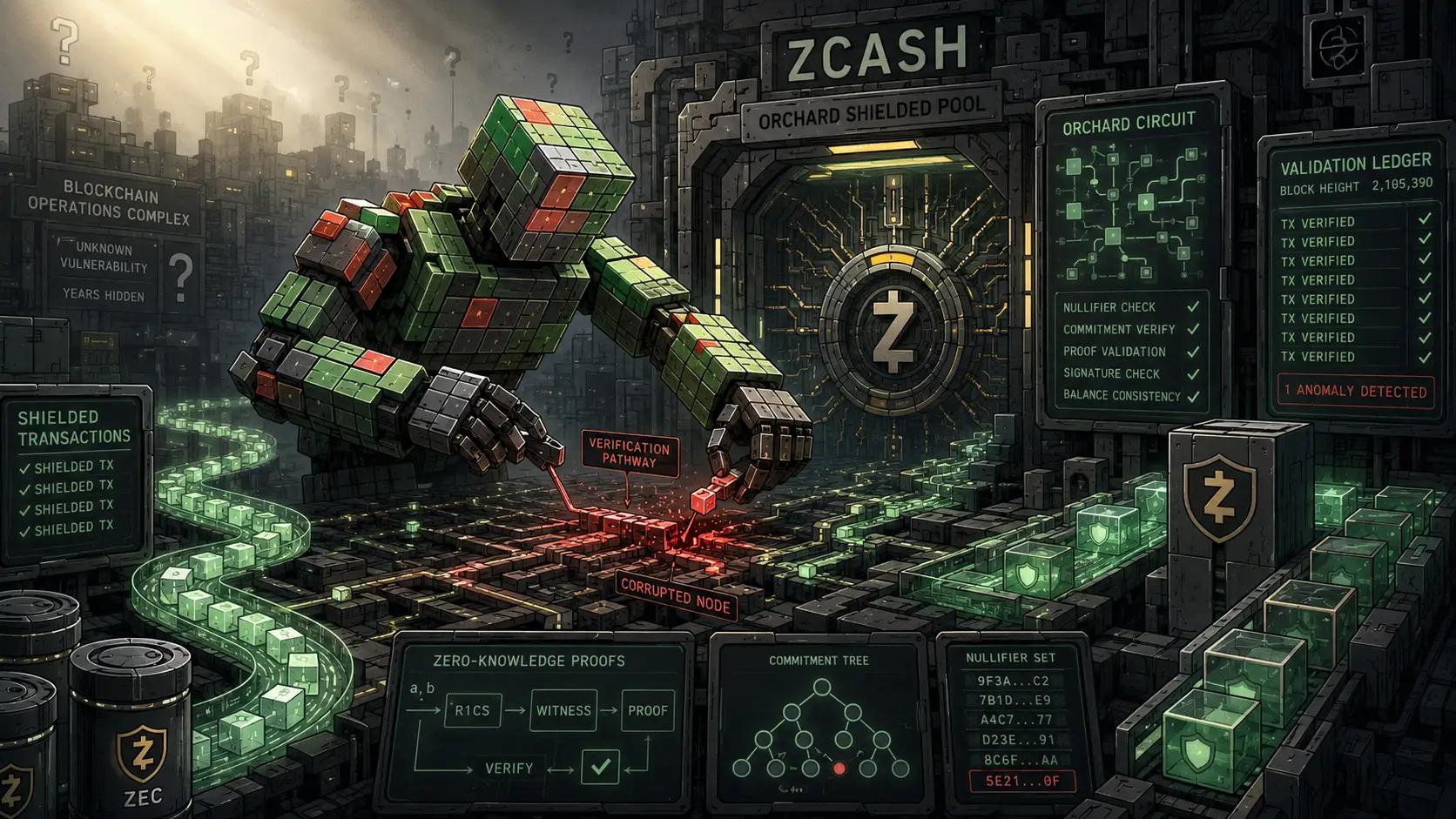
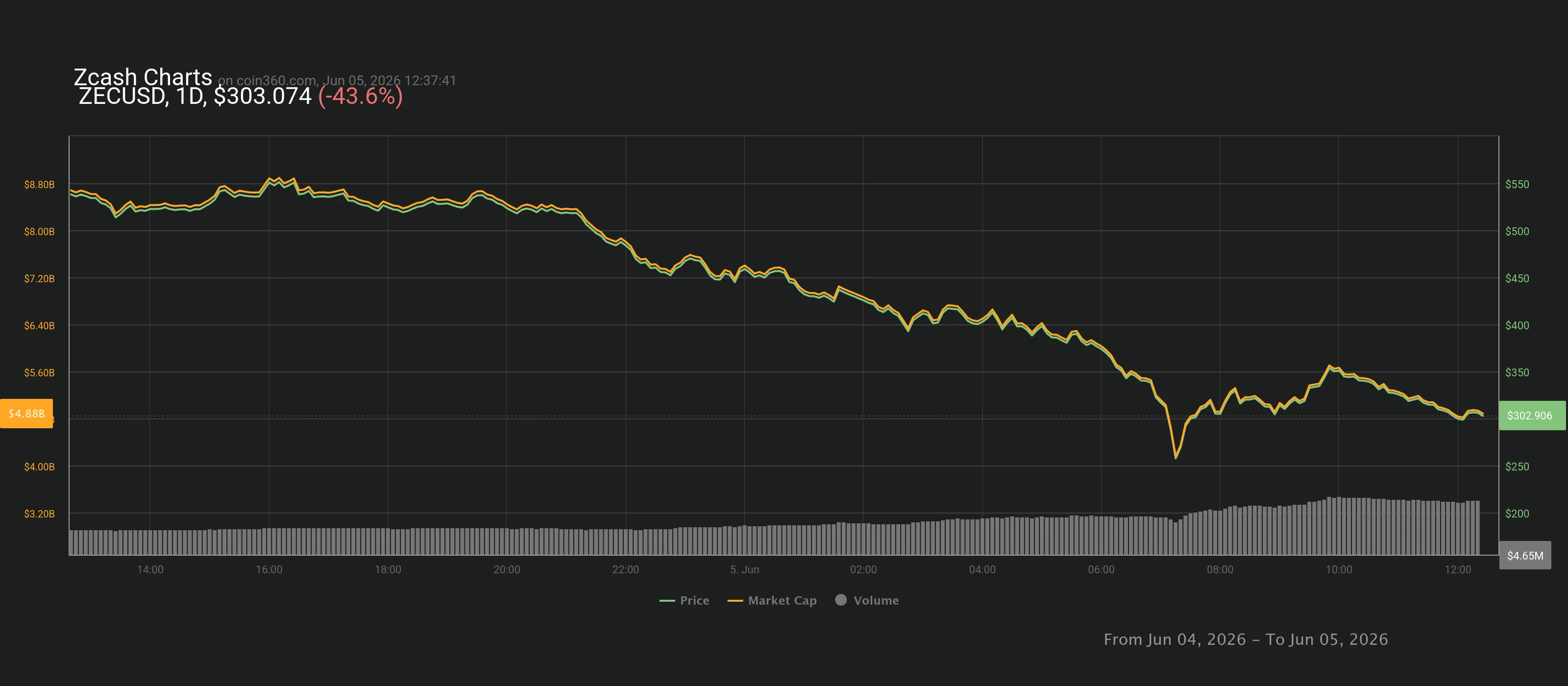
Zcash’s ZEC token dropped sharply after developers disclosed a critical vulnerability in Orchard, the protocol’s advanced shielded pool, that could have allowed counterfeit ZEC to be created without a clear on-chain trace.
The disclosure was released on June 5, 2026, while the bug was discovered on May 29, 2026, by Taylor Hornby, a security engineer engaged by Shielded Labs in April 2026 to search for protocol vulnerabilities before malicious actors could find them.
Shielded Labs said Hornby used Anthropic’s Opus 4.8 artificial intelligence model during a targeted review of Orchard’s cryptographic circuit. The flaw was found in two lines of code in the Orchard circuit, which governs shielded Zcash transactions. Hornby wrote a complete exploit and tested it locally, where it generated unlimited counterfeit ZEC that appeared valid.
We’ve launched the all-new COIN360 Perp DEX, built for traders who move fast!
Trade 130+ assets with up to 100× leverage, enjoy instant order placement and low-slippage swaps, and earn USDC passive yield while climbing the leaderboard. Your trades deserve more than speed — they deserve mastery.
Market Selloff Followed Supply-Integrity Concerns
Zcash launched in 2016 as an early attempt to build private digital money. Its shielded addresses obscure transaction amounts, senders and recipients, unlike transparent chains where balances and transaction flows are publicly traceable. Roughly 30% of circulating ZEC, equal to more than 5 million coins, sits in shielded addresses, making Orchard’s integrity central to confidence in the network’s supply.
Shielded Labs wrote that “The vulnerability was present from Orchard’s activation in May 2022 until the emergency fix was deployed on June 1, 2026.” Developers first introduced a temporary network change to disable affected Orchard actions, then rolled out a hard-fork upgrade that corrected the vulnerability and restored full functionality.
Shielded Labs said there was no evidence that the bug had been exploited before the patch. But Shielded Labs also wrote that “Due to the privacy properties of Orchard and the nature of the bug, there is no definitive way to determine, using only cryptography, whether such exploitation occurred.”
Mert Mumtaz, co-founder and CEO of Helius, said the issue applies beyond Zcash. “In theory, with a zk privacy protocol (not just zcash), you could have a bug in a circuit that inflates supply provided someone extremely sophisticated finds it and somehow exploits it undetected (the difference between a regular defi exploit is that it's harder to detect).”
Gemini co-founder Cameron Winklevoss defended Zcash’s response, saying: “Zcash has unparalleled cryptographers, security engineers, and security researchers. And the community is heavily focused on continuous improvement and hardening the network. That's why it engages world class security researchers to look for bugs. And that's why the recent potential exploit was found. It wasn't by accident and it's a vote of confidence, not a cause for alarm.”
BitMEX co-founder Arthur Hayes said he sold his entire ZEC position after reassessing the privacy thesis. “The Holy Trinity is dead. Sadly due to the Orchard Pool exploit, I had to dump our entire $ZEC bag.” Hayes said minting was “extremely unlikely,” but added: “The privacy from AI, govt, big tech narrative demands perfection not improbability.”
Craig Salm, chief legal officer at Grayscale, argued that pre-patch exploitation was unlikely because an attacker would have needed to examine the codebase more thoroughly than all core developers combined, then avoid draining the entire pool during a historic bull run. His conclusion was: “Seems unlikely to me.”
Crypto commentator Udi Wertheimer said the incident exposed a structural risk for privacy assets. “Zcash enables a unique class of bugs where if they're exploited, no one would know.” Wertheimer added: “This unique class still exists. The fact that they fixed this specific bug is immaterial.”
Joe Andrews, CEO of Aztec Labs, said the flaw belongs to the category of under-constrained elliptic curve checks, which he described as one of the most common weaknesses in production ZK circuits. Andrews said the pattern is not new to Zcash and said the broader industry should expect AI to accelerate the rate at which similar bugs are discovered.
Andrews said the long-term fix is formal circuit verification combined with a second proof system, an approach Ethereum is already planning. “Both systems must agree for a state transition to be valid, which drastically lowers the chances of bugs being exploited,” Andrews said.
Shielded Labs proposed a network upgrade that would create a new shielded pool and use turnstile accounting for coins migrating out of Orchard. The proposed migration would require coins to unshield before entering the new pool, allowing supply integrity to be checked more directly.
Andrews said the upgrade design effectively caps the risk from prior exploitation to the current amount of shielded assets because all coins must unshield before entering the new pool. “Formal verification of the new upgrade reduces risks substantially further,” Andrews said.
Josh Swihart, founder of the Zcash-focused firm ZODL, said the larger long-term issue is preventing similar vulnerabilities from recurring. Swihart pointed to formal verification, meaning mathematical proofs that confirm a circuit’s implementation matches its intended design.
Zcash developers and affiliated teams are now pursuing continued work with Taylor Hornby, formal verification of Orchard’s circuit and additional security hiring. Shielded Labs also said a more detailed proposal for supply-verification upgrades could follow shortly.
The AI angle remains central to the episode because artificial intelligence did not create the Orchard vulnerability, but helped compress the time between hidden technical risk and public discovery. Open-source protocols with complex financial logic are now being reviewed by AI systems that can identify bugs faster, cheaper and at larger scale.
DeFi applications, cross-chain bridges and layer-1 blockchains were identified as especially exposed because they rely on open-source code and complex financial logic governing large pools of capital. OpenZeppelin co-founder Manuel Aráoz reportedly warned investors last month to exit DeFi altogether, arguing that AI agents are becoming capable of identifying vulnerabilities much faster than human reviewers.
The DeFi sector has lost over $1.1 billion to exploits in the past year. Anthropic’s reported unveiling of Claude Mythos, described as a vulnerability-seeking AI model considered too dangerous for public release, added to concern that advanced bug-finding tools could create sudden losses if misused.
Deddy Lavid, chief executive of blockchain security firm Cyvers, estimated that the sector’s financial exposure to AI-driven exploits ranges from hundreds of millions to billions of dollars. Grayscale Chairman Barry Silbert framed the episode as evidence that digital assets have entered an “AI-enabled” threat environment.
Gemini co-founder Tyler Winklevoss said AI does not fundamentally change the security race between developers and attackers, but accelerates both sides. “AI doesn't change this game of cat and mouse, it just accelerates it. Every piece of software has to run this race. There's no escaping it.”
Zcash Faces Misinterpreted Outage
On June 3, 2026, Zcash experienced an incident where block explorers showed no new blocks for over four hours, leading to claims of a network outage. CEO Mert Mumtaz clarified that the network was not down but faced explorer synchronization issues post-upgrade. ZEC's price dipped 2% amid uncertainty despite a recent 46% gain over the month.
Misinterpretations suggested halted transactions, impacting exchanges like Binance and Kraken. The incident was linked to a bug in the Orchard pool, which accounted for 30% of ZEC. Explorers like ZecMiningPool continued block production, challenging outage claims.
FAQ
What was the Zcash vulnerability?
A flaw in Orchard could have allowed counterfeit ZEC inside the shielded pool.
Was the bug exploited?
Shielded Labs said there was no evidence, but no definitive cryptographic proof.
Who found the bug?
Taylor Hornby discovered it during an AI-assisted security review.
What fix was proposed next?
Shielded Labs proposed a new shielded pool with turnstile accounting.
This article has been refined and enhanced by ChatGPT.


