




 USD
USD
Strategy Faces MSCI Index Removal Risk Under New Eligibility Rules


Potential passive selling could also pressure MSTR’s Bitcoin funding model
TL;DR
- MSCI finalized a methodology that can exclude companies it classifies as non-operating businesses from its Global Investable Market Indexes.
- Strategy is at risk of removal, but its deletion has not been finalized.
- Beyond forced index selling, sustained pressure on MSTR could weaken the premium Strategy has used to finance Bitcoin purchases.
Trade smarter on Jupiter, Solana’s leading DEX built for fast execution and deep liquidity.
Swap tokens at competitive rates, route across multiple liquidity sources automatically, and access perpetuals, DCA, and advanced trading tools — all in one place!
MSCI’s finalized eligibility rules put Michael Saylor-led Strategy at risk of removal from its Global Investable Market Indexes, but the company has not yet been formally deleted. MSCI plans to publish final constituent changes on Nov. 11 before implementing the methodology after the Nov. 30 market close.
MSCI announced the change on Oct. 15 after proposing the methodology in August. The framework targets companies that lack substantial operating assets and resemble passive investment vehicles. Firms that fail an initial core screen face five financial-ratio tests covering areas including expenses, cash flow, changes in asset values and reliance on outside financing. A company becomes ineligible if it is flagged on at least four of those tests.
Existing constituents receive an additional buffer: they must fail the eligibility screen in both of their two most recent annual filing periods before removal, while prospective additions can be blocked if they fail in either period. MSCI may also consider the latest interim filing. The framework replaces restrictions aimed at companies whose digital assets represented at least 50% of total assets after MSCI abandoned an earlier outright exclusion proposal in January.
Strategy Pushes Back on MSCI Classification
Strategy challenged the methodology in September, arguing that it creates an arbitrary distinction between operating companies and investment vehicles and undermines MSCI’s neutrality. The company said the term “non-operating company” has no basis in U.S. GAAP, IFRS or a recognized legal framework and maintained that its Bitcoin business qualifies as an operating segment under U.S. accounting rules, consistent with discussions with SEC staff. Strategy asked MSCI to withdraw the proposal.
Michael Saylor had separately called the rule “discriminatory.” MSCI had already identified Strategy, Japan’s Metaplanet and uranium investment company Yellow Cake as potential deletions in an August simulation using May financial data. Ethereum treasury company SharpLink was also among three firms placed on a proposed watchlist.
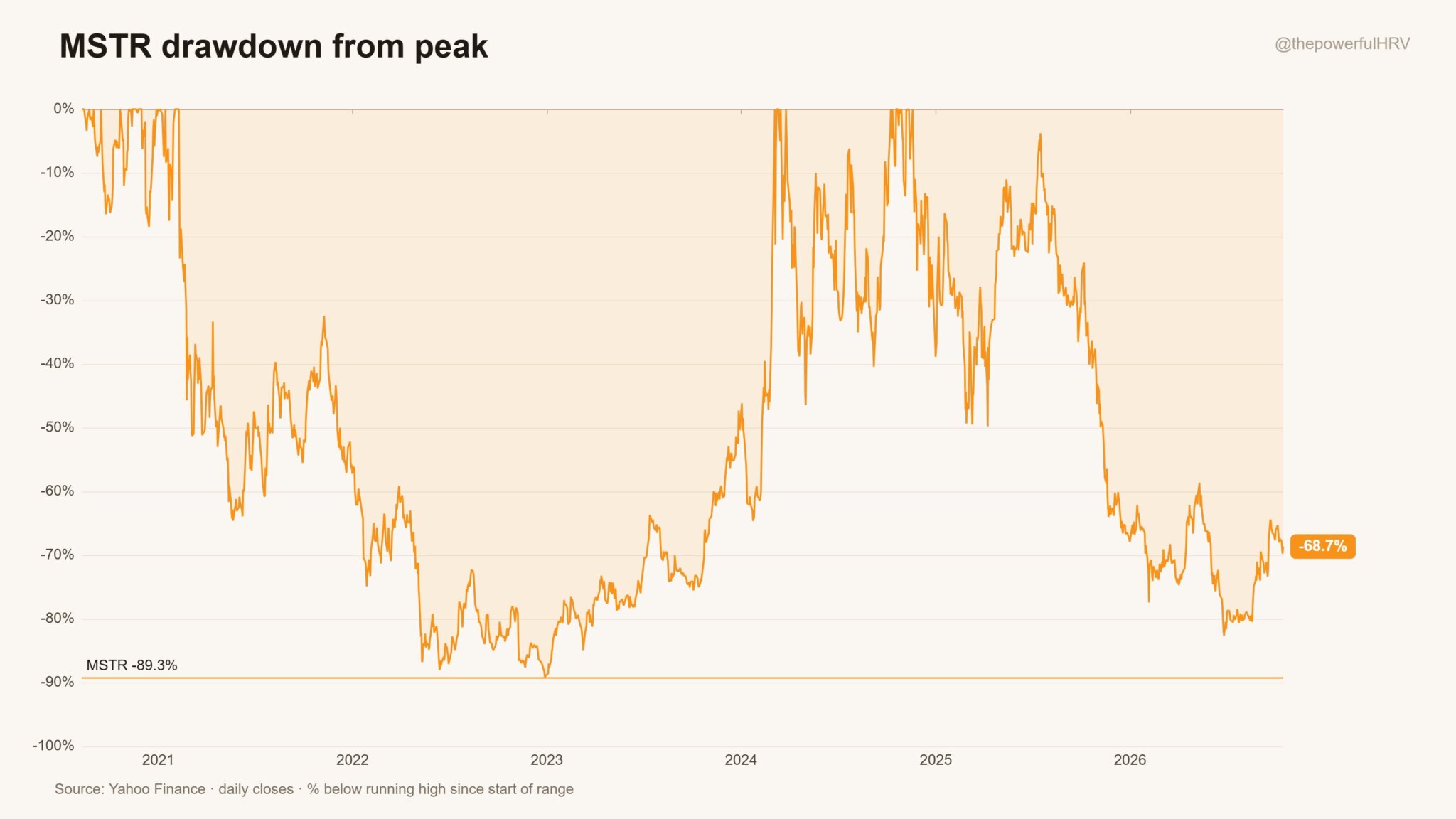
MSTR’s weakness adds another layer to the dispute. A chart shared by market commentator Mark Harvey put the stock 68.7% below its running high, after a drawdown exceeding 80% earlier in 2026 and a previous low of 89.3% below the running high. Harvey described the depressed valuation as a generational buying opportunity.
Passive Selling Versus Strategy’s Financing Model
JPMorgan analysts estimated in November 2025 that MSCI exclusion could trigger approximately $2.8 billion of passive MSTR selling. Bitcoin analyst Adrian Morris argued that the potential liquidity impact is overstated based on Strategy’s trading activity.
Morris said: “Any forced selling will be into trading flow, around rebalances, etc. This will not be a market dump event. MSTR has the liquidity and turnover to absorb this selling with little issue IMO. This is a near term ripple to deal with, not an existential threat to MSTR.”
Coin Bureau CEO Nic Puckrin identified a different risk: sustained selling could compress MSTR’s premium to the value of its Bitcoin holdings. Strategy has historically issued common stock above its underlying Bitcoin net asset value and used the proceeds for additional purchases. A smaller premium could make common-stock issuance less attractive and increase reliance on preferred securities, debt or existing liquidity.
Strategy’s latest disclosure showed that it bought 250 BTC for $21.5 million during the week ending Oct. 11, funded primarily with $21 million from common-share sales. It also spent $192.4 million repurchasing STRC preferred stock. Holdings reached 848,250 BTC acquired for approximately $64 billion, alongside a $4.88 billion dollar reserve and another $640.5 million in cash available for broader treasury purposes.
This article has been refined and enhanced by ChatGPT.


