




 USD
USDStrategy Approves Bitcoin Monetization and $2 Billion Buyback Plan


New Framework Adds Reserve Rules, STRC Support and Capital Controls
TL;DR
- Strategy approved a Digital Credit Capital Framework on June 29, 2026, adding Bitcoin monetization, reserve rules and repurchase authority.
- The company paused Bitcoin buys, kept holdings at 847,363 BTC and rebuilt its USD Reserve to $2.55 billion.
- Strategy authorized up to $2 billion in repurchases and raised STRC’s annual dividend rate to 12.00%.
Trade smarter on Jupiter, Solana’s leading DEX built for fast execution and deep liquidity.
Swap tokens at competitive rates, route across multiple liquidity sources automatically, and access perpetuals, DCA, and advanced trading tools — all in one place!
Strategy approved a new Digital Credit Capital Framework on June 29, 2026, marking a shift from simple Bitcoin accumulation toward active capital management as the company moved to support preferred securities, rebuild liquidity and preserve long-term Bitcoin exposure.
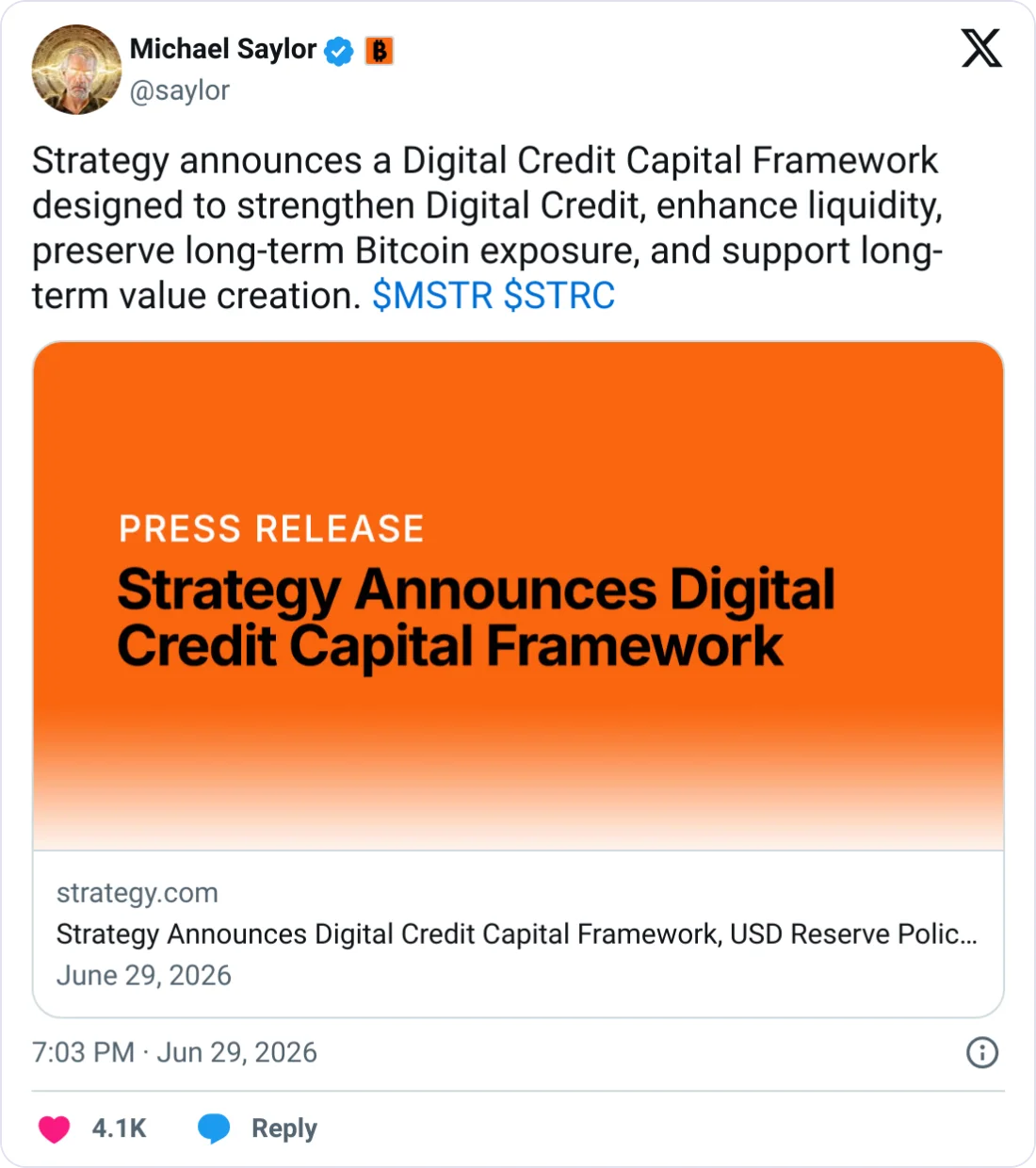
The framework gives Strategy more tools to manage its balance sheet during market stress. It includes a Bitcoin Monetization Program, a board-approved USD Reserve policy, a Digital Credit Securities repurchase program, a Class A common stock repurchase program and a new monthly dividend policy for STRC, the company’s Variable Rate Series A Perpetual Stretch Preferred Stock.
Strategy did not announce a fresh Bitcoin purchase with the update. The company paused Bitcoin acquisitions between June 22 and June 28, 2026, even though it raised approximately $1.15 billion through MSTR stock sales during the week. Strategy’s Bitcoin holdings remained at 847,363 BTC.
Strategy Creates a Controlled Bitcoin Monetization Tool
The Bitcoin Monetization Program allows Strategy to sell Bitcoin from time to time when management considers it advantageous. The program authorizes up to $1.25 billion in proceeds from potential BTC sales, but Strategy emphasized that it is not required to sell any Bitcoin under the plan.
Proceeds from Bitcoin sales may be used to build or replenish the USD Reserve, fund preferred-stock dividends and interest expenses, or finance repurchases of Digital Credit Securities or Class A common stock. The company said material monetization activity and related balance-sheet updates will be disclosed through standard 8-K filings.
Michael Saylor said, “Strategy remains committed to Bitcoin as its primary treasury reserve asset.” Saylor also said, “At the same time, Digital Credit requires liquidity, discipline, and active capital management.”
Strategy said the framework is designed to “strengthen Digital Credit, enhance liquidity, preserve long-term Bitcoin exposure, and support long-term value creation.” The company also said, “The actions announced today are intended to support that objective by strengthening preferred dividend liquidity, improving market confidence in Strategy’s Digital Credit Securities, and providing the Company with additional capital allocation tools.”
CEO Phong Le described the framework as a move from primarily issuing capital toward actively managing Strategy’s capital structure through both issuance and repurchases, depending on market conditions.
Strategy rebuilt its USD Reserve to $2.55 billion as of June 28, 2026, up from $1.4 billion as of June 21, 2026. The reserve increase included shares sold but not yet settled as of June 26, 2026.
The board-approved USD Reserve policy limits the reserve to preferred-stock dividends and interest expenses on outstanding debt. Strategy’s board policy requires management to maintain a minimum reserve equal to at least 12 months of expected annual preferred-stock dividend payments and interest obligations.
At its current level, the reserve covers about 17.4 months of preferred dividend and interest obligations. One figure put the annual run-rate for those obligations at roughly $1.76 billion, explaining why the $2.55 billion reserve provides that coverage. Strategy had reportedly earmarked $2.25 billion at the start of the year for dividends and debt management.
Analysts at CryptoQuant had previously said Strategy should stop buying Bitcoin altogether for now, arguing that dividend obligations had risen while cash reserves had fallen sharply. The capital framework followed those concerns, as well as pressure from preferred-share weakness, a shrinking equity premium and questions about the company’s Bitcoin-per-share narrative.
We’ve launched the all-new COIN360 Perp DEX, built for traders who move fast!
Trade 130+ assets with up to 100× leverage, enjoy instant order placement and low-slippage swaps, and earn USDC passive yield while climbing the leaderboard. Your trades deserve more than speed — they deserve mastery.
Repurchase Programs Target Preferred Securities and MSTR
Strategy authorized up to $1 billion in repurchases of Digital Credit Securities and up to $1 billion in repurchases of its Class A common stock. The combined authorization totals up to $2 billion.
The Digital Credit Securities Repurchase Program may cover outstanding preferred securities including STRC, STRF, STRD and STRK. Strategy expects STRC to be the initial repurchase priority. The repurchase programs may be used from time to time, have no fixed expiration date, and may be modified, suspended or terminated at any time.
Strategy said actual repurchases will depend on market conditions and management’s assessment of whether the transactions are accretive. The company framed the programs as tools for market dislocations and said the common-stock repurchase program will not be funded from the USD Reserve.
The Digital Credit Securities repurchase program is also separate from the USD Reserve, preserving the reserve for dividends and interest expenses. Strategy’s rationale is that repurchasing preferred securities below par could reduce future recurring dividend obligations.
STRC was designed to trade near its $100 stated value, but the security had struggled to regain par since mid-May. It had drifted more than 25% below par in recent weeks, fell to a new low of $71.25 last week as Bitcoin dropped below $60,000, and recovered slightly to close Friday at $74.57.
STRC jumped as high as $82.50 before the opening bell after the framework was announced. Another figure showed STRC higher by around 9% after the announcement.
Strategy increased the regular annual dividend rate on STRC by 50 basis points to 12.00%. The new rate is effective for record dates or dividend periods beginning in July 2026, with one detail specifying dividend periods beginning July 1, 2026.
Michael Saylor said, “STRC dividend rate has been increased by 50 bps to 12.00%, effective for record dates in July, 2026.” Saylor added, “We will continue to evaluate the rate monthly. Our corporate objective is for STRC to trade over time at $99-$100.”
The STRC increase was described as the product’s eighth dividend-rate hike. Strategy’s new STRC Dividend Policy requires management to evaluate the rate monthly, considering STRC trading levels, market yields, credit spreads, Bitcoin price and volatility, USD Reserve coverage, capital-market conditions and Strategy’s overall capital structure.
Strategy said, “The company will not necessarily increase the STRC dividend rate solely because STRC trades below its stated amount.”
Strategy’s common stock had also come under pressure before the announcement. MSTR fell sharply over the prior trading stretch, and the company’s enterprise mNAV was described as having fallen below 1 on Friday.
Strategy’s so-called mNAV stood around 0.99 on Monday. The measure was used to compare Strategy’s enterprise value against its Bitcoin holdings, and the decline placed the company at a slight discount under that framework.
Strategy raised the USD Reserve through at-the-market sales of its Class A common stock. During the week before the announcement, Strategy sold 12,669,017 MSTR shares for approximately $1.15 billion. As of June 28, 2026, Strategy still had $24.3 billion worth of MSTR shares available for issuance and sale under that program.
Michael Saylor said, “Strategy expects to remain disciplined in its use of MSTR issuance, particularly when the stock trades at or near 1x mNAV.”
The framework also affects how Strategy approaches future Bitcoin purchases. Moving forward, Strategy indicated it would not issue more common shares to purchase Bitcoin unless the company was valued at a premium to its holdings.
Bitcoin traded near or below the $60,000 area during the announcement window.
If Strategy sold the full amount permitted under the Bitcoin Monetization Program, the company said it would have enough resources to cover around 26 months of dividend costs. Before the reserve rebuild, analysts had noted Strategy’s cash stockpile had slimmed to cover only about 14 months of recurring costs.
Strategy has issued more than $10 billion worth of preferred stock in less than a year. STRC had become the main driver of Strategy’s Bitcoin acquisitions earlier in the year, making the preferred-security market central to the company’s capital strategy.
Polymarket showed traders assigning a 15% chance that Strategy would hold more than 1 million BTC before year-end, slightly up from 14.5% a week earlier.
The next test for Strategy is whether the new framework stabilizes STRC, supports MSTR’s valuation and lets the company preserve Bitcoin exposure while managing its preferred-stock obligations. The company has not committed to selling Bitcoin or executing repurchases, leaving those actions dependent on management judgment and market conditions.
FAQ
What did Strategy approve?
Strategy approved the Digital Credit Capital Framework on June 29, 2026.
Did Strategy buy more Bitcoin?
No. Strategy paused Bitcoin purchases during the cited week.
How much can Strategy sell under the Bitcoin program?
Strategy can generate up to $1.25 billion from potential BTC sales.
What is Strategy’s STRC target?
Michael Saylor said the objective is for STRC to trade at $99-$100.
This article has been refined and enhanced by ChatGPT.


