




 USD
USDS&P Pantera Digital Asset Index Launches Without Bitcoin

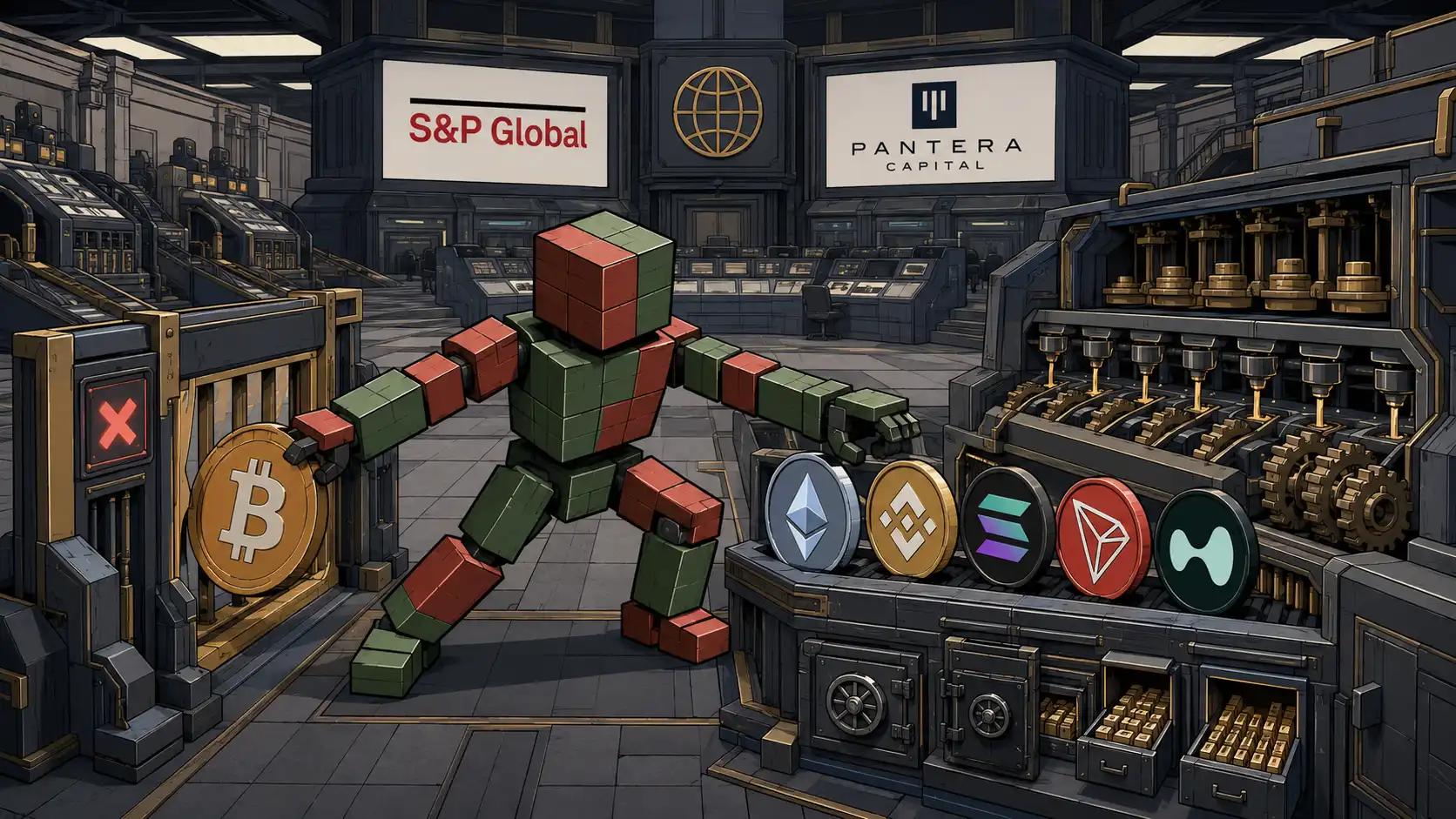
Revenue-based methodology favors economically active blockchain protocols over monetary assets
TL;DR
- S&P Dow Jones Indices and Pantera Capital launched a digital-asset benchmark that excludes Bitcoin.
- The methodology prioritizes protocol revenue, blockchain utility and value-accrual mechanisms.
- Ether, BNB, Solana, Tron and Hyperliquid are the benchmark’s largest initial holdings.
Trade smarter on Jupiter, Solana’s leading DEX built for fast execution and deep liquidity.
Swap tokens at competitive rates, route across multiple liquidity sources automatically, and access perpetuals, DCA, and advanced trading tools — all in one place!
S&P Dow Jones Indices and Pantera Capital launched the S&P Pantera Digital Asset Index on July 22, 2026, excluding Bitcoin because the benchmark requires constituents to demonstrate measurable economic activity and revenue generation. The new crypto price index begins with 18 digital assets and is designed for institutional portfolios seeking exposure to economically active blockchain protocols rather than assets valued primarily as stores of value.
The benchmark applies predetermined eligibility, weighting and concentration rules intended to bring traditional index-construction practices into digital assets. Its methodology screens protocols for tangible economic activity, sustainable blockchain utility and revenue generation before weighting qualifying constituents according to market capitalization.
Bitcoin’s exclusion was a direct result of that screening process rather than a decision based on its liquidity, market size or recognition. The methodology treats Bitcoin primarily as a monetary asset and store of value, not as an operating protocol that directs revenue to holders through staking distributions, token repurchases, token burns or a holder-governed treasury.
Bitcoin collects transaction fees, but those fees are paid to miners for validating transactions and securing the network. They are not distributed to BTC holders or retained in a protocol treasury controlled by holders. Under the index methodology, transaction activity alone does not qualify a token when the resulting fees do not create identifiable value for token holders or the token economy.
Cathy Clay, CEO of S&P Dow Jones Indices, said the benchmark was intended to help investors evaluate digital assets through standardized and economically grounded measures. “S&P Dow Jones Indices helps investors cut through market noise with benchmarks you can trust,” Clay said.
Ether Leads Revenue-Focused Constituent Group
The index’s five largest initial constituents span smart-contract platforms, exchange-linked ecosystems, payments infrastructure and decentralized financial applications. Hyperliquid’s placement among the largest holdings also shows that the methodology can assign substantial representation to an application-focused decentralized finance ecosystem rather than limiting the benchmark to established general-purpose blockchain networks.
Qualifying assets are weighted by market capitalization after passing the economic-fundamentals screen. The largest constituent is capped at 35%, while every other holding is capped at 20%. Those limits are intended to prevent excessive concentration while preserving differences in scale among eligible protocols. Quarterly rebalancing allows the composition and weights to adjust as market values and eligibility conditions change.
The methodology considers economic mechanisms that can connect protocol usage with token value, including transaction and application fees, decentralized finance services, staking distributions, token repurchases, supply burns, holder-governed treasuries and real-world asset tokenization. A protocol may process transactions and collect fees without qualifying if those fees do not produce identifiable value for holders or the protocol’s token economy.
Artemis will provide project-valuation data for the index process. Its role gives the benchmark access to blockchain-specific operating information alongside market capitalization, allowing the selection process to consider protocol activity rather than relying exclusively on token prices and circulating supply.
The framework does not establish that every included token gives holders a legal claim on revenue comparable to a corporate dividend. Instead, protocol-level revenue and value-accrual mechanisms are used as evidence that a blockchain network is producing measurable economic activity.
We’ve launched the all-new COIN360 Perp DEX, built for traders who move fast!
Trade 130+ assets with up to 100× leverage, enjoy instant order placement and low-slippage swaps, and earn USDC passive yield while climbing the leaderboard. Your trades deserve more than speed — they deserve mastery.
Pantera Targets Institutional Allocation Decisions
Pantera Capital co-developed the methodology with S&P Dow Jones Indices, combining its digital-asset investment experience with S&P’s index-governance and benchmark-construction infrastructure. Pantera was founded by Dan Morehead, the firm’s founder and managing partner, and has managed more than $3 billion across three investment strategies.
Pantera launched its first cryptocurrency fund in 2013. Morehead said the institutional question has shifted from whether investors should enter digital assets to how they should allocate capital efficiently across the sector. He said the benchmark combines Pantera’s experience evaluating digital assets with S&P Dow Jones Indices’ benchmark standards to identify blockchain projects important to the industry’s development.
The index is intended to serve as a benchmark for institutional portfolios rather than only as a broad retail-market tracker. It could support passive index-tracking funds, structured investment products, institutional mandates and actively managed strategies that use the index as a benchmark or eligible investment universe.
The methodology creates a distinction between monetary assets and productive blockchain protocols. Bitcoin represents the first category because its investment case centers on its monetary role and store-of-value characteristics. The eligible constituents represent the second category because their networks produce measurable fees, applications or token-economic activity.
That distinction means the index is not a neutral representation of the entire digital-asset market. It measures a narrower group of revenue-producing blockchain networks and excludes assets whose economic value does not fit that framework, even when those assets have substantial market capitalization.
The benchmark also differs from conventional market-cap-weighted crypto indices because eligibility is determined before constituent size affects weighting. Assets must first satisfy the economic-activity and utility requirements. Market capitalization then determines their relative representation, subject to the concentration limits.
Existing crypto benchmarks can depend heavily on market capitalization or recent performance. The S&P Pantera Digital Asset Index instead filters the eligible universe using network activity, protocol revenue and token-value mechanisms before applying market-cap weighting. The approach is intended to reduce exposure to highly speculative tokens and networks lacking sustainable economic activity.
Bitcoin’s omission does not establish that institutional investors are abandoning the asset. The benchmark provides a separate allocation framework for revenue-generating blockchain protocols and may sit alongside Bitcoin-focused investment products rather than replacing them.
Launch Arrives as Altcoin Indicators Strengthen
Broader altcoin conditions were improving when the index launched, although available indicators had not confirmed a full market rotation. The CoinGlass Altcoin Season Index reached 58 in mid-July 2026 after rising to 64 on June 4, 2026. Both readings remained below the 75 threshold used to confirm a full altcoin season.
A March 2026 discussion involving institutional-market participants found that major allocators were concentrating digital-asset exposure around Bitcoin, Ethereum and a limited group of decentralized finance assets rather than spreading capital broadly across the market. The new benchmark follows a selective approach but removes Bitcoin and expands the allocation framework around economically active protocols.
Regulatory frameworks across several major markets had also become clearer before the launch, while the approval and expansion of spot exchange-traded funds had made digital-asset exposure easier for traditional investors. More blockchain networks were simultaneously producing measurable revenue from transaction fees, decentralized finance applications and tokenized real-world assets.
The complete constituent list and individual weights were not provided. The available information also did not disclose the index’s base date, historical back-tested performance, minimum liquidity requirements, custody standards or the precise quantitative threshold used to define qualifying protocol revenue.
No exchange-traded product, fund or derivative was identified as being directly connected to the index at launch. The benchmark was presented as infrastructure for institutional portfolios and as a possible foundation for future passive and active investment strategies.
FAQ
Why was Bitcoin excluded?
Bitcoin does not direct protocol revenue to holders through staking, buybacks, burns or a governed treasury.
How are eligible assets weighted?
Qualifying assets are weighted by market capitalization after passing the benchmark’s economic-activity screen.
What data provider supports the methodology?
Artemis supplies project-valuation data used in the index process.
Is an investment product already attached?
No specific fund, exchange-traded product or derivative was identified at launch.
This article has been refined and enhanced by ChatGPT.


