


 USD

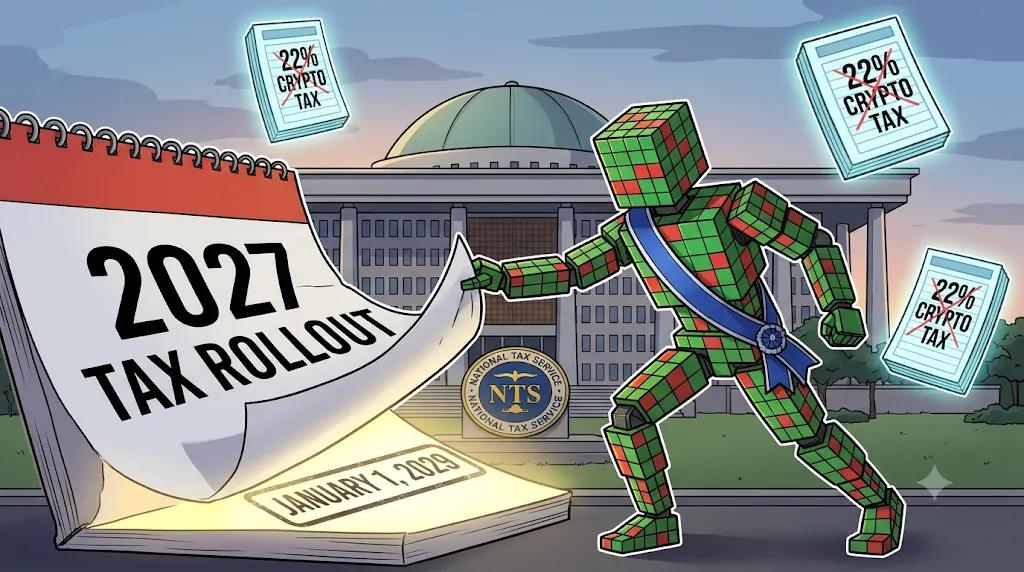
South Korea Seeks to Delay 22% Crypto Tax to 2029 With Loss Relief

Government Proposes New Timeline as U.S. Data-Sharing Rules Approach
TL;DR
- South Korea's government is seeking to postpone its 22% cryptocurrency income tax from 2027 to 2029, marking a potential fourth delay.
- The proposal would allow investors to carry forward trading losses for three years to offset future taxable gains.
- The changes require National Assembly approval, while preparations for U.S. transaction data sharing and stronger digital asset regulations continue.
Trade smarter on Jupiter, Solana’s leading DEX built for fast execution and deep liquidity.
Swap tokens at competitive rates, route across multiple liquidity sources automatically, and access perpetuals, DCA, and advanced trading tools — all in one place!
South Korea's government said on November 5, 2026, that it would seek to delay cryptocurrency income taxation by another two years, pushing implementation from January 1, 2027, to January 1, 2029. The proposal also introduces a three-year loss carryforward for crypto investors, allowing eligible losses to offset future gains. Both measures require legislative approval, meaning the existing tax schedule remains in effect until lawmakers amend the Income Tax Act.
Finance Minister Lee Hyoung-il announced the proposed postponement at a press conference in Seoul, acknowledging repeated changes to the country's taxation timetable.
“It is with a heavy heart that I announce another proposed delay in taxation, after its implementation has already been postponed three times,” he said. “The government will use the two-year period to ensure that taxation of virtual assets can be implemented smoothly in 2029.”
The announcement followed a November 4 request from Democratic Party of Korea leader Kim Min-seok, who urged the government to postpone crypto taxation until a broader regulatory framework was established.
According to Yonhap, Kim wanted the Digital Asset Basic Act to provide an overall framework before companies and investors received an adjustment period. He also called for improvements in overseas transaction data collection, computer-system verification and taxpayer guidance. Party committee members had mainly discussed a two-year extension before the government identified its preferred timetable.
Previous legislative efforts had already pointed toward another postponement. Rep. Kim Sang-hoon proposed an Income Tax Act amendment on August 28, 2026, seeking the same implementation change. The Democratic Party had earlier agreed to a two-year moratorium in December 2024, when lawmakers amended the tax legislation to establish the currently scheduled start. If the latest proposal passes, it would become the fourth postponement since South Korea first legislated cryptocurrency taxation in 2020.
What South Korea's Crypto Tax Proposal Means for Investors
South Korea's existing tax framework applies to annual net income earned from transferring or lending digital assets. According to the National Tax Service (NTS), taxable income is calculated after deducting acquisition costs, related expenses and an annual basic allowance. The tax is classified as separately taxed miscellaneous income rather than a levy on the total value of an investor's cryptocurrency holdings.
The scheduled tax structure includes the following rates and thresholds:
Under NTS guidance, residents would calculate annual gains and losses and file their taxable income in May of the following year. For cryptocurrency acquired before the scheduled tax commencement, the acquisition cost would be determined using the higher of the actual purchase price or the asset's market value at the end of 2026. These provisions form part of the existing framework, while the government is seeking legislative changes to the implementation timetable.
A separate proposed amendment would introduce relief for investors who experience losses. Current legislation allows gains and losses to be netted within a tax year but does not permit unused losses to be carried into subsequent years.
Under the new plan, qualifying losses incurred after the revised tax commencement could offset future taxable gains for up to three years. Losses originating in the first taxable year could therefore remain eligible through 2032, while losses realized before taxation begins would be excluded. The proposed approach resembles loss-offset provisions used in the United States and Britain.
U.S. Data Sharing and Exchange Reporting Problems Drive Delay
The Finance Ministry cited preparations for international cryptocurrency transaction reporting as a central reason for postponing the tax. South Korea expects to begin exchanging crypto transaction information with the United States under the OECD-backed Crypto-Asset Reporting Framework (CARF) when the proposed taxation timetable begins. Officials also pointed to planned digital asset legislation and the need to strengthen domestic reporting systems before collecting taxes.
Domestic cryptocurrency exchanges have raised concerns about incomplete transaction records and unclear reporting standards. Exchanges have warned that uncertainty surrounding tax requirements has delayed the development of collection software, while retail investors and lawmakers have also raised objections.
A particular problem arises when users transfer cryptocurrency purchased on overseas platforms to domestic exchanges. Local operators may lack the original purchase-price information needed to calculate taxable profits, making cross-border reporting a significant operational challenge.
Ministry officials also raised concerns that taxing domestic transactions before gaining access to overseas trading records could disadvantage local exchanges. The government plans to work with the Financial Services Commission to align tax administration with proposed digital asset legislation covering platform operating standards and stronger consumer protection.
To address these issues, the Finance Ministry plans to establish a public-private working group comprising industry representatives and legal experts. The group will review taxation standards for complex cryptocurrency activities and work to simplify filing procedures during the first half of 2027.
The government intends to submit amendments covering the postponement and loss carryforward during the National Assembly's current regular session. Further structural changes recommended by the working group could be introduced during the following regular legislative session. Final administrative guidelines are expected in the first half of 2028, ahead of the proposed implementation date.
This article has been refined and enhanced by ChatGPT.


