




 USD
USD
Solana Pushes Faster Disinflation as Governance Fight Exposes Validator Split


Tokenomics Vote, Fee Reform and Storage Cuts Reshape Network Economics
TL;DR
- Solana’s SGP-0002 would accelerate disinflation and reduce projected issuance by 18.9 million SOL.
- Kraken reversed its SGP-0002 position as the proposal approached its two-thirds approval threshold.
- Anza also began a five-stage program targeting a 90% reduction in Solana account-storage requirements.
Trade smarter on Jupiter, Solana’s leading DEX built for fast execution and deep liquidity.
Swap tokens at competitive rates, route across multiple liquidity sources automatically, and access perpetuals, DCA, and advanced trading tools — all in one place!
Solana moved forward with several major economic and governance changes on August 28, 2026, including a proposal to accelerate the decline in new SOL issuance, a disputed transaction-fee overhaul and a phased reduction in the capital needed to maintain token accounts. Contemporary voting snapshots differed on whether the main disinflation proposal, SGP-0002, had already passed or remained just short of its required approval threshold.
SGP-0002 Would Accelerate Solana’s Path to Terminal Inflation
SGP-0002, known as Double Disinflation, would double Solana’s disinflation rate from 15% to 30%. Solana would continue issuing new SOL to reward participants that secure the network, but issuance-based rewards would decline more quickly until annual inflation reaches the network’s existing 1.5% floor.
The proposal estimates that the faster schedule could result in 18.9 million fewer SOL being issued over six years. One estimate valued that reduction at $1.5 billion. Solana would reach its terminal inflation rate in about 2.8 years instead of 5.7 years, while another description said the network could reach that level as early as 2029.
The change would reduce dilution from newly issued SOL for existing holders, but the information provided does not present slower issuance as a guarantee of higher asset prices. Staking rewards funded through issuance could decline faster over time, while validator commissions, transaction fees and other sources of network income would remain unchanged by SGP-0002 itself.
A later August 28 voting snapshot showed turnout at 60.17%, above the required one-third quorum. Support stood at 65.15%, representing 169.91 million SOL, leaving the proposal 1.52 percentage points below its required 66.67% approval threshold.
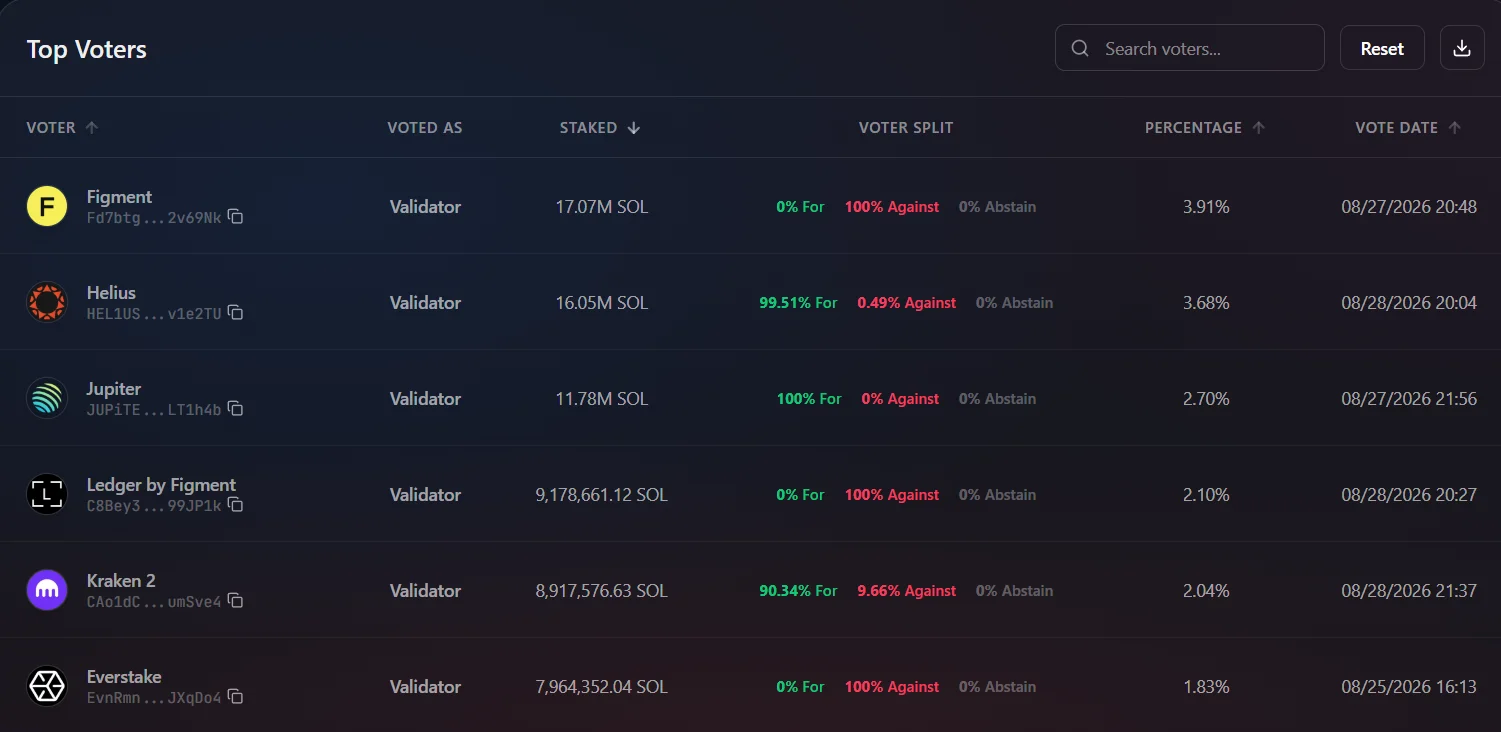
Kraken became central to the dispute because its voting pool held 8.92 million SOL. Kraken initially joined Figment, Everstake and P2P.org in opposing SGP-0002, a position characterized as preserving staking yields. Helius CEO Mert Mumtaz publicly challenged the opposition and accused the exchanges of mathematical irrationality.
Kraken later reversed its vote from “NO” to “YES” following community criticism. The shift was characterized as reshaping the “tug-of-war between whales and the community.” As the vote approached its threshold, Mumtaz also called on Solana founder Anatoly Yakovenko to help mobilize remaining validators.
Approval alone would not immediately change Solana’s issuance schedule. SGP-0002 would provide a governance mandate, while implementation would require the separate SIMD-0550 technical upgrade. Coordination and rollout among validators were expected to take at least 4.5 months.
Fee Proposal Divides Major Validators
SGP-0003 proposed a separate restructuring of Solana transaction fees. Users currently pay a standard fee based on the number of signatures attached to a transaction. The proposal would instead add a small fixed charge and another charge tied to the amount of network capacity requested.
Simple transactions could become cheaper under the proposed system, while more demanding transactions and applications reserving more capacity than necessary could pay more. The additional fee would be destroyed rather than paid to validators.
Depending on the final parameters, SGP-0003 could remove between 1,500 and 9,000 SOL from circulation each day. The proposal also required decisions over the fixed charge, the rate at which capacity-related fees would rise and whether the proceeds should be burned.
Major validators took sharply different positions. Figment and Staking Facilities supported SGP-0003, while Jupiter, Bitwise Onchain Solutions and Forward Industries opposed it. Helius, Kraken, Everstake and Kiln placed most or all of their voting stake in the abstain category.
A third proposal, SGP-0001, would establish formal rules for future Solana network decisions and allow individual stakers to override the governance position taken by their validator. It had substantially broader support, with 89.17% of participating stake voting in favor.
Anza Begins Five-Stage Reduction in Solana Account Costs
Separate from the governance votes, Solana core development team Anza began implementing a phased reduction in the amount of capital required for on-chain account storage. Anza announced that the first of five feature gates had gone live as part of a program targeting an eventual 90% reduction.
At that stage, only the first reduction had been activated on testnet rather than the complete reduction being active on mainnet.
The reform is defined by SIMD-0437, written by Igor Durovic from Anza. It changes the lamports_per_byte constant used to determine the minimum account balance required for storage, ultimately lowering that value from 6,960 to 696.
The first gate cuts the constant by approximately 9%. Each later stage requires separate activation based on state-growth information reviewed by Solana’s core developers, making the full reduction conditional on the network progressing through all remaining gates.
The Solana Foundation said the storage constant had been established many years earlier and had remained unchanged. Because the requirement was linked to SOL, the cost of storage rose alongside the value of SOL rather than tracking validators’ actual storage costs.
Solana rent is not a recurring fee under the system described by the Solana Foundation. It is a fully refundable bond returned when an account is closed. SIMD-0437 reduces the amount of capital that must be deposited upfront.
For a standard SPL token account, the rent-exempt deposit would decline from about $0.159 to $0.0159 once the entire program is implemented. For a payments company creating 1 million accounts, the required capital would fall from $159,000 to $15,900, a difference of $143,100.
The lower deposits are aimed particularly at stablecoin issuers, payment companies, fintech firms and wallets that may create large quantities of token accounts for users. Payment volume on Solana was reported to have increased 755.3% in 2025 as the network was used as a settlement layer for stablecoins associated with Western Union, PayPal and Fiserv.
Developers are using the phased rollout to limit the risk of state bloat, because every validator must store and index on-chain state. A sixth feature gate can restore the storage constant to its original level if problems emerge, while companion proposal SIMD-0392 would allow rent requirements to be increased later without disrupting existing accounts.
Solana Foundation data researcher Umberto Natale modeled the economics of a state-bloat attack after the full reduction. His analysis estimated that exhausting the network’s existing storage headroom would still require about $17.2 million in locked capital, and he concluded that the full reduction would not create systemic risk to the cluster.
The rent changes ship with Agave 4.2, Anza’s validator release recommended for mainnet in August 2026. Agave 4.2 also supports 4,096-byte transactions and reduces slot times by half to 200 milliseconds.
The Solana Foundation said mainnet feature activations for the release began during the week of August 17. Existing accounts continue operating without being recreated and can reduce their balances to the newly applicable minimum as lower requirements become active.
Four reduction gates remain after the first stage, and each must clear a separate risk review before activation. The stated “90% lower storage costs” figure therefore refers to the completed rollout rather than the reduction already active at the first testnet stage.
FAQ
What does SGP-0002 change?
It accelerates the decline in SOL issuance while keeping the terminal inflation floor unchanged.
Why did Kraken attract attention?
Kraken reversed its SGP-0002 vote after initially joining several validators in opposition.
What does SIMD-0437 reduce?
It lowers the minimum capital required to maintain Solana accounts.
Is the full storage reduction already active?
No. The first stage was activated on testnet, with later gates requiring separate reviews.
This article has been refined and enhanced by ChatGPT.


