


 USD

Solana Activates Alpenglow, Cutting Finality to 150 Milliseconds

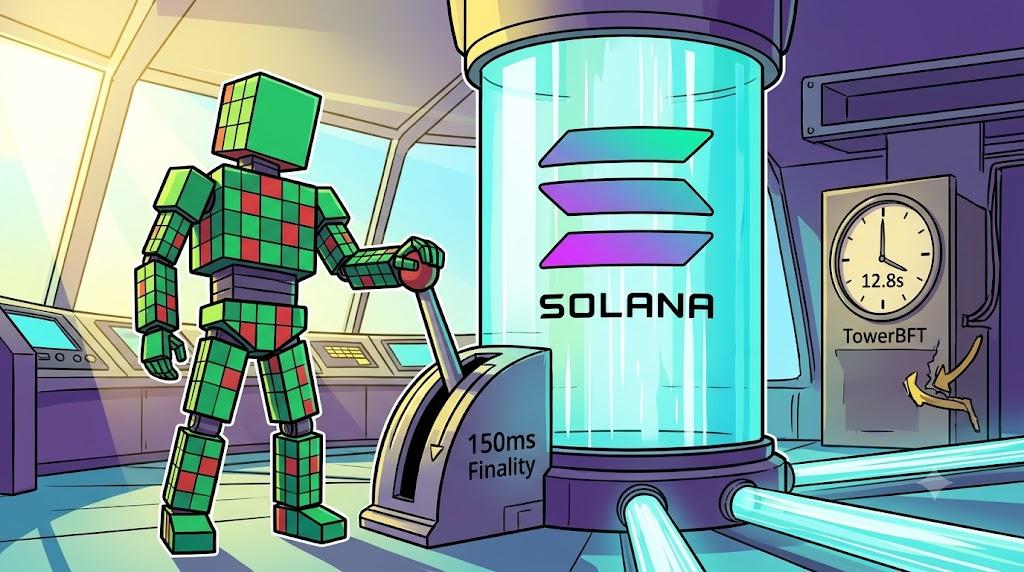
Votor replaces TowerBFT as validators complete a live consensus migration
TL;DR
- Solana activated Alpenglow on Oct. 21, reducing targeted transaction finality from 12.8 seconds to about 150 milliseconds.
- Votor moves validator voting offchain and required participation representing at least 82% of staked SOL for the transition.
- Existing applications, smart contracts and fee mechanisms remain intact, while Rotor and Quantumglow are planned or researched follow-on changes.
Trade smarter on Jupiter, Solana’s leading DEX built for fast execution and deep liquidity.
Swap tokens at competitive rates, route across multiple liquidity sources automatically, and access perpetuals, DCA, and advanced trading tools — all in one place!
Solana activated its Alpenglow consensus upgrade on Oct. 21, replacing TowerBFT and targeting transaction finality of about 150 milliseconds instead of 12.8 seconds. Anza said Alpenglow reached mainnet-beta at slot 459,653,000 at approximately 14:00 UTC, retiring the consensus protocol Solana had used since its March 2020 launch.
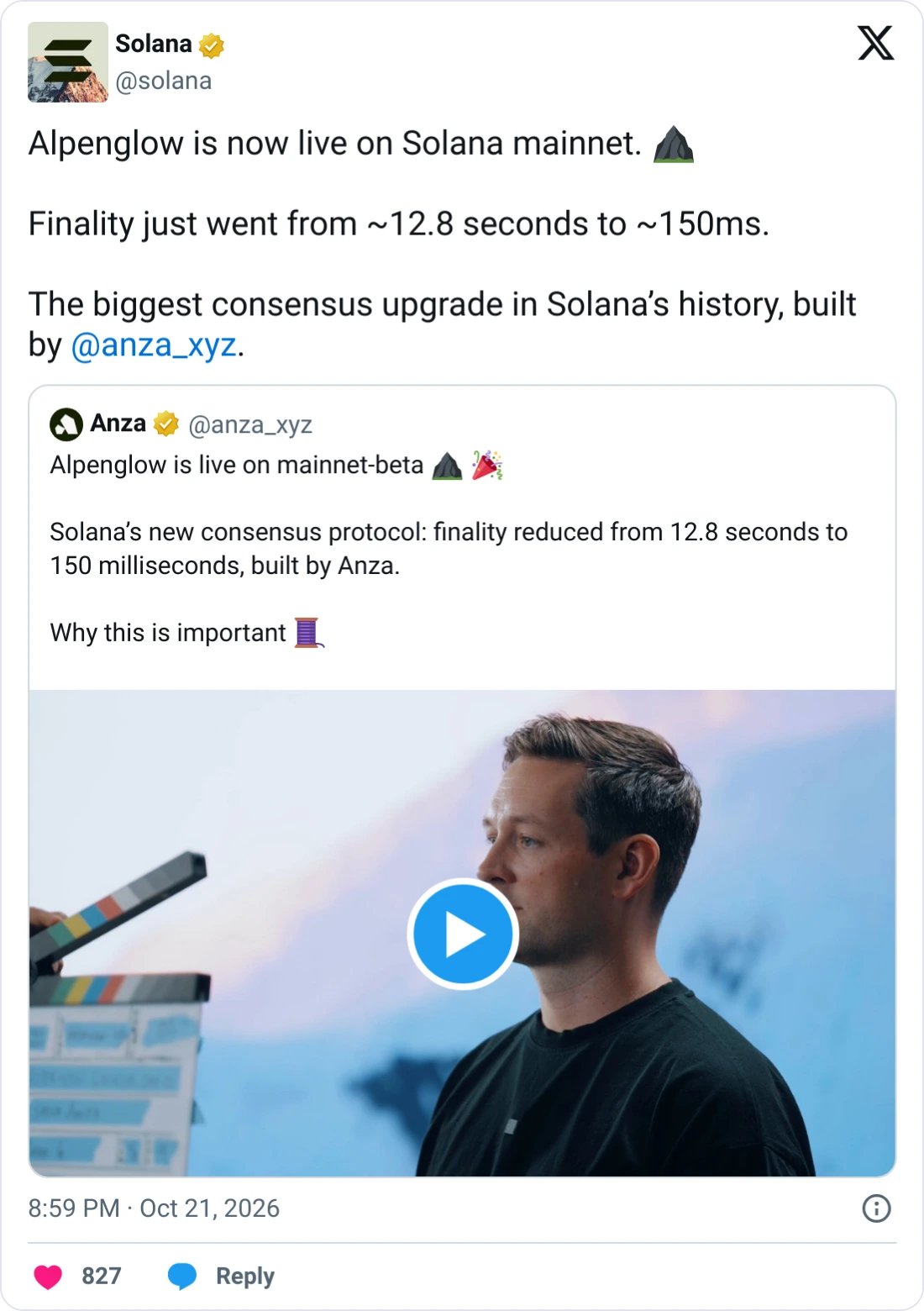
The Solana Foundation has described the change as a roughly 99% improvement in finality speed, although actual performance will depend on network conditions.
Alpenglow changes how validators reach agreement by replacing Solana’s previous two-step confirmation process with a single-step system. Its Votor voting protocol lets validators communicate votes directly rather than recording each vote as an onchain transaction.
Votor aggregates those votes into certificates that can establish consensus in one or two rounds. Under the previous system, validator votes consumed network capacity and transactions required multiple confirmation rounds before becoming irreversible.
The migration was designed to complete within a single slot following an approximately 18-minute transition period as validators prepared to switch from TowerBFT to Votor. Completion required participation from validators representing at least 82% of staked SOL.
Alpenglow does not change transaction execution, leaving existing applications, smart contracts and transaction fee mechanisms intact. Validator votes will also stop appearing as ordinary blockchain transactions, meaning reported transaction counts could fall without a corresponding decline in user activity.
Alpenglow testing leads into Rotor and Quantumglow work
Anza first published the Alpenglow design in May 2025. Testing before deployment included red teaming, penetration testing, repeated migration rehearsals and a security competition, while Solana’s testnet and devnet were used for testing in September.
Anza CEO Brennan Watt said, “This is the largest, most ambitious blockchain upgrade since 'The Merge,' and Anza took it from a white paper to running on mainnet in under 18 months.”
Alpenglow was also billed as the “biggest consensus upgrade in Solana’s history.”
Rotor is designed as another component of the broader Alpenglow initiative, changing how block data is distributed across the network. Anza has also outlined geographically aware leader rotations intended to reduce delays between block producers. Rotor does not have a scheduled activation date, and the additional protocol changes outlined by Anza have no confirmed release dates.
A separate research design called Quantumglow would replace Alpenglow’s elliptic-curve cryptography with hash-based signatures to address post-quantum security while preserving its finality speed. Separately, Jump Crypto’s Firedancer team proposed removing Solana’s 60 million compute-unit block limit in September 2025. Proposal SIMD-0370 would allow block capacity to scale with validator hardware instead of remaining fixed.
This article has been refined and enhanced by ChatGPT.


