




 USD
USDPrediction Markets Surge as Polymarket Upgrades and Kalshi Wins Appeal

Volume climbs while platforms add infrastructure and legal momentum
TL;DR
- Prediction markets reached $25.7 billion in March 2026, with Polymarket and Kalshi leading activity.
- Polymarket rolled out Polymarket USD and CTF Exchange V2 on April 6, 2026.
- Kalshi won an appeals ruling the same day blocking New Jersey from using state gambling law against its sports event contracts.
We’ve launched the all-new COIN360 Perp DEX, built for traders who move fast!
Trade 130+ assets with up to 100× leverage, enjoy instant order placement and low-slippage swaps, and earn USDC passive yield while climbing the leaderboard. Your trades deserve more than speed — they deserve mastery.
Prediction markets expanded further in March 2026 as trading volume reached $25.7 billion, Polymarket launched a major infrastructure overhaul on April 6, 2026, and Kalshi secured an appeals court win against New Jersey over sports-related event contracts, according to figures from Dune compiled by @datadashboards, platform announcements, court reporting, and comments from Sygnum Bank chief investment officer Fabian Dori.
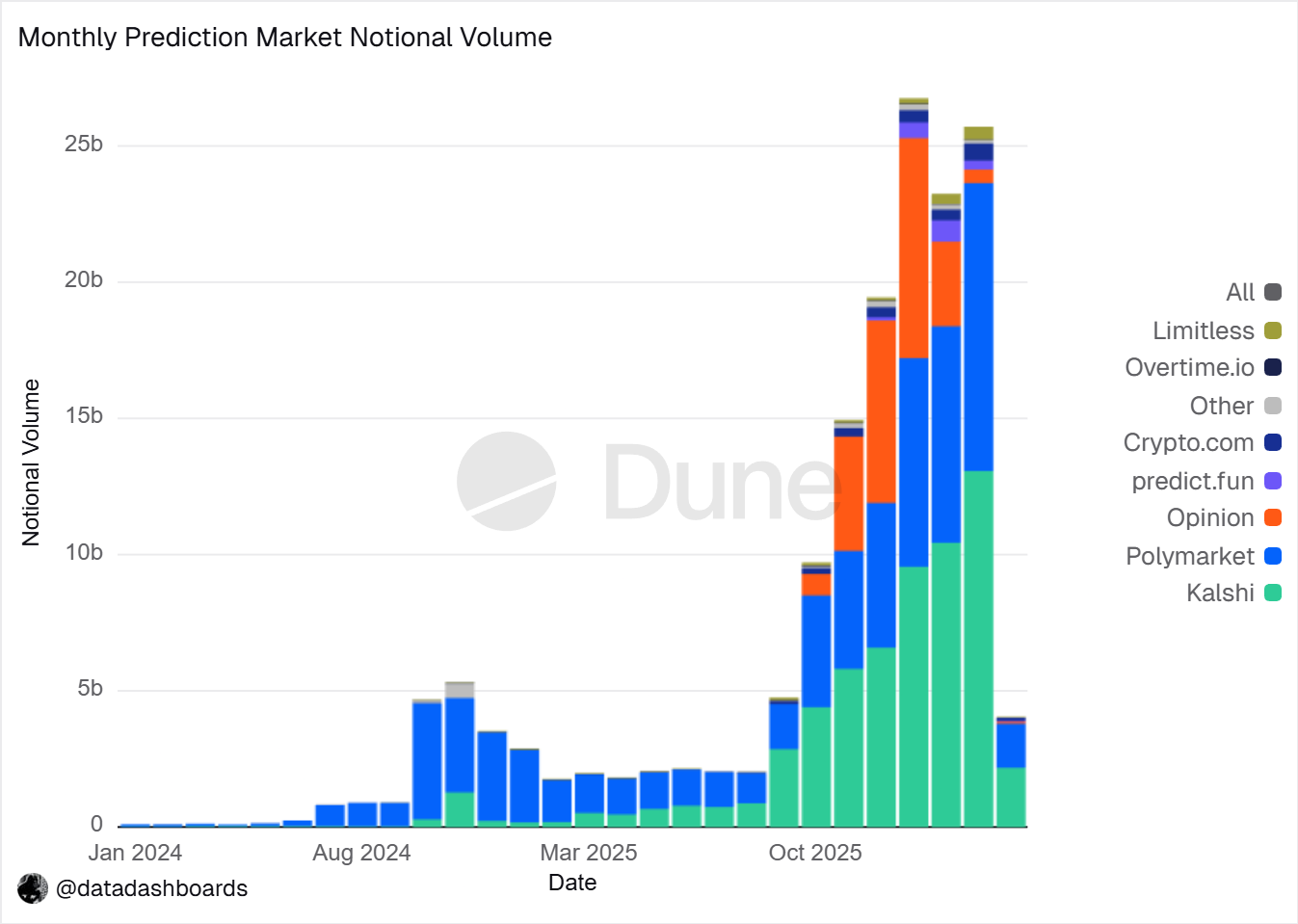
Dune data showed prediction market activity continuing near record levels. January 2026 set the high-water mark for notional volume at $26.75 billion, followed by February at $23.24 billion and March at $25.7 billion. March trading also included 115 million trades on Polymarket and 88 million on Kalshi, while the two platforms approached $940 million in open interest as regulatory scrutiny intensified.
The White House has warned staff against using confidential information for futures trading following suspicious oil bets linked to Iran. A $500 million surge in Brent and West Texas Intermediate crude futures occurred just before President Trump's March 23 announcement, leading to a 15% drop in oil prices.
This incident raised concerns about potential insider trading by officials and politically connected individuals. It has renewed efforts in Washington to strengthen rules around prediction-market trading. Notably, the STOCK Act amendment prohibits federal officials from trading based on non-public information related to their official positions, a law established in 2012.
Polymarket replaces bridged collateral and rebuilds trading engine
Polymarket said its April 6 upgrade was its largest infrastructure change since launch. The platform introduced Polymarket USD, replacing bridged USDC.e as collateral across all prediction markets, and launched CTF Exchange V2, a rebuilt engine designed to reduce gas costs, speed order matching, support EIP-1271 signatures for smart contract wallets and account abstraction, add builder codes for onchain order attribution, and improve fee collection and distribution logic.
Polymarket said the new collateral token gives the platform direct control over the rails supporting its outcome tokens and removes dependence on Polygon’s bridged USDC.e. The company described Polymarket USD as a wrapped stablecoin built for the platform, backed 1:1 by USDC and issued directly by Polymarket. Users holding USDC or USDC.e on the platform will have funds wrapped automatically through the frontend after a one-time approval, while power users operating outside the frontend will need to call the wrap() function on the Collateral Onramp contract.
The platform said most users will not need to do anything beyond approving the wrap prompt, but API traders, bot operators and developers will need to update to the latest CLOB-Client SDK in Typescript, Python and Go. Updated documentation and code examples were still in progress, and Polymarket said all open orders would be canceled during a short maintenance window. The company also said the transition would affect API traders and bot operators within two to three weeks.
Polymarket also drew a distinction between the infrastructure rollout and any future token distribution. The platform said Polymarket USD is a collateral change, while a POLY governance token airdrop confirmed by its CMO in October 2025 remains separate and pending a full U.S. relaunch. “The two developments are separate,” the article said. “Polymarket USD is a collateral infrastructure change. POLY, if and when it launches, would serve a governance or utility function.”
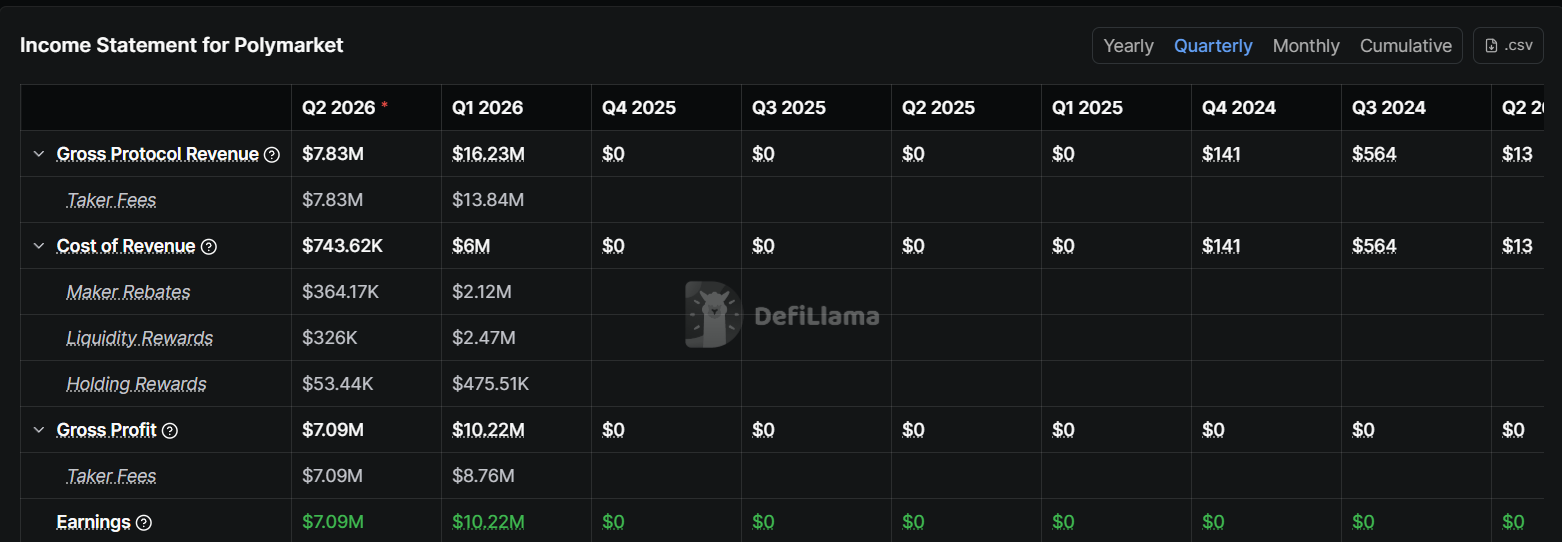
Polymarket has emerged as a leading platform in decentralized finance following a pricing overhaul, generating approximately $7.83 million in fees in the first week of Q2 2026, which implies an annualized run rate of $365 million.
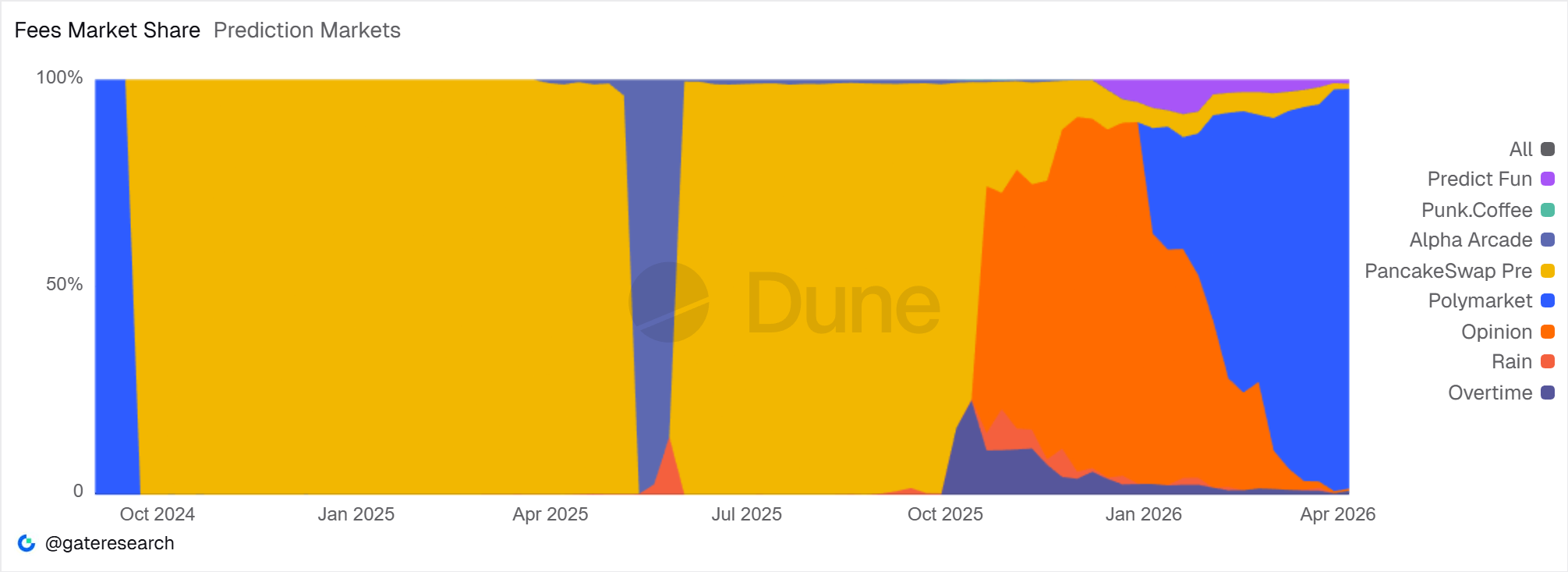
This remarkable fee generation gives Polymarket an impressive 96.8% market share of onchain prediction market fees, positioning it among the top decentralized finance protocols. The platform's total value locked was over $432 million, nearing its November 2024 peak of $510 million.
Kalshi partners with Fox for data integration amid New Jersey legal ruling challenges
Kalshi won a legal victory on April 6 when the U.S. Court of Appeals for the Third Circuit ruled 2-1 that New Jersey gaming regulators cannot block the company from offering sports event contracts in the state. The ruling said New Jersey does not have explicit authority over those contracts, marking a win for prediction markets as lawmakers and regulators scrutinize the sector more closely.
One judge dissented and described Kalshi’s conduct as a “performative sleight meant to obscure the reality that Kalshi’s products are sports gambling.” That dissent underscored the legal tension around event contracts even as the majority ruling limited New Jersey’s ability to use state gambling law to shut the platform down.
Fox Corporation has partnered with Kalshi to integrate its prediction market data across its networks, including Fox News, Fox Business Network, Fox Weather, and the Fox One platform. However, Fox Sports is not involved at this stage, although Kalshi hinted that sports data might be incorporated in the future. The integration aims to provide real-time data for enhanced insights in reporting, enriching audience engagement on various platforms, according to Fox Media Group's Tubi Media Group CEO Paul Cheesbrough.
This partnership aligns with Kalshi's goal to expand its influence, having already collaborated with CNN and CNBC. Notably, Kalshi, which holds a valuation of $22 billion and recently raised over $1 billion, faces legal challenges in several states regarding its sports-related contracts.
Macro traders are watching prediction markets more closely
Sygnum Bank chief investment officer Fabian Dori said prediction markets are becoming more useful to professional crypto desks during periods of geopolitical stress. He suggested that platforms such as Polymarket and Kalshi repriced the odds of U.S. escalation in the Iran conflict in real time as President Donald Trump paired new threats with signals of possible negotiations on Sunday, while Bitcoin rose more than 3.5% on Monday.
“Prediction markets price discrete, named outcomes with real capital behind them,” Dori said. “For crypto in particular, where so much price action is driven by specific binary events, regulatory decisions, geopolitical developments [and] protocol upgrades, that is a categorically different signal.”
Dori said prediction market odds on de-escalation shifted before mainstream financial media coverage caught up and “had direct correlation” with Bitcoin price. He also said some professional desks now use prediction markets as real-time event monitors alongside funding rates, options surfaces and flows. For example, ARK Invest is integrating Kalshi’s prediction market data into its investment process as an example of event odds moving into institutional workflows.
Dori said prediction markets in a regulated environment function as a context layer that helps teams frame risk scenarios rather than serving as direct buy-or-sell signals. His comments came as prediction market activity, platform upgrades and legal developments all converged on the same day, adding to signs that the category is gaining a larger role in trading and risk management.
FAQ
What was the March 2026 prediction market volume?
It reached $25.7 billion.
What changed on Polymarket on April 6, 2026?
Polymarket launched Polymarket USD and CTF Exchange V2.
What did the appeals court decide for Kalshi?
It ruled New Jersey cannot block Kalshi’s sports event contracts.
How did Fabian Dori describe prediction markets?
He said they price “discrete, named outcomes with real capital behind them.”
This article has been refined and enhanced by ChatGPT.


