




 USD
USDNew Hampshire Rejects $100 Million Bitcoin Bond Plan


Divided council blocks CleanSpark-linked financing despite governor’s support and overcollateralized structure
TL;DR
- New Hampshire’s Executive Council rejected a proposed Bitcoin-backed bond issuance by a narrow vote.
- CleanSpark would have pledged Bitcoin as collateral, while taxpayers and state credit would not have guaranteed repayment.
- Supporters called for reconsideration after the proposal failed at its final approval stage.
Trade smarter on Jupiter, Solana’s leading DEX built for fast execution and deep liquidity.
Swap tokens at competitive rates, route across multiple liquidity sources automatically, and access perpetuals, DCA, and advanced trading tools — all in one place!
New Hampshire’s Executive Council rejected a proposal to issue up to $100 million in Bitcoin-collateralized bonds on July 8, 2026, blocking a CleanSpark-linked private financing transaction after councilors voted 3–2 against the plan. The proposal had gubernatorial support and prior approval from the New Hampshire Business Finance Authority, but it still required the council’s authorization before the bonds could be issued.
Councilors Karen Liot Hill, Dave Wheeler and Janet Stevens opposed the proposal. Councilors Joseph Kenney and John Stephen voted in favor. Gov. Kelly Ayotte supported the financing structure, calling it a historic and innovative way to attract additional investment opportunities to New Hampshire without putting state funds or taxpayers at risk.
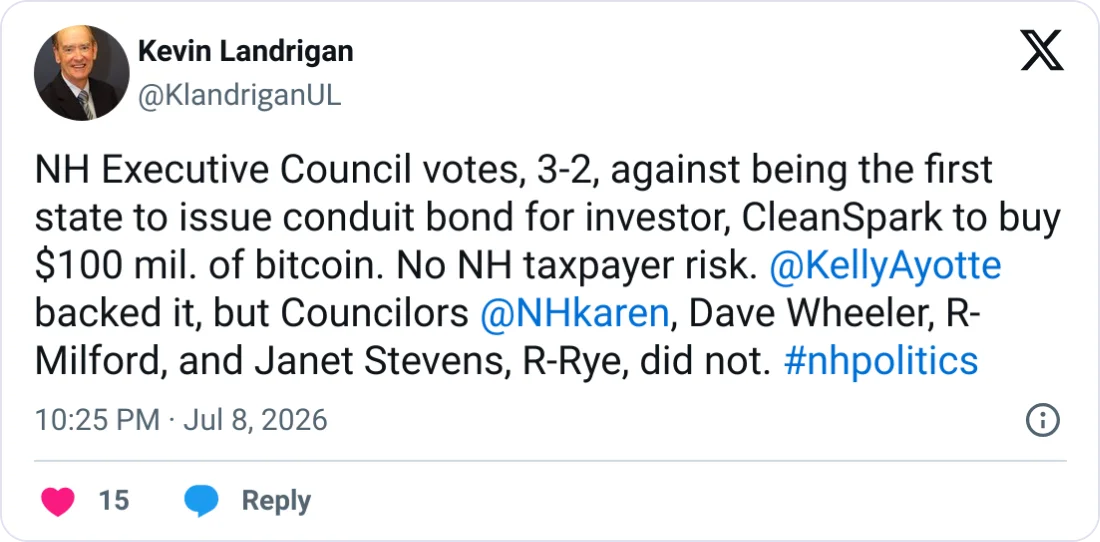
The New Hampshire Business Finance Authority had approved the proposed issuance in November 2025. The securities would have been structured as taxable conduit revenue bonds, with the authority serving as the legal issuer while proceeds financed a private borrower connected to Bitcoin miner and data-center operator CleanSpark.
The proposal did not involve New Hampshire borrowing money to purchase Bitcoin. CleanSpark, rather than the state, would have supplied the Bitcoin collateral. Bondholders would have relied on the pledged assets and related proceeds for repayment, not New Hampshire’s tax revenue, treasury or general credit.
Bitcoin collateral would have backed limited-recourse bonds
The bonds were designed as limited-recourse obligations. That structure would have restricted bondholders’ repayment claims to the pledged Bitcoin and proceeds generated from its liquidation. New Hampshire would not have been required to cover a collateral shortfall, guarantee repayment with public funds or assume the debt on its balance sheet.
CleanSpark would have deposited about $160 million worth of Bitcoin to support the proposed issuance. The transaction would have placed the collateral with BitGo in segregated wallets, separating the pledged assets from other holdings under custody.
The predetermined liquidation mechanism would have required the Bitcoin to be sold and the bonds redeemed if the collateral value fell below the specified trigger. For CleanSpark, the arrangement would have provided access to bond-market financing without requiring the company to sell its entire pledged position when the bonds were issued.
Bond investors would have depended on the excess collateral, custody controls and liquidation process to protect repayment. The structure’s effectiveness would have rested on whether the pledged Bitcoin could be sold quickly enough during a sharp market decline to redeem the securities before the available collateral fell below the outstanding obligation.
Moody’s Investors Service assigned the proposed bonds a provisional Ba2 rating in March 2026. The classification was speculative grade and stood two notches below investment grade. The rating applied to the proposed transaction rather than New Hampshire’s general credit because repayment depended on the pledged Bitcoin and related proceeds.
Some experts warned before the vote that the arrangement could carry “substantial risk” for New Hampshire residents, despite provisions intended to prevent direct taxpayer liability. The identified concerns included Bitcoin price volatility, the performance of the liquidation mechanism during rapid declines and the administrative or reputational consequences of involving a state financing authority.
Supporters pointed to the limited-recourse terms, segregated custody, excess collateral and automatic liquidation trigger as safeguards designed to separate the transaction’s financial risks from the state. The council majority nevertheless declined to authorize the financing.
We’ve launched the all-new COIN360 Perp DEX, built for traders who move fast!
Trade 130+ assets with up to 100× leverage, enjoy instant order placement and low-slippage swaps, and earn USDC passive yield while climbing the leaderboard. Your trades deserve more than speed — they deserve mastery.
Supporter calls rejection short-sighted
State Representative Keith Ammon criticized the decision on July 9, 2026, and urged the Executive Council to reconsider the proposal after reviewing additional information.
“It was an extremely short-sighted decision,” Ammon said. “I can't believe I witnessed it in person. They should gather all relevant facts and information and reconsider their vote at a future meeting.”
Ammon also argued that the rejection could affect conduit financing beyond the proposed Bitcoin transaction. “The EC decision yesterday chokes revenue that the Business Finance Authority receives from all future potential conduit bonds, which hurts our economic growth,” he said.
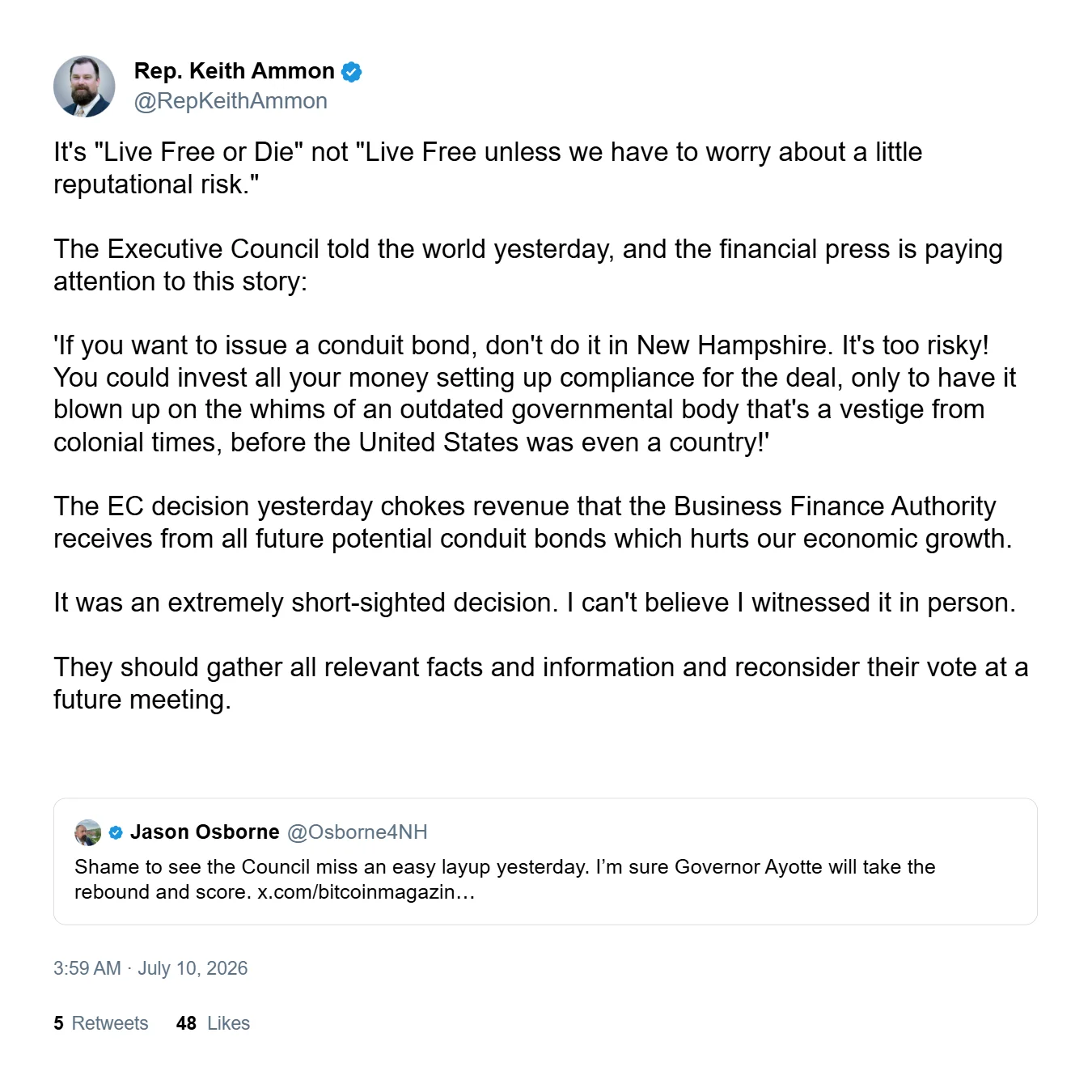
His comments framed the vote as a potential signal to other private borrowers considering financing through the authority. Ammon argued that reduced willingness to pursue future conduit-bond transactions could limit revenue received by the Business Finance Authority and affect its broader economic-development role.
The narrow result leaves a political path for reconsideration if the proposal returns with revised terms or if one opposing councilor changes position. Ayotte’s support could not substitute for council approval because the financing required authorization from the Executive Council after clearing the Business Finance Authority.
New Hampshire had enacted a crypto reserve law in May 2025, but the council’s decision prevented the state-linked financing authority from expanding its digital-asset activity into this specific bond structure. The vote did not repeal the reserve law, prohibit Bitcoin-backed financing or establish a general ban on future digital-asset bonds.
No bonds had been issued when the council rejected the authorization, and the collateral arrangement had not been activated. Taxpayers therefore did not incur a direct financial loss from the decision, and the outcome did not represent a default, liquidation or failure of an operating bond program.
The rejection means BitGo will not take custody of the proposed collateral under the current transaction, CleanSpark will not deposit the contemplated assets and the authority will not issue the securities under the rejected authorization.
As of July 10, 2026, Ammon had called for another vote, but no revised proposal, replacement timetable or formal commitment to reconsider the authorization had been announced.
FAQ
Was New Hampshire planning to buy Bitcoin?
No. CleanSpark would have supplied Bitcoin collateral for private financing facilitated by a state authority.
Would taxpayers have guaranteed the bonds?
No. Repayment claims were limited to pledged collateral and related proceeds.
Who would have held the Bitcoin?
BitGo would have held the pledged assets in segregated wallets.
Can the proposal return?
Yes, but no revised terms or new vote had been announced.
This article has been refined and enhanced by ChatGPT.


