




 USD
USD
National Sheriffs’ Association Drops CLARITY Act Opposition

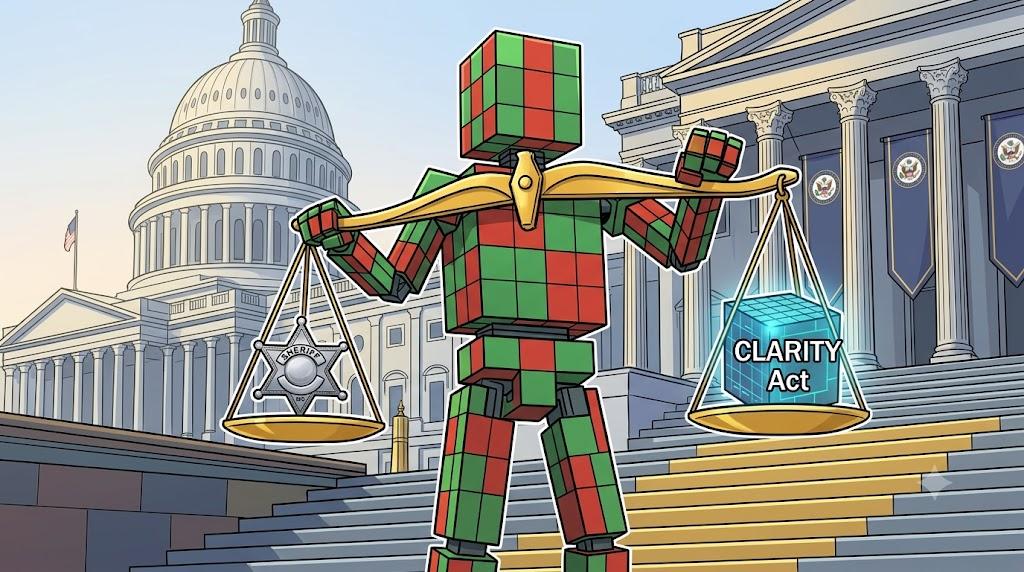
Law-enforcement group moves to neutral as Senate prepares to revisit crypto market-structure bill
TL;DR
- The National Sheriffs’ Association shifted from opposing the CLARITY Act to a neutral position after months of raising anti-money-laundering and enforcement concerns.
- The group said Congress, the administration and stakeholders had done significant work on the bill and that the legislative process should proceed.
- The change removes a prominent law-enforcement critic while lawmakers still face disputes over stablecoin rewards, tokenized equities, ethics provisions and other issues.
Trade smarter on Jupiter, Solana’s leading DEX built for fast execution and deep liquidity.
Swap tokens at competitive rates, route across multiple liquidity sources automatically, and access perpetuals, DCA, and advanced trading tools — all in one place!
The National Sheriffs’ Association said on Sept. 4, 2026, that it had dropped its opposition to the Digital Asset Market Clarity Act and adopted a neutral position, reversing months of criticism centered on anti-money-laundering and law-enforcement concerns as the Senate prepares to take up the crypto market-structure legislation again.
The NSA communicated the shift in a Thursday letter to Senate Majority Leader John Thune and Senate Minority Leader Chuck Schumer. The organization cited the complexity of the legislation, unresolved details and the “significant work undertaken by Congress, the Administration, and stakeholders to navigate the many legal, regulatory, and enforcement considerations involved” in addressing the bill.
NSA president Troy Wellman and CEO and executive director Justin Smith said, “At this time, we believe the most appropriate course is to step back and allow the legislative process to proceed to establish a clear, effective, and much needed regulatory framework.”
The change moves the NSA from opposition to neutrality rather than support. The association is no longer actively opposing the CLARITY Act, while its explanation emphasized the ongoing legislative process and the number of legal, regulatory and enforcement issues still being considered.
NSA had warned of risks from mixer and DeFi exemptions
The shift represents a sharp change from the NSA’s earlier position. The association wrote to the Senate Banking Committee in May 2026 warning that Section 604 could provide mixers, tumblers and decentralized finance platforms with “a blanket exemption” from anti-money-laundering rules.
The NSA said amendments exempting crypto mixers from many registration requirements raised “significant concerns” because the provision could “[impair] law enforcement’s ability to trace transactions and digital assets, and recover victims’ money.”
The association also warned about emerging technology being used to move digital assets outside traditional tracing mechanisms. “Some will use evolving software, algorithms, and agentic AI to help transfer digital assets without tracing or accountability, launder money, finance terrorism, and evade sanctions,” the NSA said.
A month after that letter, the White House invited law-enforcement organizations that had raised concerns about the legislation to discuss their objections. The talks focused on concerns over provisions viewed as protecting infrastructure that could be used for illicit finance.
The NSA remained publicly critical in July 2026. Sheriff Jim Skinner said in a video from the association, “The CLARITY Act protects the crypto industry, not the public.”
Blockchain Association CEO Summer Mersinger pushed back against the criticism that month, calling the legislation “the most important consumer protection effort in years.”
CLARITY Act still faces political and procedural hurdles
The CLARITY Act passed the U.S. House of Representatives in July 2025 and later moved to the Senate, where lawmakers spent months negotiating over the scope and structure of the legislation.
Both the Senate Agriculture Committee and Senate Banking Committee passed their respective versions of the bill in 2026. Interest groups and lawmakers, however, continued to raise concerns about stablecoin rewards, tokenized equities and potential conflicts of interest involving President Donald Trump and his family.
Democrats have also sought a key ethics provision before supporting the legislation. Those disputes remain separate from the NSA’s law-enforcement objections and continue to complicate the bill’s path through Congress.
President Donald Trump pushed for passage of the CLARITY Act in August 2026 while appearing alongside SEC Chair Paul Atkins, CFTC Chair Michael Selig and representatives of several digital-asset companies.
Atkins and Selig, both Trump nominees, have indicated that their agencies could continue addressing crypto regulation administratively if Congress does not enact the market-structure legislation.
Before the Senate’s August recess, Thune filed a motion for a cloture vote on Sept. 15, setting the next identified procedural step after lawmakers return from their state work periods. A cloture vote would determine whether the Senate can move toward ending debate and advancing the legislation.
The congressional calendar remains another obstacle. The House said earlier during the week of the NSA announcement that it would hold its final votes before the midterm election shortly after the Senate returns, making passage of the CLARITY Act before the November 2026 election unlikely.
The NSA’s neutral position removes one prominent law-enforcement opponent as the Senate prepares to revisit the measure, but the legislation still faces disputes over ethics, stablecoin rewards, tokenized equities and other provisions as well as a compressed pre-election schedule.
This article has been refined and enhanced by ChatGPT.


