




 USD
USDMoneyGram Becomes Solana Validator

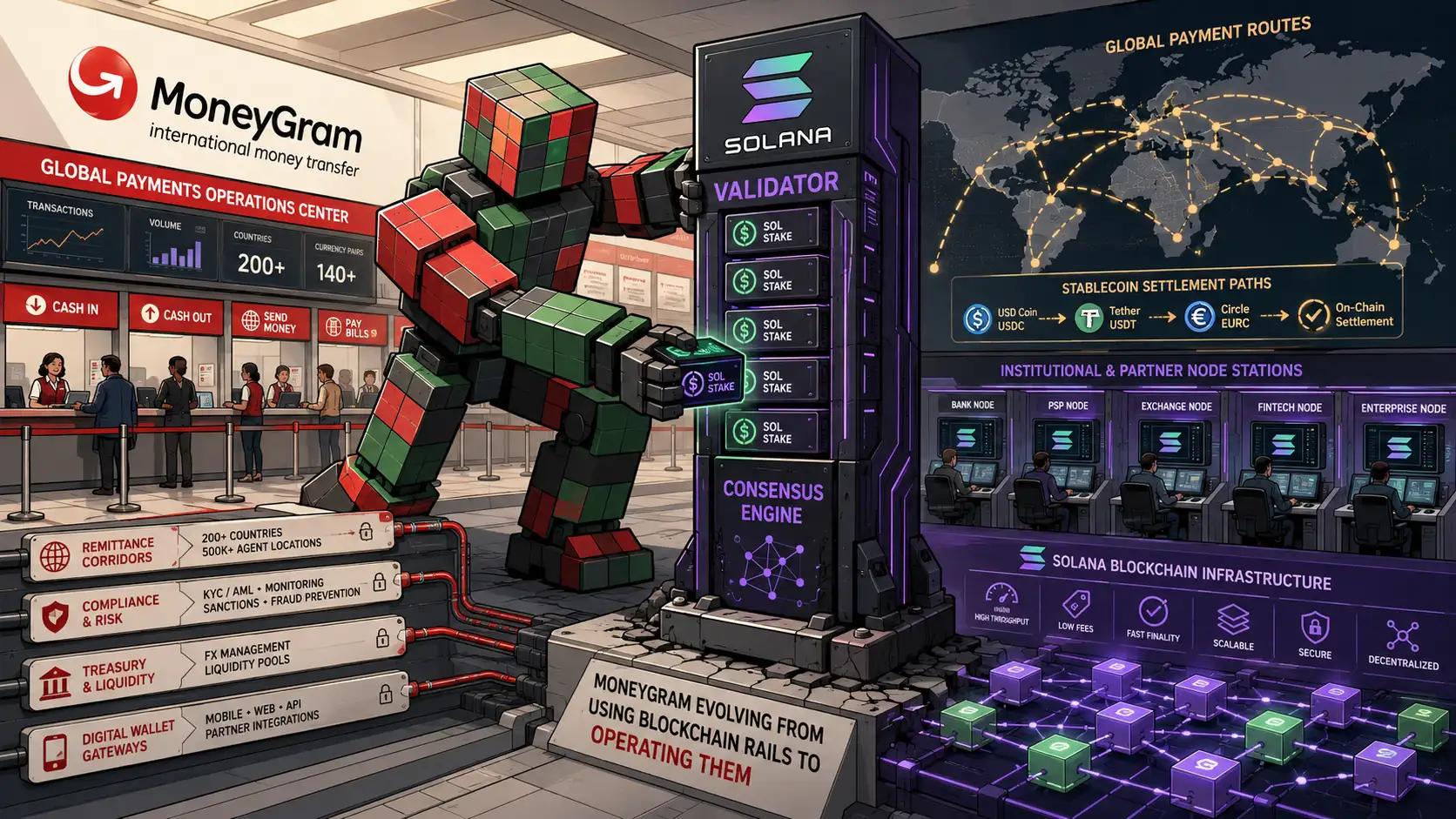
Payments Firm Moves From Using Blockchain Rails to Operating Them
TL;DR
- MoneyGram became an active Solana validator on June 22, 2026.
- The company is staking SOL, processing transaction blocks and joining Solana’s Developer Platform.
- The move follows MoneyGram’s MGUSD stablecoin launch and years of blockchain payment infrastructure work.
Trade smarter on Jupiter, Solana’s leading DEX built for fast execution and deep liquidity.
Swap tokens at competitive rates, route across multiple liquidity sources automatically, and access perpetuals, DCA, and advanced trading tools — all in one place!
MoneyGram became an active validator on Solana on June 22, 2026, expanding its blockchain payments strategy from building products on crypto rails to helping operate part of the network infrastructure behind them.
The move places MoneyGram inside Solana’s validator set, where the company is staking SOL, processing transaction blocks and supporting the network’s security, consensus, performance and resilience. MoneyGram also joined the Solana Developer Platform, giving the company access to institutional tooling designed for compliant financial products on Solana.
MoneyGram CEO and Chairman Anthony Soohoo said the validator role reflects the company’s view that institutions using blockchain infrastructure should also support it. “As blockchain infrastructure becomes increasingly important to global payments, we believe institutions that rely on these networks should also contribute to their security, resilience, and long-term development,” Soohoo said. He added that “by becoming a validator, MoneyGram contributes to the long-term strength of the ecosystem.”
Luke Tuttle, MoneyGram’s Chief Product and Technology Officer, described the move as a direct infrastructure step for the payments company. “Running a validator puts MoneyGram inside Solana’s consensus,” Tuttle said. He said MoneyGram now stakes Solana, processes transaction blocks and helps secure the network at the protocol level, adding: “We help run the rails we move money on.”
MoneyGram Adds Protocol-Level Role to Stablecoin Strategy
MoneyGram’s Solana validator launch is part of a broader blockchain payment strategy that has developed over more than five years. The company has integrated blockchain and stablecoins into treasury operations, product development and payments operations, according to the provided information.
Tuttle said MoneyGram is using the Solana Developer Platform to keep building toward seamless money movement “wherever the users are and in whatever form of money it may be.” The Solana Developer Platform is described as an AI-ready, API-driven environment for institutions building and scaling compliant financial products on Solana.
Mastercard is listed among the other early institutional participants on the Solana Developer Platform. MoneyGram’s participation therefore places the company alongside other institutions exploring blockchain infrastructure for payments and financial applications.
Sheraz Shere, GM of Payments and Commerce at the Solana Foundation, said MoneyGram’s validator launch and Solana Developer Platform membership “reflects a commitment to the Solana ecosystem.” Shere said players like MoneyGram, with global scale and experience serving customers across markets, are engaging with Solana as more payments activity moves onchain.
MoneyGram’s role on Solana is described alongside its validator activity on Tempo and the Midnight Network. The available information also presents the Solana node as MoneyGram’s first direct protocol-level validator role on a public blockchain network, creating an important distinction between the company’s broader validator footprint and its public-chain infrastructure participation.
MoneyGram has more than 60 million active customers globally and operates through nearly half a million retail locations. Its digital ecosystem reaches billions of devices, while the company has more than 85 years of operating history in global payments.
Soohoo said MoneyGram has “spent the past several years integrating blockchain into our payment infrastructure,” and that “everything we are building now leverages this foundation.” He said MoneyGram sees the future of global money movement as built on stablecoin rails. “We believe the future of global money movement will be built on open, interoperable stablecoin rails that anyone, anywhere can access,” Soohoo said.
Soohoo said that building such a system requires compliance, regulatory clarity and operational scale, and said MoneyGram brings all three. He also said MoneyGram has never viewed blockchain as an end in itself, but as a tool to make money movement faster, simpler and more accessible for customers globally.
We’ve launched the all-new COIN360 Perp DEX, built for traders who move fast!
Trade 130+ assets with up to 100× leverage, enjoy instant order placement and low-slippage swaps, and earn USDC passive yield while climbing the leaderboard. Your trades deserve more than speed — they deserve mastery.
MGUSD and Earlier Blockchain Partnerships
MoneyGram launched MGUSD on June 2, 2026, as a U.S. dollar stablecoin built natively on Stellar and integrated into MoneyGram’s global network. MGUSD is designed to reach MoneyGram’s 60 million-plus active customers across nearly 500,000 retail locations worldwide.
MGUSD is built with partners including Stripe-owned Bridge, Crossmint, Fireblocks, M0 and Stellar. Bridge serves as the regulated issuer under the GENIUS Act framework, M0 provides smart contract infrastructure for minting and burning, and Fireblocks provides custody infrastructure.
MoneyGram holds MGUSD in Fireblocks wallets before distributing funds to customer wallets embedded in the MoneyGram app. MGUSD launched initially in the U.S., with global scaling planned.
Soohoo said MGUSD was built for customers who use MoneyGram’s global network. “MGUSD is the stablecoin we built for our customers, for the families sending money home and for the billions of people around the world with limited financial access,” Soohoo said.
The MGUSD launch deepened MoneyGram’s relationship with the Stellar Development Foundation. The partnership stretches back more than five years and previously involved stablecoin-powered money movement using Circle’s USDC before MoneyGram moved toward its own issuance.
Denelle Dixon, CEO of the Stellar Development Foundation, called MGUSD the “next milestone” showing what purpose-built blockchain can deliver when paired with a trusted payments network.
MoneyGram and Stellar have worked together since 2021 on stablecoin cash on- and off-ramps, the MoneyGram Ramps API and in-app stablecoin balances. MoneyGram also recently expanded off-ramp services through a partnership with Kraken, extending its crypto-to-cash capabilities beyond its Stellar-linked work.
MoneyGram previously partnered with Ripple in 2019, using RippleNet and XRP-based On-Demand Liquidity products. Ripple said the partnership processed “billions of dollars” in transactions and paid MoneyGram millions of dollars in fees as Ripple sought to expand into new markets.
The MoneyGram-Ripple partnership ended in 2021 after the U.S. Securities and Exchange Commission sued Ripple, alleging Ripple conducted a $1.3 billion unregistered securities offering through XRP sales. The case reached a final resolution late last year while leaving in place a 2023 ruling that found XRP itself is not inherently a security and that XRP sales on public crypto exchanges did not violate securities laws, though Ripple’s direct institutional sales violated federal securities laws.
When asked whether MoneyGram could partner with Ripple again, Soohoo said: “We are not in a position to comment on any future partnership arrangements.”
Western Union, MoneyGram’s longtime remittance rival, launched its own Solana-based stablecoin USDPT in May. That places both major legacy cross-border payments companies in the provided information alongside Solana-linked payment or stablecoin infrastructure.
What MoneyGram Is Building on Blockchain Rails
MoneyGram’s current blockchain strategy now spans customer-facing stablecoin products, developer-platform access for new Solana financial products and protocol-level participation through staking and block processing.
The company’s stablecoin infrastructure is designed so fiat and digital currency systems can operate in a format that is agnostic at the systems level. That means the payment experience is intended to work across traditional and blockchain-based rails without requiring customers to focus on the underlying infrastructure.
Solana is described as capable of processing thousands of transactions per second at low cost. The network is presented as suitable for payments and financial applications because of that speed and cost profile.
MoneyGram’s stablecoin strategy also differs from digital-only payment models because the company already has a physical cash access network. That retail footprint could support cash-in and cash-out usage while app-based wallets support digital balances.
The company’s latest move gives MoneyGram a larger role in blockchain payment infrastructure. It now has exposure to app-layer stablecoin products, developer tools for Solana-based financial products and validator operations that process blocks and help secure the network.
FAQ
What did MoneyGram do on Solana?
MoneyGram became an active validator, staking SOL and processing transaction blocks.
When did MoneyGram become a Solana validator?
MoneyGram became an active Solana validator on June 22, 2026.
What is MGUSD?
MGUSD is MoneyGram’s U.S. dollar stablecoin built natively on Stellar.
Who issued MGUSD?
Bridge, a Stripe company, serves as the regulated issuer under the GENIUS Act framework.
This article has been refined and enhanced by ChatGPT.


