


 USD

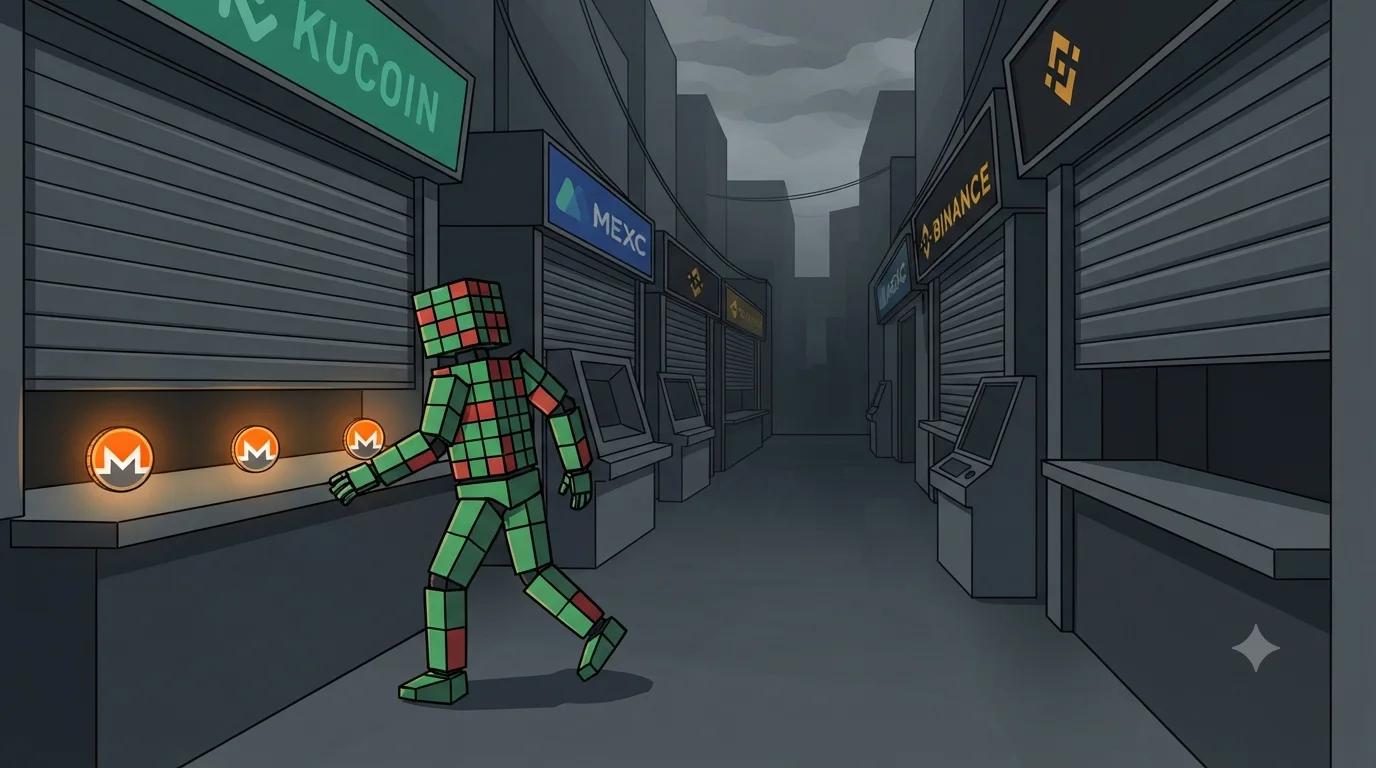
Monero Drops More Than 11% as KuCoin Delisting Pressures XMR

Exchange Restrictions Deepen Privacy Coin Sell-Off as Grayscale Favors Zcash
TL;DR
- Monero (XMR) fell more than 11% on Thursday, marking its steepest single-day decline since June 4, following KuCoin's delisting announcement.
- The exchange restrictions follow MEXC's decision to remove XMR trading and come ahead of new European Union restrictions on privacy coins.
- Grayscale's Zach Pandl said Zcash has a stronger privacy model than Monero, citing its zero-knowledge technology and selective transaction disclosure features.
Trade smarter on Jupiter, Solana’s leading DEX built for fast execution and deep liquidity.
Swap tokens at competitive rates, route across multiple liquidity sources automatically, and access perpetuals, DCA, and advanced trading tools — all in one place!
Monero (XMR) dropped more than 11% on Thursday as successive exchange delisting announcements intensified selling pressure on the privacy-focused cryptocurrency. KuCoin's decision to remove XMR trading, following a similar move by MEXC, added to concerns about the token's shrinking exchange availability. Meanwhile, Grayscale is maintaining its commitment to Zcash (ZEC), with its head of research arguing that Zcash's privacy architecture offers advantages over Monero's approach.
KuCoin Delisting Adds to Pressure on Monero
KuCoin announced that it would remove Monero trading pairs, making it the latest major cryptocurrency exchange to withdraw support for the privacy coin. The exchange scheduled the removal of its XMR/USDT, XMR/USDC, XMR/ETH and XMR/BTC spot trading pairs for November 30, 2026.
KuCoin instructed users to update or cancel their outstanding spot orders before trading ceased. The exchange also warned that remaining orders would be automatically removed following the suspension of trading.
The announcement followed MEXC's decision to delist Monero spot trading pairs and remove its perpetual futures contracts earlier in November. Coinbase International, Binance, OKX and Bitget also do not offer XMR trading, adding to the restrictions facing the cryptocurrency.
The delisting activity has contributed to Monero's increasingly concentrated trading environment, with liquidity shifting toward a smaller group of offshore or unregulated exchanges.
Pseudonymous Hyperliquid contributor PerpetualCow.hl also highlighted KuCoin's importance to Monero's trading infrastructure, saying that more than 50% of users sourced their XMR indirectly through the exchange.
"Over 50% of users sourced their XMR indirectly from Kucoin, it fueled ALL instant swap exchanges. Instant swap exchanges don't have their own liquidity; they simply wrapped around KuCoin and sold/bought into their order books," PerpetualCow.hl wrote on X.
The contributor added that Wagyu had become the leading exchange by Monero market dominance following KuCoin's announcement.
Monero Price Decline Coincides With Broader Privacy Coin Weakness
Monero's sell-off extended beyond the immediate reaction to the exchange announcements, with other privacy-focused cryptocurrencies also recording losses.
The following figures were reported across the two publications, using their respective reporting periods:
The broader exchange withdrawal trend predates the latest announcements. TRM Labs data showed that 73 exchanges delisted Monero during 2025.
Binance removed Monero in 2024, while Kraken ended support for the cryptocurrency in the European Economic Area later that year.
EU Privacy Coin Restrictions Add Regulatory Pressure
Monero's exchange difficulties are developing alongside regulatory changes targeting privacy-focused digital assets.
The European Union's Anti-Money Laundering Regulation is scheduled to introduce restrictions on financial firms, including crypto asset service providers, preventing them from maintaining anonymous accounts or accounts that obscure transactions through anonymity-enhancing coins.
The rules are scheduled to take effect on July 10, 2027, and apply regardless of whether a cryptocurrency's privacy features are enabled by default or available as an optional function.
However, the regulation does not prohibit individuals from holding privacy coins in self-custody wallets.
The regulatory definition of anonymity-enhancing coins could also bring cryptocurrencies with optional privacy features, including Zcash, within the scope of the restrictions.
The regulatory debate has developed across multiple jurisdictions. Japan's Financial Services Agency previously pressed exchanges to remove anonymity-focused cryptocurrencies, while South Korea and Dubai have also taken steps to restrict their availability.
Grayscale Sees Zcash as a Stronger Privacy Alternative
While Monero faces mounting exchange restrictions, Grayscale continues to support Zcash, whose privacy architecture allows users to choose between transparent and shielded transactions.
Zach Pandl, head of research at Grayscale, said the investment firm remains committed to Zcash for "many years to come."
Pandl argued that Zcash's selective disclosure capabilities offer an advantage over Monero's transaction-obfuscation approach. Zcash uses zero-knowledge proofs to verify shielded transactions without publicly revealing sensitive transaction information onchain.
The cryptocurrency also incorporates viewing keys that allow holders to disclose transaction information selectively.
Pandl said viewing keys allow Zcash holders to disclose transactions "to an auditor or regulator, law enforcement if they need."
He added: "That is exactly how the financial system works today. It’s just that it gives the authority to individuals rather than institutions."
However, whether viewing keys alone can satisfy regulatory requirements remains a point of debate.
Pandl also raised concerns about Monero's ring signatures, which obscure transaction sources among multiple possible signers.
As artificial intelligence advances, he argued, linking pseudonymous blockchain addresses with offchain information has become easier.
"much easier to link pseudonymous addresses with offchain information," Pandl said.
He also described Monero's ring-signature approach as a method that "may be vulnerable" as AI-powered blockchain analytics improve.
"We believe strongly that Zcash is the stronger tech," he said, explaining that "it takes a shielding approach rather than an obfuscation approach."
Monero developers, meanwhile, are working on an upgrade intended to replace ring signatures with a zero-knowledge proof system to strengthen transaction privacy.
Grayscale's Zcash ETF Retains Institutional Interest
Grayscale's support for Zcash also extends to its investment products, with the firm offering exposure to the cryptocurrency through its Zcash Trust before converting the product into an exchange-traded fund.
The Grayscale Zcash ETF began trading on NYSE Arca following the conversion. Investors seeking to use Zcash's actual privacy features must still hold the cryptocurrency directly.
Pandl said the ETF can nevertheless provide exposure to the underlying investment thesis, explaining that "the ETF can provide the store of value use case of these [privacy] technologies."
Token Terminal data showed substantial changes in the fund's assets under management and Zcash's market performance.
Pandl also compared Zcash's appreciation over the past year to "Bitcoin’s Solana moment," referencing Solana's growing market capitalization and its challenge to Ethereum's position as the leading smart contract platform.
He added: "At 1.2% of Bitcoin’s market cap, I would still consider Zcash at a relatively low value," while confirming that Grayscale has no price targets for ZEC.
This article has been refined and enhanced by ChatGPT.


