




 USD
USDMANTRA Halts Blockchain After Cosmos EVM Security Incident

Patch testing, validator coordination and token volatility shape the network’s recovery
TL;DR
- MANTRA halted its Layer 1 blockchain after identifying a security incident tied to its Cosmos EVM module and said two wallet addresses were affected.
- MANTRA said user funds were not exploited and prepared a patched software release for testing before a coordinated mainnet restart.
- The network halt coincided with a sharp selloff in MANTRA’s native token and a surge in trading activity.
Trade smarter on Jupiter, Solana’s leading DEX built for fast execution and deep liquidity.
Swap tokens at competitive rates, route across multiple liquidity sources automatically, and access perpetuals, DCA, and advanced trading tools — all in one place!
MANTRA halted its Layer 1 blockchain on Aug. 21, 2026, after a security incident tied to its Cosmos EVM module, freezing block production, transactions and public network access while developers investigated the issue. MANTRA said two wallet addresses were affected and the immediate threat was contained. The MANTRA price fell about 18.5% from its 24-hour peak to a new all-time low of $0.004126 as the shutdown disrupted normal network activity.
MANTRA initially said, “We’re aware of an incident affecting MANTRA Chain and have halted the chain as a precaution while we investigate.” The project subsequently said it had identified the root cause and isolated the incident to the Cosmos EVM module. The incident was characterized as an attempted exploit targeting a software weakness, with the vulnerability linked to a software dependency used by the blockchain rather than definitively identified as originating in MANTRA’s core code.
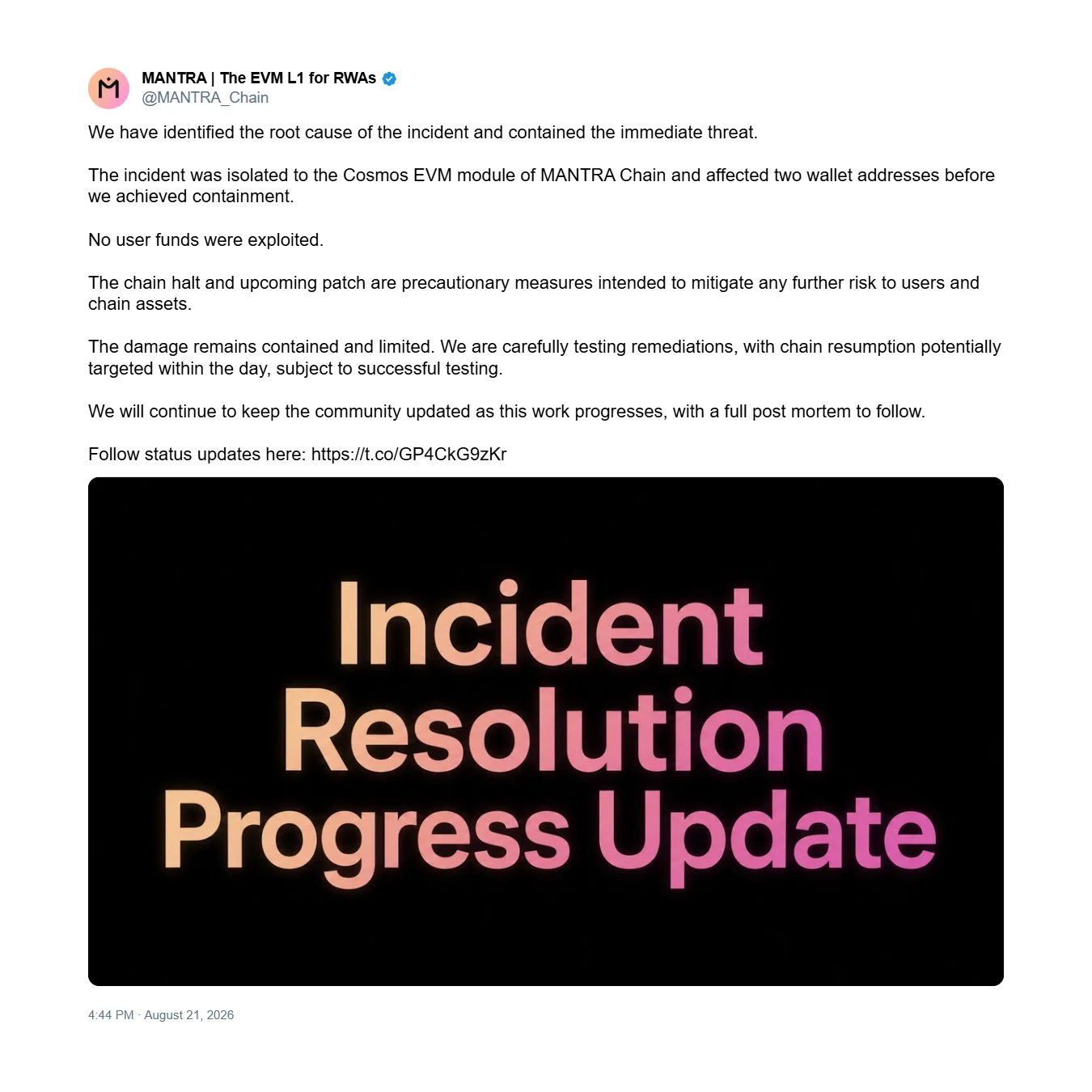
MANTRA said the shutdown itself did not compromise customer assets and repeated, “No user funds were exploited.” The halt disabled transactions and transfers, staking operations and bridges, while deposits and withdrawals through affected exchanges were also interrupted. All network endpoints were frozen during the response, leaving tokens already held on centralized trading venues available for trading while normal on-chain transfers, deposits, withdrawals and cross-market arbitrage were restricted.
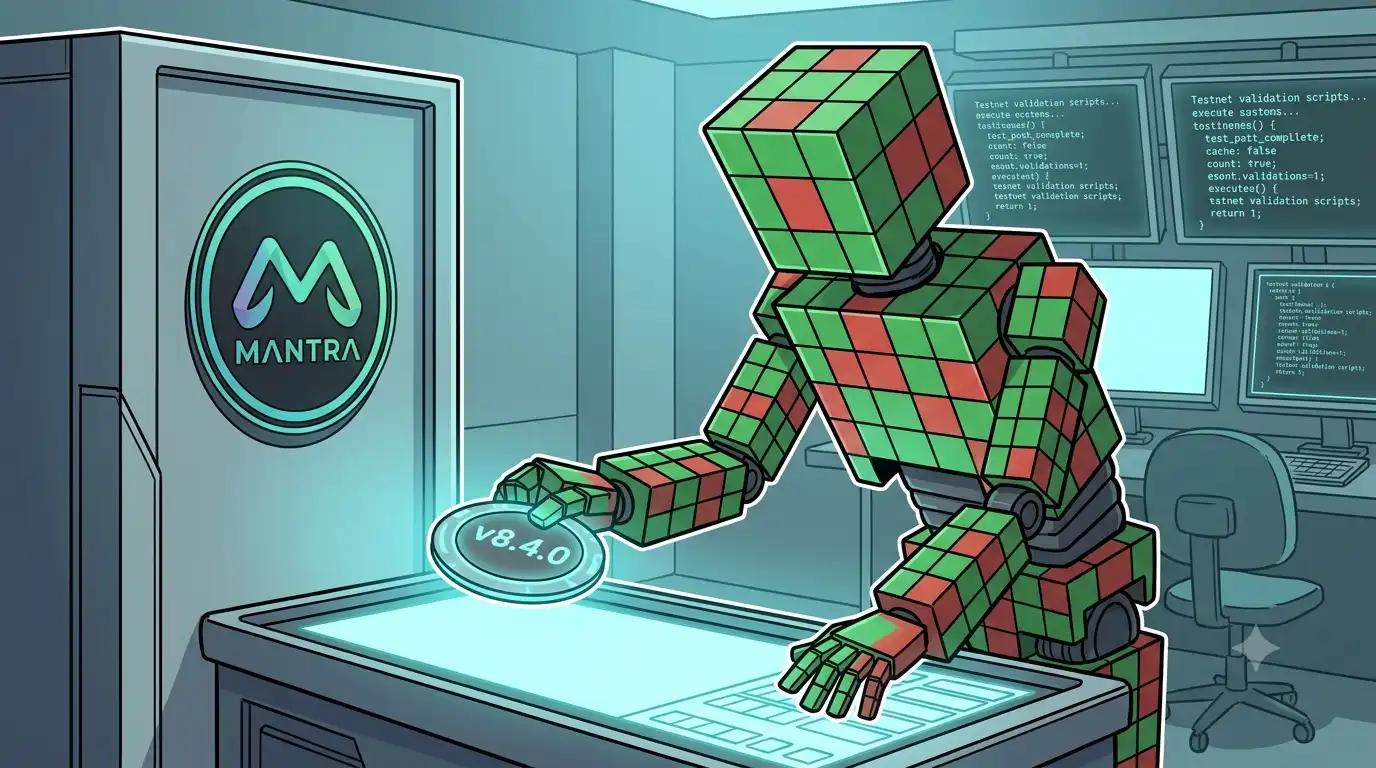
Before beginning the recovery process, MANTRA took a full snapshot of the blockchain state. Developers then prepared patched software release v8.4.0 to address the vulnerability and began testing it on the DuKong testnet. MANTRA said a coordinated mainnet upgrade and restart could take place later that day if testing completed successfully and independent validators were ready to resume operations. Validators were instructed to keep their mainnet nodes offline until MANTRA formally announced the restart.
MANTRA also said it was working with external security partners to examine the incident and assess additional risks. A full post-mortem was planned after network restoration. The information available at the time established that two wallet addresses and the Cosmos EVM module were affected, but the technical reconstruction of the exploit path and the complete remediation process remained subject to the promised post-mortem.
MANTRA price falls as trading activity surges
The MANTRA price decline extended beyond the immediate record low, with several market snapshots capturing different stages of the selloff and partial recovery. Because those figures were recorded at different points, they show a changing market rather than a single simultaneous price reading.
The native asset was formerly known as OM but now trades under the MANTRA ticker after a 1:4 non-dilutive redenomination and ticker change completed in March 2026. Holders received four MANTRA tokens for each former OM token, with the conversion designed to leave their aggregate value unchanged at the time of redenomination.
The Aug. 21 selloff followed a much larger token collapse on April 14, 2025, when OM fell from above $6 to below $1 in less than one hour, wiping out roughly 90% of its market value. Liquidations exceeded $70 million during that episode. CEO John Patrick Mullin blamed the collapse on what he called “reckless forced closures” by centralized exchanges.
The fallout continued into January 2026, when MANTRA announced staff reductions across several teams. MANTRA said rapid expansion during 2024 and early 2025 had left its cost base too high following a difficult market period and the effects surrounding the token collapse. Mullin had also pledged to burn 300 million OM after the April crash, with the burn completed later that month.
Security incident lands amid MANTRA’s RWA expansion
The Aug. 21 shutdown carries additional importance for MANTRA because the blockchain positions itself as infrastructure for real-world asset tokenization, including the movement of funds, bonds and other tokenized financial instruments. The project has built that strategy around institutional participation and has raised capital and established partnerships intended to expand its RWA operations.
Partners and investors associated with the RWA strategy include Nomura’s Laser Digital, Brevan Howard Digital, Shorooq and Amber Group, along with other investment firms. MANTRA also secured a strategic investment from Laser Digital aimed at expanding its real-world asset operations across the Middle East and Asia.
The security incident came three days after MANTRA launched a major EVM interface upgrade on Aug. 18, 2026. That upgrade was identified as another element developers could examine during their investigation, but no causal link between the interface upgrade and the Aug. 21 incident was established.
MANTRA warned users during the shutdown to avoid people offering recovery assistance or directing them to unofficial token websites. The network remained paused while the patched software underwent testing, with the restart dependent on successful testing and validator coordination rather than an immediate return to normal block production.
This article has been refined and enhanced by ChatGPT.


