




 USD
USDIranian Crypto Outflows Jump to $10.3M After Airstrikes as Exchange Withdrawals Spike Up to 873%


Wartime shock triggers rapid crypto withdrawals across Iranian exchanges
TL;DR
- Iranian crypto exchanges recorded about $10.3 million in outflows after airstrikes beginning Feb. 28, 2026.
- Hourly withdrawals surged as much as 873%, with a peak of $2.89 million within one hour.
- Researchers say crypto activity rose 700% during the conflict as citizens moved funds amid financial uncertainty.
We’ve launched the all-new COIN360 Perp DEX, built for traders who move fast!
Trade 130+ assets with up to 100× leverage, enjoy instant order placement and low-slippage swaps, and earn USDC passive yield while climbing the leaderboard. Your trades deserve more than speed — they deserve mastery.
Airstrikes linked to escalating military tensions between the United States, Israel, and Iran triggered a rapid spike in cryptocurrency withdrawals from Iranian exchanges beginning Feb. 28, 2026, according to blockchain analytics data released in early March. Monitoring firms tracked approximately $10.3 million in crypto assets leaving domestic trading platforms between Feb. 28 and March 2 as users transferred funds out of local services. The surge occurred as markets reacted to the strikes and geopolitical uncertainty spread through the region, while global crypto price movements were tracked through the broader crypto price index used across digital asset markets.
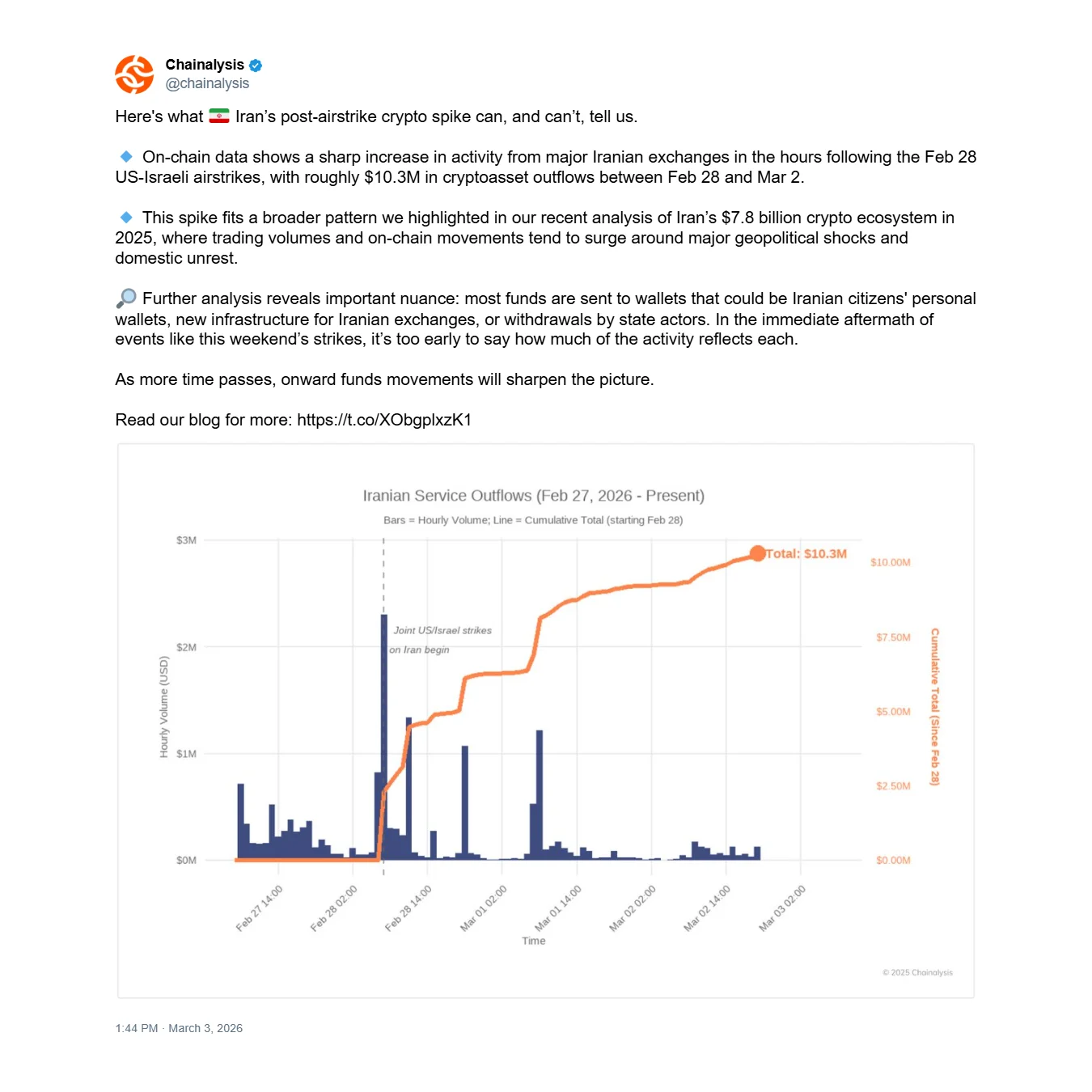
Blockchain transaction records show the largest spikes in activity occurred within hours of the attacks, when hourly withdrawals exceeded $2 million as users rapidly moved assets off local exchanges. Data from blockchain analytics providers recorded a peak withdrawal window between 11:00 and 12:00 GMT, when $2.89 million left one major exchange in a single hour. Researchers reported that the spike represented an eightfold increase compared with the highest hourly withdrawals recorded during the previous day.
Analysts examining blockchain flows said hourly withdrawals during the crisis rose as much as 873% above the average levels recorded earlier in 2026. Another dataset recorded a surge of roughly 700% in crypto withdrawals within minutes of the airstrikes, illustrating how quickly digital asset transactions can accelerate during geopolitical shocks. Researchers tracking the flows noted that crypto transfers are publicly visible on blockchains but do not immediately reveal the identity of the parties involved.
Blockchain analytics firms said the identities behind the transactions remain uncertain because wallet addresses appear only as pseudonymous strings rather than verified personal accounts. Researchers wrote that several scenarios could explain the spike in withdrawals, including retail investors attempting to protect savings during escalating conflict, exchanges repositioning liquidity during operational stress, or state-linked entities shifting funds across international crypto platforms.
One analysis noted that “some of these flows are almost certainly ordinary Iranians moving funds in response to rising risk,” while adding that government-linked actors could also be moving assets through global platforms. Another researcher described the spike as “more indicative of activity under stress than evidence of systemic capital flight,” referring to the complexity of interpreting blockchain transaction flows during sudden geopolitical events.
Iran’s largest domestic crypto exchange sits at the center of the country’s digital asset activity, with researchers estimating the platform processed $7.2 billion in cryptocurrency transactions during 2025 while serving more than 11 million users. The exchange allows customers to convert Iranian rials into digital assets and withdraw them to external wallets, creating a pathway for funds to move outside the domestic financial system even as international sanctions restrict traditional banking channels.
Blockchain tracing indicated that many withdrawals were transferred to overseas crypto trading platforms, suggesting funds were leaving domestic exchanges during the period of military escalation. Analysts cautioned that some transactions may represent internal operational movements by exchanges rather than direct user withdrawals, particularly during periods of market volatility or infrastructure adjustments.
Historical blockchain data shows similar surges in Iranian crypto activity during previous political shocks. Researchers documented a comparable spike on Jan. 9, 2026, following nationwide protests and a government-imposed internet blackout that temporarily halted exchange access before activity resumed once connectivity returned. Data collected from earlier incidents shows that withdrawal volumes tend to accelerate once internet access is restored.
Several analysts described the recent withdrawals as evidence that cryptocurrencies are used in crisis situations as a financial exit mechanism rather than as a long-term hedge. One report stated that “for ordinary Iranians, Bitcoin wasn’t seen as a portfolio hedge but rather a means to find an accessible exit and preserve purchasing power as their local currency collapses.”
Despite the geopolitical turmoil and withdrawal activity, Bitcoin’s crypto price remained relatively stable during the period, trading around $67,900 based on COIN360 data tracking the crypto price index. The digital asset remains far below its earlier record near $126,200 reached in October according to the same data tracking global coin market cap valuations across the cryptocurrency sector.
Researchers estimate Iran’s domestic crypto ecosystem has grown substantially in recent years despite international sanctions. Studies cited in the report estimate that between $8 billion and $11 billion worth of cryptocurrency transactions occurred within the country during 2025. Other estimates indicate up to 15 million residents have interacted with digital asset markets, according to figures referenced in the data.
Separate research cited in the analysis estimates that as much as 50% of Iran’s cryptocurrency activity may involve entities linked to the Islamic Revolutionary Guard Corps, although analysts say a large share of trading activity still originates from retail investors using exchanges to store savings or move funds internationally.
Western regulators have increasingly monitored the country’s digital asset sector as part of broader sanctions enforcement efforts, citing concerns that cryptocurrencies may allow sanctioned actors to move funds across borders or conduct international transactions outside the traditional financial system. Analysts tracking blockchain data said the $10.3 million in withdrawals during the airstrike period represents a relatively small portion of the country’s estimated $7.8 billion cryptocurrency ecosystem.
This article has been refined and enhanced by ChatGPT.


