




 USD
USD
Harmony Proposes Layer-1 Shutdown and ONE Migration to Ethereum

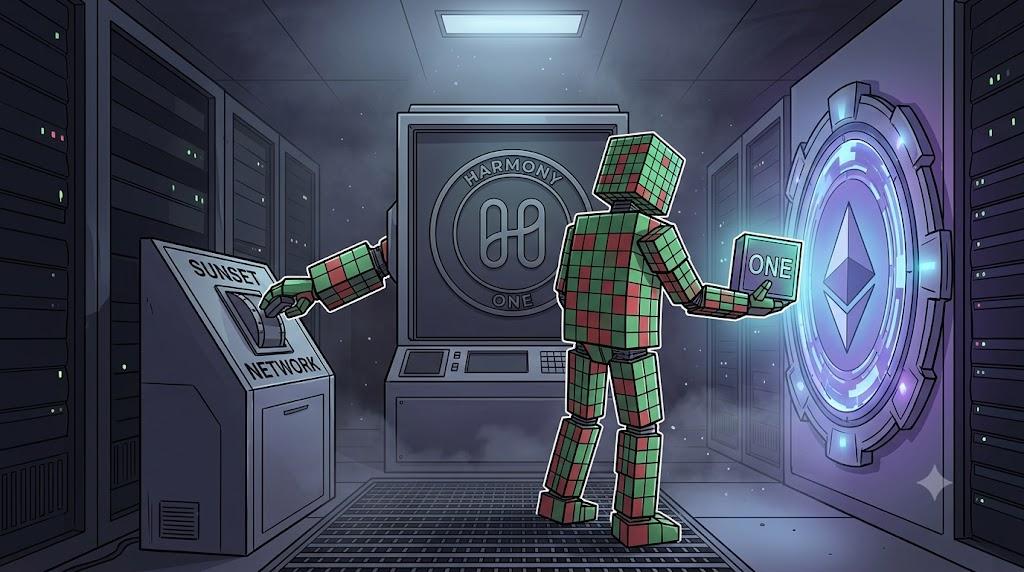
Security threats push blockchain toward AI-video business and new Ethereum-based token structure
TL;DR
- Harmony has proposed fully sunsetting its Layer-1 blockchain and moving ONE to Ethereum as it pivots toward an AI-video “remix economy.”
- Harmony cited threats from state actors and AI agents, while users with assets in smart contracts face a September 10 migration deadline.
- Validators could become governors in the new initiative, while ONE’s total supply and emission rate would remain unchanged.
Trade smarter on Jupiter, Solana’s leading DEX built for fast execution and deep liquidity.
Swap tokens at competitive rates, route across multiple liquidity sources automatically, and access perpetuals, DCA, and advanced trading tools — all in one place!
Harmony proposed shutting down its Layer-1 blockchain after repeated security incidents and moving its native ONE token to Ethereum, saying threats from state actors and AI agents had become too great to continue operating the network. The proposal, announced on September 6, 2026, is non-binding and would replace Harmony’s blockchain-focused model with an AI-video initiative while requiring users to exit non-migratable smart contracts before September 10, 2026.
Harmony framed the proposed shutdown as a response to an increasingly difficult security environment. “The threats posed by state actors and AI agents are too great,” the Harmony Team wrote on X. “Since our mainnet launch in 2019, our community has been resilient through attacks and changes—but it is time to fully sunset the Harmony network.”
The Layer-1 uses proof-of-stake, under which validators commit tokens to secure the network, and sharding, which separates transactions into smaller groups that can operate in parallel. Harmony’s design was intended to increase capacity without sacrificing security or concentrating control.
Harmony plans to preserve ONE rather than retire the asset with the network. The project proposes moving ONE to Ethereum and using future token issuance to support a new initiative called “The Remix Economy for AI Video.” Validators could shift from verifying blockchain transactions into governance positions or operational roles tied to the new AI-video business.
Harmony said the proposed business would center on a small group of AI-video creators publishing open prompts and other assets. Fans could fork, or remix, those originals, while AI agents would turn each remix into additional video clips.
“We will bootstrap this economy with creators and operators who make AI videos,” Harmony said. “Advertising could generate tens of millions of dollars from a million users.”
ONE migration would use a final-block snapshot
Harmony proposes taking a snapshot at the network’s final block to determine replacement ONE allocations on Ethereum. The snapshot would cover tokens held directly in wallets, staking delegations, validator rewards, smart contracts and centralized exchanges.
Replacement tokens would be airdropped to the corresponding Ethereum wallet addresses, while exchange listings would also migrate to the new token. Harmony said holders, delegators and validators would not need to submit a separate claim for balances that can be transferred through the snapshot process.
“Delegated stakes and unclaimed rewards will be airdropped to individual governor vaults,” Harmony said.
Smart-contract positions face different treatment because Harmony said multisig safes, liquidity pools and onchain applications cannot be transferred automatically. “Multisig safes, liquidity pools, and onchain apps cannot be migrated; users are urged to exit all smart contracts before September 10, 2026,” the Harmony Team wrote.
Validators can cease node operations beginning on that deadline. Harmony has proposed compensating qualifying validators and delegators while transitioning participating validators into “governor” roles in the new initiative.
Harmony said validators must sunset their nodes, maintain their stakes, sign an agreement and serve as governors to qualify for the proposed compensation arrangement.
Harmony also plans to preserve ONE’s monetary framework after the migration. “The ONE token’s total supply and emission rate will remain unchanged. Tokens issued through emissions will now be allocated to our new mission, “The Remix Economy for AI Video”, subject to governor feedback,” the team wrote.
ONE price was reported at $0.00073 after falling 3.86% over 24 hours around the announcement.
August exploit followed earlier Harmony security failures
Harmony’s proposed shutdown follows a major August 2026 exploit involving unauthorized ONE issuance. Early reporting said the attacker minted roughly 4 billion unauthorized ONE tokens, while Harmony’s later reconstruction found that more than 3 trillion ONE had been minted across six transactions.
Harmony said the exploit stemmed from a flaw in its cross-shard receipt verification system that allowed valid receipts to be processed multiple times. The vulnerability enabled new ONE tokens to be created without a corresponding debit elsewhere. Harmony also identified a bug involving its pre-staking quorum-checking system.
The team subsequently rolled the network back to a state before the unauthorized tokens were forged. Harmony had already identified migrating ONE as a possible response while addressing the exploit, after initially releasing a patch and considering a rollback.
Harmony had also suffered a major breach in June 2022 when its Horizon cross-chain bridge was exploited. Attackers stole crypto assets valued at nearly $100 million, including Ethereum and multiple stablecoins. Security experts linked the breach to a compromise of the bridge’s multi-signature wallet, and the FBI later attributed the attack to the North Korean state-backed Lazarus Group and APT38.
AI is also changing crypto’s defensive security efforts
Harmony’s security rationale comes as AI is increasingly being used on both sides of crypto security, with suspected AI-assisted attacks occurring alongside efforts to use the technology to identify vulnerabilities before attackers exploit them.
Coldcard maker Coinkite said in July 2026 that it suspected an attacker used AI to uncover a flaw that made wallet keys easier to guess, even though the vulnerability had escaped the company’s own AI review. Coinkite overhauled its security in August 2026 after thefts exceeded $100 million.
Developers formed the Bitcoin Red Team following the Coldcard attack to search proactively for vulnerabilities. The group combines AI models, including Moonshot AI’s Kimi K3, with human review to examine wallets, payment applications and other Bitcoin software before privately alerting developers to discovered flaws.
The group grew to about 20 to 25 volunteers, according to pseudonymous member and developer Calle, who said the team had found no issues in Bitcoin’s underlying protocol. “The reason why the Bitcoin Red Team exists right now is because we need to get ahead of the attackers as fast as possible,” Calle said.
This article has been refined and enhanced by ChatGPT.


