




 USD
USDGnosisDAO Approves Gnosis Chain Shift to Ethereum Economic Zone


GIP-153 Sets Path for ZK-Proven Rollup With Ethereum Settlement
TL;DR
- GnosisDAO approved GIP-153, directing Gnosis Chain to transition from a standalone Layer 1 toward a ZK-proven Ethereum Economic Zone rollup.
- The planned network would settle on Ethereum while preserving existing applications, balances and xDAI gas.
- The vote establishes a governance mandate rather than a completed migration, with substantial technical work still required.
Trade smarter on Jupiter, Solana’s leading DEX built for fast execution and deep liquidity.
Swap tokens at competitive rates, route across multiple liquidity sources automatically, and access perpetuals, DCA, and advanced trading tools — all in one place!
GnosisDAO approved GIP-153 on Aug. 20, 2026, giving Gnosis Chain a governance mandate to move from its standalone Layer 1 architecture toward a ZK-proven Ethereum Economic Zone, or EEZ, rollup that settles on Ethereum. The change would eventually retire Gnosis Chain’s independent validator set and make the network a Layer 2 relying on Ethereum validators for settlement and security. The approval sets the network’s direction but does not mean the technical migration has already taken place.
Gnosis Chain disclosed the voting figures in an X post. The proposal passed with the overwhelming majority of voting power supporting the transition, while the approved plan remains a directional governance decision rather than an immediate deployment. Completing the change requires engineering and testing work as well as decisions around sequencer and prover design, bridge considerations, user migration planning, security review and ecosystem coordination.
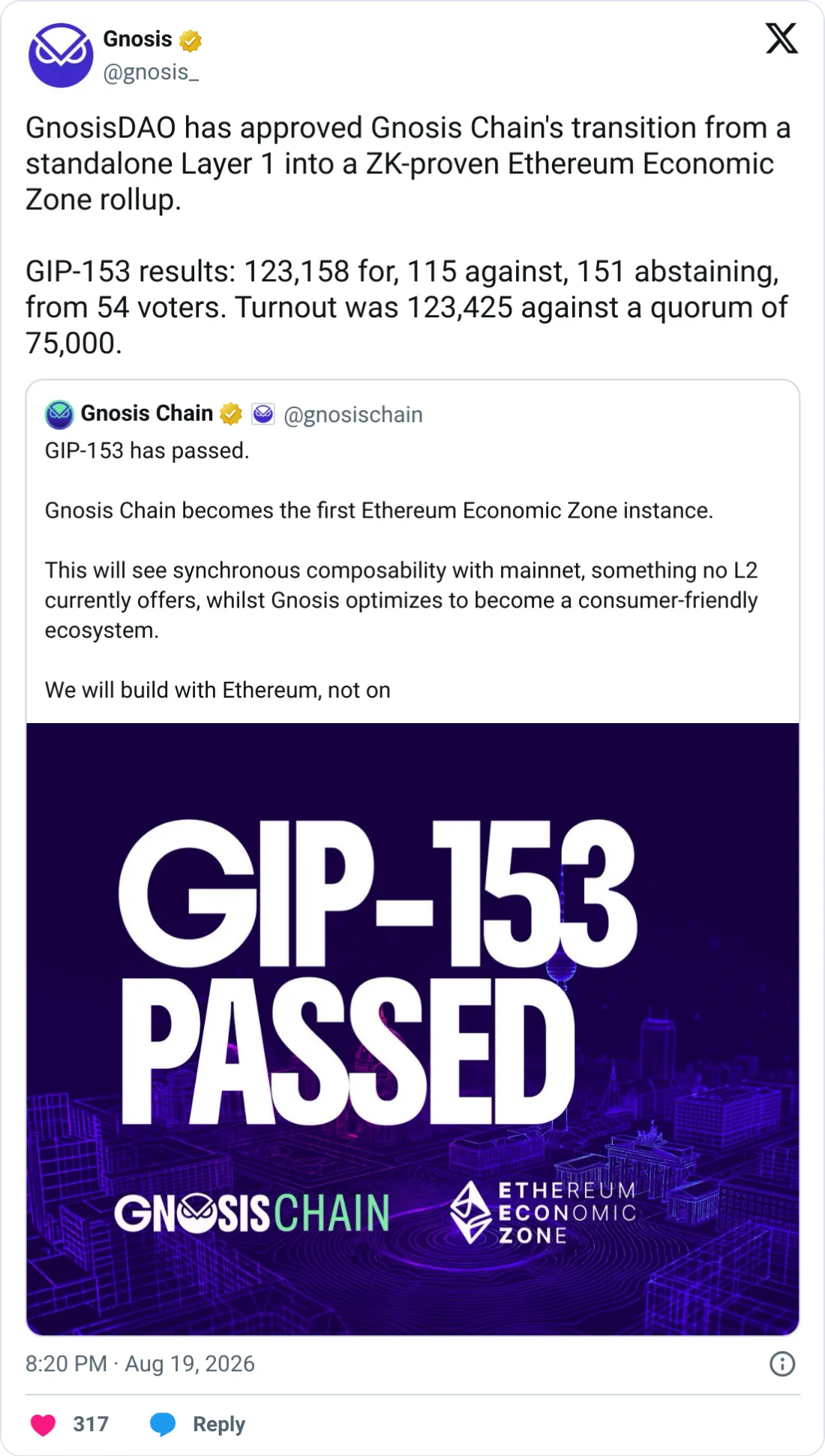
The target genesis window is late 2026 or early 2027, subject to the required EEZ technology being ready. Preparations also include technical design, implementation milestones, test environments, ecosystem communication and final launch planning. Until that work is completed, Gnosis Chain continues to operate under its existing architecture despite the governance approval.
Ethereum Settlement Would Replace Gnosis Chain’s Independent Validator Model
Gnosis Chain has operated as its own blockchain while remaining closely aligned with Ethereum tooling and values. Under GIP-153, Ethereum would instead become its settlement layer. The planned structure would allow Gnosis Chain to rely on Ethereum’s validator network, liquidity base, developer ecosystem and institutional credibility while keeping transaction execution within the Layer 2 environment rather than moving all activity directly onto Ethereum mainnet.
The transition is also designed to preserve familiar parts of the Gnosis Chain user experience. Gas would continue to be paid in xDAI rather than ETH, and Gnosis Chain is expected to retain its existing applications, account balances and xDAI gas token when it becomes the first production deployment of the EEZ architecture. The proposal therefore changes the network’s settlement and interoperability model without resetting its existing application environment.
The EEZ was developed by Gnosis and ZisK with funding from the Ethereum Foundation as a framework for Ethereum-aligned rollups. Its stated objective is to reduce fragmentation across Ethereum’s Layer 2 ecosystem by allowing smart contracts on participating networks to execute synchronously without depending on conventional cross-chain bridges.
The proposal would allow Gnosis Chain-native smart contracts to call Ethereum and use the resulting state or output within the same transaction. That would give applications access to Ethereum mainnet assets and liquidity in an environment the proposal calls “optimized” for consumers. The proposal says that capability is not currently available on existing Layer 2 networks.
Ethereum scaling has increased transaction capacity by distributing activity across numerous networks, but the EEZ initiative targets the resulting separation of liquidity, infrastructure, applications and users across different blockchains. Its architecture is intended to make participating networks interact more directly while reducing the number of cross-chain operations that depend on bridge infrastructure.
GNO Staking Structure Would Change With the Migration
The proposal would also unlock approximately 350,000 staked GNO as Gnosis Chain moves away from its independent validator architecture. Releasing those tokens could change staking incentives and give holders greater flexibility while altering how GNO functions within the future network structure.
The material supporting the proposal raises several possible directions for GNO’s role, including becoming more governance-centered or taking on a different economic function within the Ethereum-aligned system. It does not state that the unlocked tokens would be sold, and the unlocking itself should not be treated as evidence of planned market disposal.
Ethereum’s broader scaling ecosystem already secures substantial value. L2Beat data cited alongside the proposal showed the following figures:
The EEZ design also addresses concerns raised about centralized sequencers and trusted bridging systems in some Layer 2 architectures. Ethereum co-founder Vitalik Buterin wrote in a Feb. 3 X post, “The original vision of L2s and their role in Ethereum no longer makes sense, and we need a new path.”
Standard Chartered Sees Reduced Bridge Dependence as an EEZ Benefit
Geoffrey Kendrick, global head of digital assets research at Standard Chartered, said the EEZ could reduce reliance on blockchain bridges while increasing activity across Ethereum. Kendrick wrote in a May 28 report, “The EEZ will have the benefit of reducing the need for bridges (where hacks tend to occur) and increasing the usability of assets in EVM chains.”
Kendrick also said the EEZ could improve composability between assets by allowing smart contracts on different participating networks to interact within the same transaction. Addressing bridge dependence and improving asset usability could have a broader ecosystem effect, he said: “Both of these are likely to lead to greater activity in the Ethereum ecosystem.”
Gnosis Chain would serve as the first production implementation of that model if the transition is completed. The network would move from operating as an independent blockchain toward functioning as a specialized extension of Ethereum’s settlement layer, while retaining Gnosis-specific application infrastructure and xDAI-based transaction fees.
Execution will determine how that transition works in practice. Rollup infrastructure remains competitive, and the implementation will be judged on reliability, transaction fees, liquidity, developer tooling and bridge safety as GnosisDAO moves from an approved governance direction to technical deployment.
This article has been refined and enhanced by ChatGPT.


