




 USD
USDGen Z Drives Crypto Speculation Into Meme and Prediction Markets as Bitcoin Ownership Tops Gold and P2P Payments Hit 72%


Younger Investors Lean Into High-Risk Crypto Markets While U.S. Bitcoin Ownership Overtakes Gold
TL;DR
- Gen Z investors dominate crypto usage patterns, accounting for 72% of global peer-to-peer cryptocurrency payments, according to a report released in early March 2026.
- Research shows around 50 million Americans own Bitcoin compared with roughly 37 million gold owners, giving Bitcoin about 13 million more holders in the United States.
- Speculative digital asset activity among younger traders continues expanding, with meme tokens reaching $31.7 billion in market capitalization and $575.8 million in daily trading volume.
We’ve launched the all-new COIN360 Perp DEX, built for traders who move fast!
Trade 130+ assets with up to 100× leverage, enjoy instant order placement and low-slippage swaps, and earn USDC passive yield while climbing the leaderboard. Your trades deserve more than speed — they deserve mastery.
Younger investors are reshaping digital asset markets across speculation, payments, and ownership patterns as cryptocurrency adoption expands among new demographics. Data released during early March 2026 describes Generation Z as a dominant participant in multiple segments of the crypto ecosystem, from high-volatility meme token trading to peer-to-peer payment activity. Research and market metrics describe younger users taking a leading role in areas that combine social media influence, mobile financial tools, and blockchain-based payment infrastructure while monitoring crypto price movements through analytics dashboards that track metrics such as the crypto price index and coin market cap rankings.
Speculative trading activity among younger investors has intensified alongside the growth of meme-driven crypto markets. Market trackers report the meme token sector has expanded to roughly $31.7 billion in market capitalization, accompanied by $575.8 million in daily trading volume, as traders respond to social media trends and fast-moving digital communities. Researchers tracking the behavior say the generation often gravitates toward high-risk opportunities tied to viral narratives rather than long-term investment strategies. Analysts studying these patterns attribute part of the trend to economic pressures that shape financial decision-making among younger participants.
Northwestern Mutual’s survey findings, referenced in recent research, state that 32% of Gen Z investors have already participated in prediction markets, platforms that allow users to bet on the outcomes of real-world events. Data tracking this sector shows prediction markets reached $12 billion in monthly trading volume during 2025, with one category of technology and science-related forecasts expanding by 1,637% during the same period. Additional survey results indicate 94% of Gen Z investors expressed interest in collectible or speculative digital assets, according to research examining participation patterns in blockchain-based marketplaces.

Financial observers have linked the behavior to broader attitudes toward wealth building among younger investors. Analysts describe a mindset commonly referred to as financial nihilism, in which traditional savings pathways appear less attainable due to inflation, student debt and housing costs. A hedge-fund executive commenting on the trend said younger traders are increasingly willing to “wager a few hundred bucks on a meme coin” rather than allocate funds to long-term retirement vehicles.

Payment data also reveals younger crypto users dominating decentralized transfer activity. A report released during early March 2026 by crypto exchange NoOnes states that Gen Z accounts for 72% of peer-to-peer cryptocurrency payments, placing the generation well ahead of other age groups in transaction activity. Millennial users represent 24% of P2P crypto payments, while Gen X contributes 4%, according to the same report. These transfers typically occur on platforms that allow individuals to send digital assets directly between wallets without relying on traditional banking intermediaries.
Regional adoption patterns vary widely across global markets. Data shows Asia leading peer-to-peer cryptocurrency adoption with 74% usage, followed by 62% in Latin America and 54% across Africa, where digital assets are frequently used for cross-border payments and remittances. Europe and North America report lower P2P usage levels in comparison, reflecting the broader availability of established financial infrastructure in those regions.
Alternative payment tools are expanding alongside direct crypto transfers. Transaction data shows crypto-linked payment cards recorded $1.6 billion in transaction volume across three years, marking a 106% increase as digital asset holders increasingly integrate blockchain-based funds into everyday purchases. Analysts studying consumer behavior say mobile-first financial tools remain central to adoption among younger users, who typically access crypto wallets, trading dashboards, and crypto price index trackers through smartphone applications that display real-time crypto price data and coin market cap rankings.
Ownership data also reveals changing preferences among U.S. investors deciding between traditional stores of value and digital assets. Research compiled by financial services firm River using data from The Nakamoto Project and Gold IRA Guide found that 50 million Americans own Bitcoin, compared with 37 million Americans who own gold. That difference represents 13 million more Bitcoin holders than gold owners within the United States, according to the dataset.

Researchers say ownership counts reflect the number of individuals holding an asset rather than the amount held by each investor. The surveys treat every holder equally regardless of investment size, meaning someone holding a small amount of Bitcoin and someone holding several coins are counted the same in adoption statistics. Analysts note that gold ownership figures also include institutional investors such as pension funds, asset managers and central banks.
Bitcoin’s rise in personal ownership comes despite gold’s long history as a reserve asset. Researchers note the precious metal has served as a dominant store-of-value instrument for centuries, while Bitcoin has existed for only 17 years, according to the dataset. Survey findings also show public opinion on potential government reserves evolving alongside adoption patterns.
Additional data from traditional brokerage platforms shows younger traders entering financial markets earlier and displaying a higher tolerance for volatility. Charles Schwab CEO Rick Wurster said Gen Z investors — those born between 1997 and 2012 — are beginning their investing journeys sooner than previous generations, a trend that is reshaping retail trading behavior. Schwab data shows Gen Z participants are about 45% more likely to begin investing by age 21 compared with millennials at the same stage. Roughly 33% of new retail households joining the brokerage are under 30, while one in six new clients is younger than 24.
“We’ve seen younger investors really engage in the market,” Wurster said. “We are the most followed financial company on YouTube and have strong engagement on TikTok and Instagram.” Retail investors have also continued buying during market pullbacks. “Retail investors have learned not to pay attention to the noise,” Wurster said. “They’re seeing the bigger picture.” Still, he warned that the trend could shift if economic fundamentals deteriorate significantly.
An OKX survey of 1,000 Americans found younger investors significantly more trusting of crypto platforms than older cohorts. About 40% of Gen Z and 41% of millennials rated their trust in crypto platforms at 7 or higher on a 10-point scale, compared with just 9% of Baby Boomers. Around 36% of Gen Z and 34% of millennials said their trust in crypto increased over the past year. That sentiment is influencing trading plans: 40% of Gen Z and 36% of millennials said they intend to increase crypto trading activity in 2026.
A separate survey conducted between February 28 and March 17, 2025, involving 3,345 respondents, asked Americans whether a portion of U.S. gold reserves should be converted into Bitcoin. Results show 80% of participants supported converting some of the reserves, while the median recommendation suggested allocating 10% of gold reserves into Bitcoin, with the middle half of responses ranging between 1% and 30%.
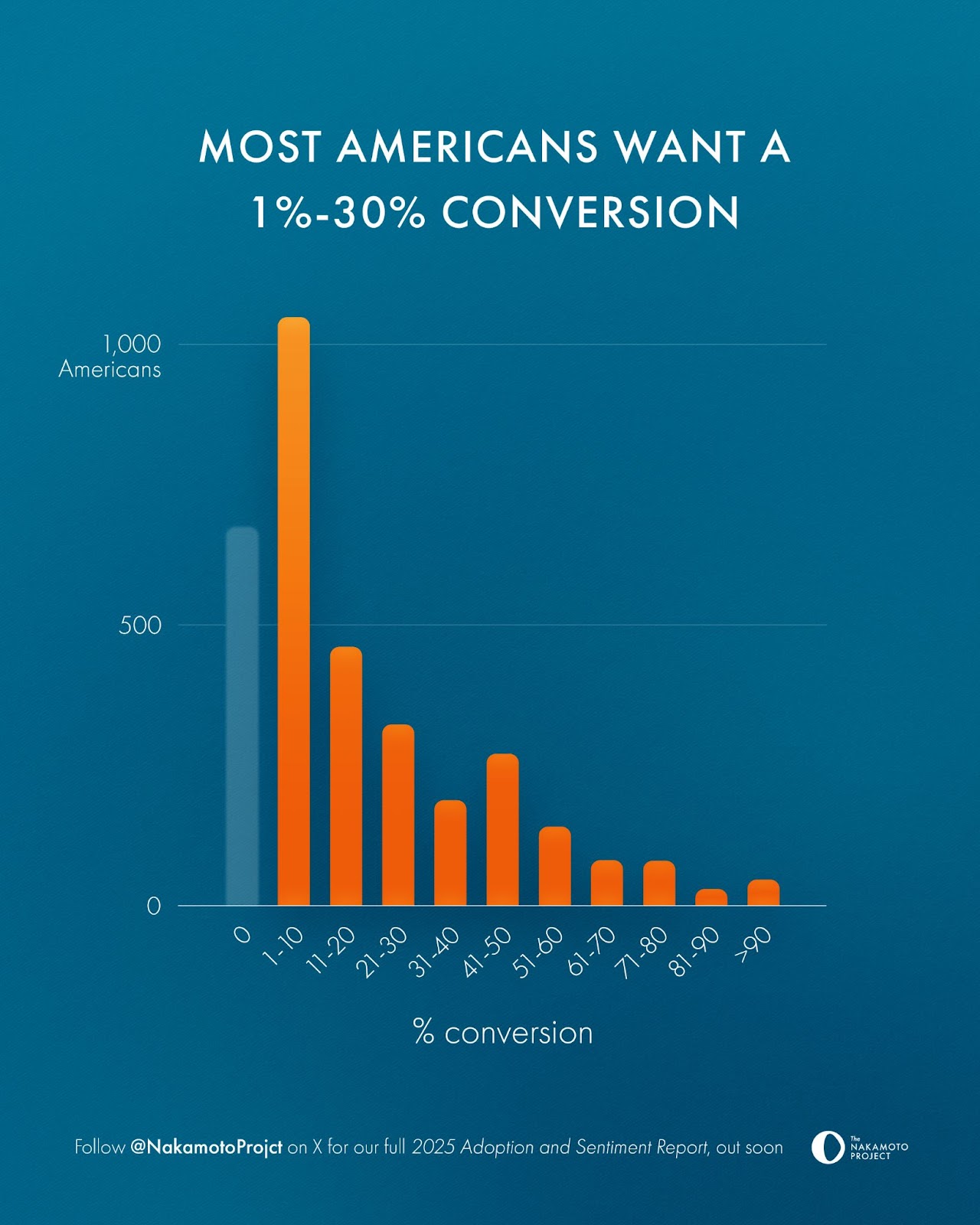
Government reserve discussions frequently reference the size of the country’s gold holdings. Data shows the United States maintains approximately 8,133 metric tons of gold, valued at more than $830 billion at recent market prices. Bitcoin ownership among individuals continues to grow as traders monitor crypto price movements through analytics platforms that track the crypto price index and coin market cap rankings while trading activity expands across exchanges and peer-to-peer networks.
This article has been refined and enhanced by ChatGPT.


