




 USD
USDGemini Faces Class-Action Lawsuit After IPO Strategy Pivot, Stock Plunges and Workforce Cut


Investors Allege Misleading Disclosures as Exchange Shifts to AI-Driven Model and Retreats From Global Markets
TL;DR
- Gemini is being sued in federal court over alleged misleading statements tied to its September 2025 IPO and subsequent strategy reversal.
- Shares dropped from a peak of $45 to about $6 after a February 5, 2026 disclosure of layoffs, global exits, and a pivot to prediction markets.
- The company has cut roughly 30% of staff since January while targeting one employee per 100,000 users through AI-driven operations.
We’ve launched the all-new COIN360 Perp DEX, built for traders who move fast!
Trade 130+ assets with up to 100× leverage, enjoy instant order placement and low-slippage swaps, and earn USDC passive yield while climbing the leaderboard. Your trades deserve more than speed — they deserve mastery.
Gemini is facing a class-action lawsuit in Manhattan federal court, where shareholder Marc Methvin accuses the crypto exchange and its executives, Tyler and Cameron Winklevoss, of misleading investors before and after its September 2025 initial public offering. The complaint, filed in the U.S. District Court for the Southern District of New York, alleges that offering documents promoted global expansion and sustained user growth while failing to disclose an internal shift already underway. The filing seeks a jury trial on four counts tied to alleged securities violations connected to the IPO disclosures and subsequent corporate actions.
Central to the lawsuit is an allegation that Gemini presented one strategy publicly while preparing another internally, with plaintiffs arguing that the company pivoted sharply toward prediction markets and cost reductions shortly after going public. Court filings include the statement that the offering materials “contained untrue statements of material fact” and omitted key disclosures required to ensure those statements were not misleading. Investors claim the divergence between messaging and execution became evident only after a series of disclosures that followed the IPO.
February 5, 2026 marked the inflection point cited across filings, when Gemini unveiled its “Gemini 2.0” strategy through a Regulation FD Form 8-K. The company disclosed that its prediction market would be “more front and center in our experience,” alongside a workforce reduction of 25% and planned exits from the United Kingdom, the European Union, and Australia. Those changes represented a decisive break from the global expansion narrative presented during the IPO process, according to the complaint.
Market reaction unfolded rapidly following the disclosure, with Gemini’s stock falling $0.64 per share, or 8.72%, to close at $6.70 on the day of the announcement. Shares had previously been priced at $28 during the IPO and later reached $45 before declining to about $6 during March 2026 trading. The drop left the stock down roughly 84% from its post-IPO peak.
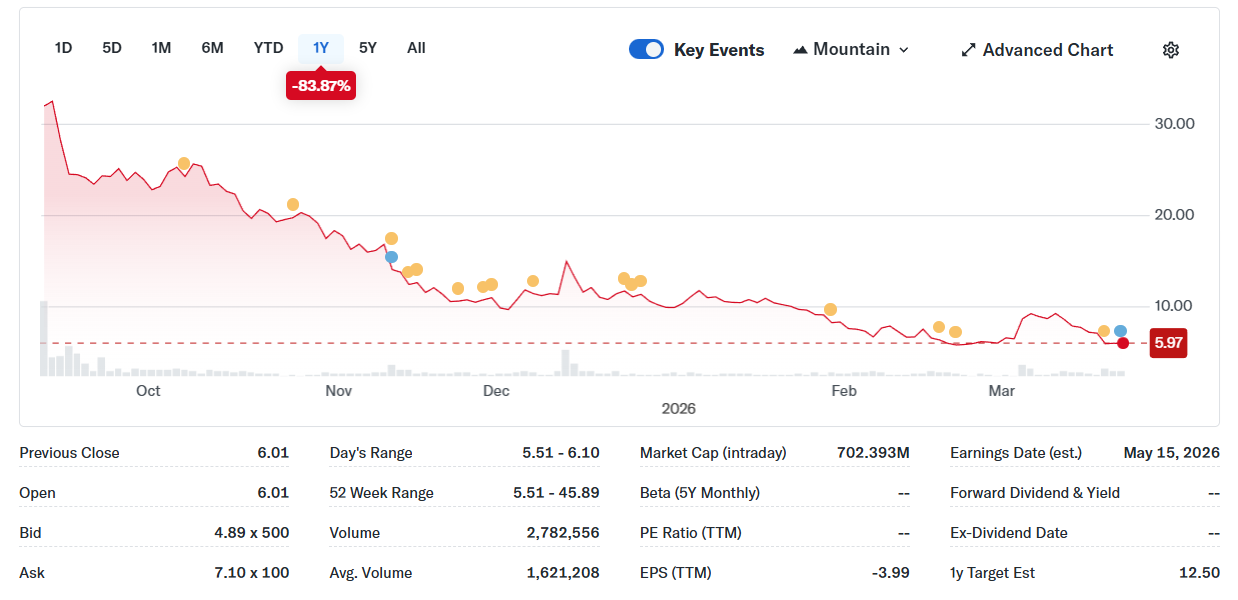
Workforce reductions extended beyond the initial announcement, with total staffing cuts reaching about 30% since the start of the year, eliminating roughly 300 roles from a workforce that previously exceeded 1,000 employees. The company framed the layoffs as part of a broader restructuring effort focused on automation rather than market weakness, even as crypto price conditions remained relatively stable. Bitcoin traded between $65,000 and $74,000 during the period, according to COIN360 data tied to the wider crypto price index.
Internal restructuring has centered on deploying artificial intelligence across engineering, compliance, and customer support functions, with Gemini targeting a staffing ratio of one employee per 100,000 users. Hiring priorities have shifted toward specialized roles such as AI prompt engineers and large language model auditors, replacing more traditional operational positions. The shift has been described in company communications as a move toward efficiency and scalability through automation.
Financial disclosures present a mixed picture, with Gemini reporting fourth-quarter revenue of $60.3 million, exceeding an analyst estimate of $51.7 million. At the same time, the company recorded a full-year loss of $583 million, according to figures cited in the lawsuit coverage. The contrast between revenue growth and overall losses forms part of the context cited by analysts reviewing the company’s post-IPO trajectory.
Analyst responses included multiple target price revisions following the February disclosures, with Evercore ISI cutting its target from $15 to $10, Truist lowering its estimate from $13 to $7 while citing the “drastic reduction in headcount,” Needham reducing its target from $23 to $10, and Rosenblatt adjusting from $26 to $11.50 while stating the company was “in full restructuring mode.” No public response from Gemini or the Winklevoss twins to the lawsuit had been reported.
This article has been refined and enhanced by ChatGPT.


