


 USD

Democratic Sweep Threatens CLARITY Act as Crypto Industry Faces New Washington Reality

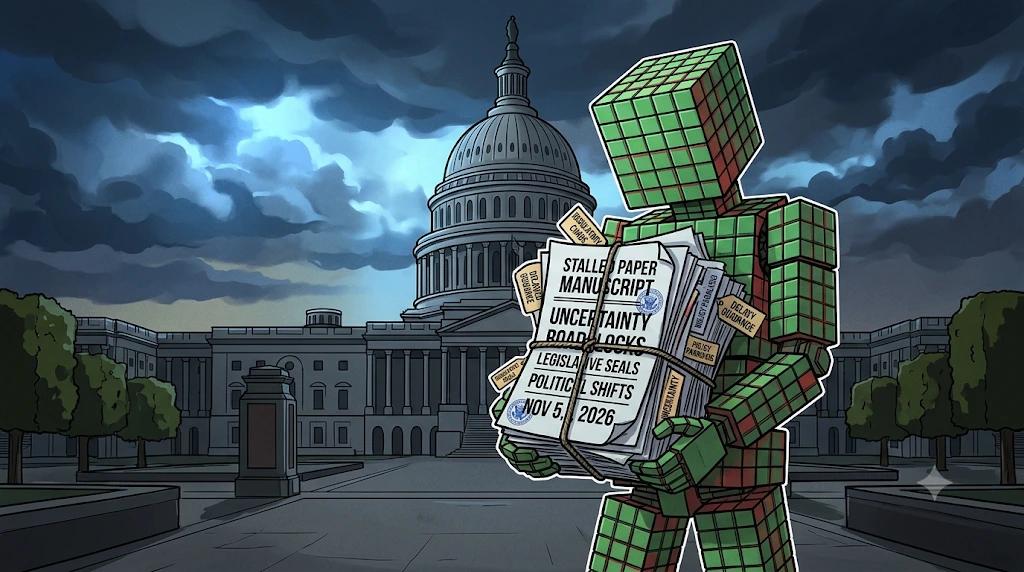
Stablecoin legislation and tokenization efforts may survive as congressional oversight intensifies
TL;DR
- Democrats won control of both chambers of Congress in the 2026 U.S. midterm elections, further weakening prospects for the CLARITY Act after its earlier Senate failure.
- Crypto political action committees spent heavily on the elections, but industry executives now expect tougher oversight, investigations and a renewed push for bipartisan legislation.
- Stablecoins, tokenized securities and institutional crypto products may continue advancing under existing laws, although regulatory changes face questions about their durability.
Trade smarter on Jupiter, Solana’s leading DEX built for fast execution and deep liquidity.
Swap tokens at competitive rates, route across multiple liquidity sources automatically, and access perpetuals, DCA, and advanced trading tools — all in one place!
Democrats' victory in both chambers of Congress in the November 3, 2026, U.S. midterm elections has dealt another setback to the cryptocurrency industry's efforts to establish a comprehensive federal regulatory framework.
The CLARITY Act, which failed to advance in the Senate under Republican control, now faces an even narrower path to passage. Industry executives expect increased congressional scrutiny of crypto companies, President Donald Trump's digital asset interests and financial regulators, although existing stablecoin legislation and tokenization initiatives could continue moving forward.
"For crypto, the Democratic sweep may well be the final nail in the Clarity Act's coffin," said Mati Greenspan, founder of Quantum Economics and a crypto market analyst. He pointed to the legislation's earlier failure despite Republicans controlling Congress. "The bill couldn't even clear a procedural vote in September, when Republicans controlled both chambers," Greenspan said. "Now the industry faces the prospect of starting from scratch in a divided Washington."
The CLARITY Act had passed the House but stalled in the Senate, failing a procedural vote by 49-50 in September. The bill sought to establish federal rules governing digital assets and the companies handling them, including the division of responsibilities between the Securities and Exchange Commission (SEC) and Commodity Futures Trading Commission (CFTC). With Democrats preparing to take control in January, lawmakers would need to find a new political agreement to advance comprehensive market-structure legislation.
"The Clarity Act is likely dead in the water in its current form," said Stefan Muehlbauer, head of U.S. government affairs at blockchain security firm CertiK. Brent Fulfer, co-founder of venture capital firm TBV, offered a different assessment of the timing.
"Clarity already died in September with Republicans running the Senate," he said, noting that more than 70 House Democrats had previously supported the legislation.
Crypto Political Spending Fails to Prevent Democratic Gains
The election results came despite substantial spending by cryptocurrency political action committees, which sought to elect candidates supportive of the industry's legislative priorities. Anton Golub, head of exchange go-to-market at Forte and a former crypto exchange executive, shared figures putting industry PAC spending at approximately $170.5 million, including at least $125.5 million directed toward Republicans.
Other figures reported by Fortune, Americans for Financial Reform and The Block detailed Fairshake's fundraising, spending and involvement in individual races. The different figures represent separately reported totals and categories rather than a single reconciled accounting of election expenditure.
One of the industry's most closely watched defeats came in Ohio, where former Democratic Sen. Sherrod Brown defeated Republican Sen. Jon Husted, who had received support from Stand With Crypto. Brown previously chaired the Senate Banking Committee, which oversees digital asset legislation, and had been viewed as critical of the cryptocurrency industry. His victory in a special election to fill Vice President JD Vance's Senate term means he could return to the chamber as early as December 15.
Kevin Wysocki, head of policy at Anchorage Digital, said Brown's previous tenure also included constructive conversations with the industry. Wysocki recalled that Brown and his Senate staff had been open to discussing digital asset policy when he chaired the Banking Committee. Nevertheless, investment bank TD Cowen said Brown's victory makes it unlikely that the CLARITY Act will advance over the next two years.
Fairshake defended its electoral record despite the Ohio defeat.
"Fairshake played a meaningful role in winning competitive races across the country in 2026 and we will do it again in 2028," spokesperson Geoff Vetter said. "Newly elected and current members will have a choice: protect consumers and American jobs or fight progress. We will be watching and '28 is a new map."
An unnamed crypto industry source questioned the effectiveness of that spending, suggesting political action committees and trade associations would need to "recalibrate" and "double down on being bipartisan." Referring specifically to Fairshake's spending in the Ohio race, the person asked:
"What did we ultimately get out of that?" and added, "Where could that money have been better spent? To be perfectly honest with you, I think it could have been better spent on shoe-leather lobbying."
The source argued that additional direct lobbying might have helped the CLARITY Act, saying:
"You spend a fraction of it, and you could have effectively hired all of DC to lobby on Clarity."
Congress Prepares for Stronger Crypto Oversight
Despite the election setbacks, crypto advocacy group Stand With Crypto identified substantial representation among newly elected lawmakers it considers supportive of digital assets. Its election tracking counted 19 pro-crypto senators and 226 pro-crypto House members elected, alongside eight senators and 106 House members classified as anti-crypto. The figures show the industry's efforts to maintain relationships across party lines even as Democratic leadership changes the congressional agenda.
"Nobody has their head in the sand," Kara Calvert, vice president of U.S. policy at Coinbase, wrote on X. "There will be headwinds for any bipartisan legislation next year, but crypto is 100% bipartisan."
Anchorage Digital's Wysocki also pointed to a generational shift among lawmakers.
"The younger members are more used to this technology, are more open to new technology that maybe rivals some of the existing technology," he said. "It's very bullish, I think, for crypto overall, so I think that's one of the great things from what happened yesterday, and I think it's only going to get better over time, regardless of who's in power, Republicans or Democrats."
Still, industry representatives expect congressional attention to shift toward cybersecurity, taxation, illicit finance and consumer protection. CertiK's Muehlbauer predicted increased hearings and investigations into cryptocurrency companies and Trump's digital asset dealings. Wysocki highlighted financial security as a likely priority following the Binance hack, described as the largest cryptocurrency theft on record, involving more than $6 billion.
"Congress is going to be asking those questions, like how do we make security at our financial institutions stronger?" he said.
TD Cowen's Washington Research Group, led by managing director Jaret Seiberg, specifically identified Trump-family-run World Liberty Financial as a potential focus of investigations.
"Democrats will investigate Trump's crypto entanglements, including World Liberty Financial," Seiberg wrote. "We believe the resulting political environment may make it impossible to advance a version of Clarity that the crypto sector could back."
Golub also identified the president's cryptocurrency interests as a political obstacle.
"Trump created a friendlier environment for crypto companies, but his family's involvement also gave Democrats a reason to oppose crypto-friendly legislation," he said.
Golub pointed to the continuing dispute between banks and crypto companies over stablecoin rewards as another reason the original legislation failed. Banks have opposed allowing exchanges to pay rewards on dollar-backed tokens because they fear customer deposits could migrate away from traditional banking institutions.
Jason Fernandes, a longtime cryptocurrency entrepreneur and founder of AdLunam, argued that the industry could still cooperate with Democrats on enforcement and consumer safeguards.
"Some regulation and enforcement against bad actors, while it can get scary for even good industry folks, overall it makes the pie much bigger," he said.
Fernandes supported a measured approach that would target misconduct without penalizing the broader industry, while Fulfer suggested bipartisan legislation containing stronger conflict-of-interest protections could prove more durable.
Shady El Damaty, co-founder of Human.tech, offered a more pessimistic assessment. He expects Democratic lawmakers to investigate Trump's cryptocurrency interests, political donations and prediction markets. He also predicted greater scrutiny of Robinhood's expansion into tokenized stocks.
"Oh, and Robinhood is likely toast," El Damaty said. "I love them, but they will likely come under intense scrutiny for their stock token offerings and aggressive crypto strategy."
His assessment concerned Robinhood specifically, while separate objections from Amazon, Tesla, SpaceX and other major companies targeted a proposed tokenized stock trading arrangement involving OKX and Intercontinental Exchange, the parent of the New York Stock Exchange. Those corporate objections did not directly concern Robinhood.
Stablecoins and Tokenized Securities May Continue Under Existing Laws
Although comprehensive digital asset legislation faces greater resistance, industry executives and legal specialists expect some blockchain-based financial services to advance under existing regulatory frameworks. Tokenized stocks, bonds and investment funds, along with stablecoin payment businesses, may be less dependent on a new market-structure bill than other parts of cryptocurrency trading.
Peter Curley, head of global regulatory affairs at Ondo Finance, expects greater congressional questioning of the SEC and CFTC but believes tokenized securities can continue developing.
"The agencies have already made substantial progress without new legislation, and we expect that work to continue, particularly in tokenized securities and derivatives markets where established regulatory frameworks already exist," Curley said.
Aaron Kaplan, founder and co-CEO of regulated digital asset firm Prometheum, similarly expects financial institutions to proceed with existing initiatives. Broker-dealers are considering cryptocurrency services for traditional brokerage accounts, securities issuers are developing tokenization strategies, and international trading platforms are examining the Depository Trust & Clearing Corp.'s tokenization service as a potential route to offering U.S. equities overseas.
"The future of this industry isn't about waiting for new legislation," Kaplan said. "It's about utilizing the securities laws we already have."
Stablecoin issuers already have a federal legislative framework through the GENIUS Act, which passed with bipartisan support in 2025. The law establishes requirements for payment stablecoins, including liquid reserve backing and federal or state supervision.
"GENIUS passed with Democratic votes and takes effect on January 18, fifteen days after the new Congress is seated, so issuers have a statute to work from," said Abhishek Vaidyanathan, chief legal officer of the NEAR Foundation. "The rest of the market continues on existing law, interpretations and proposed rules," he added.
Meanwhile, the SEC has proposed changes involving blockchain-based transfer agents, exemptions for platforms trading tokenized securities and a framework called Regulation Crypto Assets that would ease certain requirements for cryptocurrency offerings. The CFTC has advanced work on perpetual futures, derivatives that allow traders to speculate on asset prices without fixed expiration dates.
Golub pointed to the CFTC's Tuesday decision permitting single-stock perpetual futures on qualifying U.S. exchanges, although a federal judge separately indicated that the contracts might not be permissible under the agency's authority.
"I expect perpetual futures to become a much bigger part of US derivatives trading, beyond crypto into equities and other markets," Golub said.
Legal specialists disagree over how Democratic control could affect the agencies' progress. Elizabeth Lan Davis, who leads the commodities and derivatives practice at Davis Wright Tremaine and previously served as a chief trial attorney at the CFTC, expects a slower pace.
"The pace of rulemaking and the finalization of currently proposed rules for all of these areas will likely slow dramatically, especially if Democratic commissioners are appointed," she said.
Kris Swiatek, a partner at Seward & Kissel, offered a contrasting view. "I don't expect the midterms to materially slow the digital asset agenda at the SEC or CFTC," he said, while acknowledging that congressional scrutiny of the agencies' authority and procedures could increase.
The lawyers also distinguished between regulatory guidance, which a future administration can withdraw, and formal regulations, which generally take longer to reverse. Changes in commission membership could affect the finalization of rules before Trump's term ends.
"The real question is how much sticking power those efforts have through an administration change," Davis said. "That said, it does take some time to unwind rules, so those effects are not likely to be immediate."
Vaidyanathan suggested future comprehensive legislation could preserve the division of oversight between the SEC and CFTC while introducing stronger provisions concerning illicit finance and conflicts of interest involving elected officials. Decentralized finance could remain particularly contentious because Democratic proposals have sought broader oversight of parties that design, control or profit from applications providing access to decentralized protocols, raising questions about protections for software developers.
Grayscale and BlackRock Point to Global Crypto Adoption
Major asset managers have played down the election's potential impact on cryptocurrency adoption, arguing that international demand and institutional involvement provide support beyond changes in Washington.
Grayscale head of research Zach Pandl said the industry's development depends on more than any single Congress or administration.
"The GENIUS Act was a major step forward for stablecoins, but the movement toward greater regulatory clarity and institutional adoption of digital assets has much deeper foundations than the efforts of the last Congress," he said after the election.
Pandl's October 28 research note estimated that 80% to 85% of global cryptocurrency activity occurs outside the United States. The estimate drew on 14 indicators, including trading volumes, mining and cryptocurrency ownership. Those measures produced an average U.S. share of 19% and a median of 16%, although some indicators covered North America rather than the United States alone. Grayscale characterized the calculation as illustrative rather than a precise measurement of global activity.
"Elections can affect crypto on the margin, just like other asset classes. But the digital assets industry is bipartisan, global, and increasingly institutional, so we believe it will continue to move forward regardless of the outcome of the US midterms," Pandl wrote.
Grayscale cited demand for dollar-linked stablecoins in South America and Southeast Asia, along with the continued development of digital asset regulation abroad. Pandl also argued that demand for alternatives to government currencies and improved payment systems would persist, while rising federal debt could encourage interest in alternative stores of value.
A February 2024 Pew Research Center survey cited by Pandl found cryptocurrency participation among 18% of Republicans and Republican-leaning independents, compared with 17% of Democrats and Democratic-leaning independents. Pew considered those shares statistically equal.
BlackRock's head of digital assets, Robert Mitchnick, expressed a similar view at the ETF Investor Forum in New York. Asked before the election results were known whether the outcome could affect the firm's investment flows or product launches, he replied, "Not really, to be honest."
Mitchnick argued that Bitcoin and Ether already have much of the regulatory clarity needed to support investment products, even if broader cryptocurrency legislation remains stalled.
"The more you drive adoption, the more you drive real value-add use cases, the more it becomes a bipartisan issue," he said.
Pandl also cited the expansion of stablecoin services by Visa, Mastercard, Fiserv and Stripe, alongside tokenized investment funds from BlackRock, Franklin Templeton and JPMorgan, as examples of growing institutional involvement. He cautioned, however, that increasing integration with traditional finance also exposes cryptocurrency assets to wider market conditions.
"Digital assets beyond Bitcoin are also sensitive to changes in the macro markets backdrop," Pandl said.
This article has been refined and enhanced by ChatGPT.


