




 USD
USDCoin360 Weekly Dispatch | Crypto Market Updates & Highlights | June 21 - June 27, 2026


Elevate Your Trading Experience on Jupiter
Trade smarter on Jupiter, Solana’s leading DEX built for fast execution and deep liquidity.
Swap tokens at competitive rates, route across multiple liquidity sources automatically, and access perpetuals, DCA, and advanced trading tools — all in one place!
Weekly Crypto Market Performance
Period: June 21–June 27, 2026
Total crypto market cap: $2.06T
Crypto Fear & Greed Index: 15 (Extreme Fear)
BTC.D: 58.72%
Price Action and Market Structure
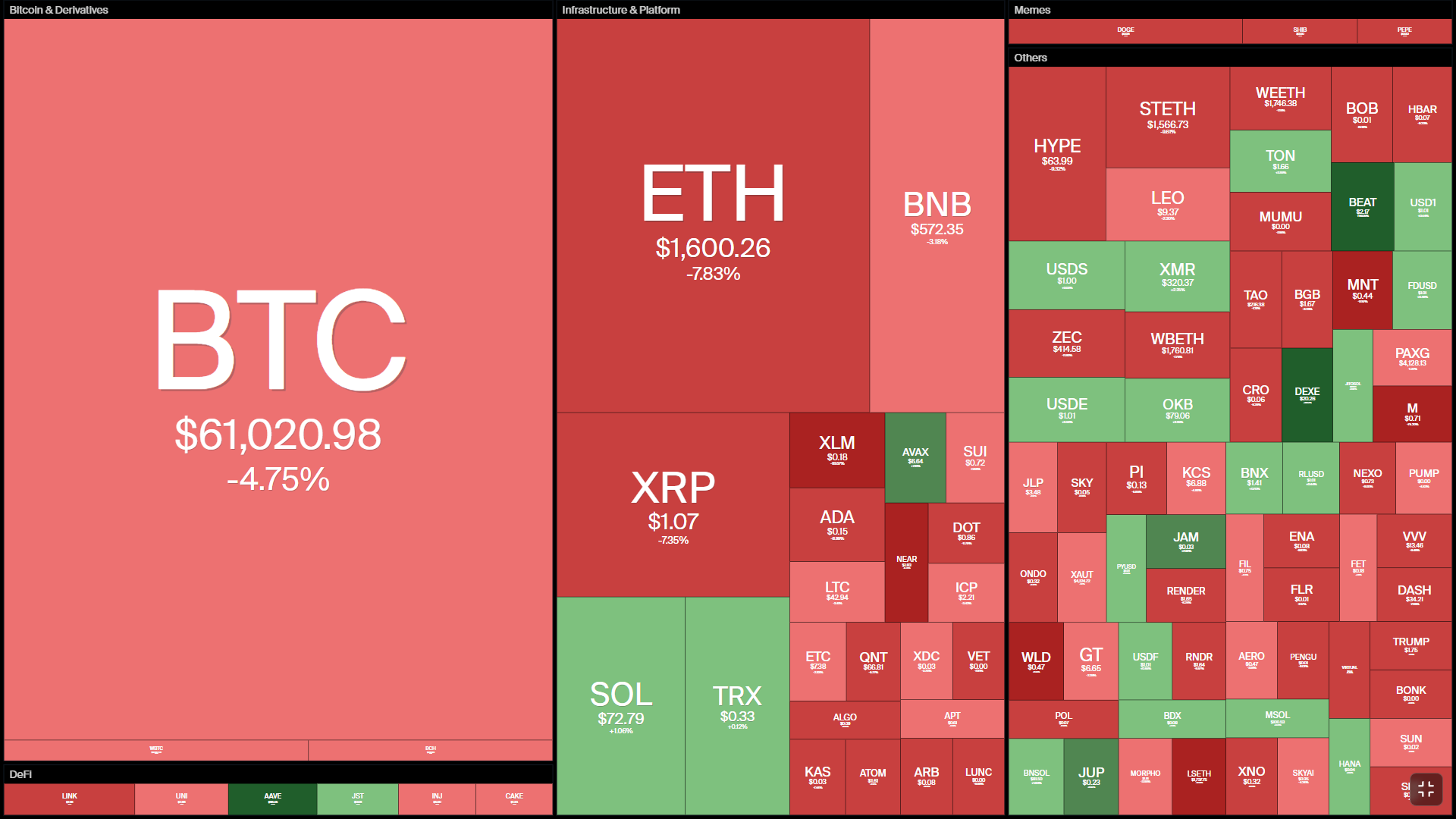
BTC and ETH ended the June 21–27 week under pressure at -4.75% and -7.83% respectively, with BTC price losing the $60,000 level on June 25 and ETH price underperforming as higher-beta crypto exposure was repriced. Spot ETF outflows, leveraged liquidations, and a large options expiry put fresh pressure on the market's strongest institutional trade.
The most important price-action event was BTC’s intraday drop toward $58,000 after the $60,000 break, marking its 20-month low since October 2024. Market structure made the move sharper, as negative funding, rising open interest into falling prices, and approximately $1 billion in reported liquidations showed forced positioning rather than calm revaluation.
Crypto-Native Fundamentals
U.S. spot BTC ETFs recorded net outflows on every trading day from June 22–26, totaling roughly $1.79 billion, while ETH ETFs lost about $273.34 million across the same window. On-chain data also showed stress moving deeper into holder cohorts, with 10.83 million BTC reportedly held at a loss after the break below roughly $59,100.
Ethereum also absorbed a crypto-native shock: on June 23, the Ethereum Foundation announced it had eliminated roughly 20% of its approximately 270-person workforce, and cut its 2026 operating budget by 40%, reorganizing the remaining organization into five domain-focused clusters. ETH price fell 5% on June 23 following the announcement.
Macro Context
The primary macro driver for the week was not new — it was the shadow of the June 16–17 FOMC meeting, where under new Chair Kevin Warsh, the Federal Reserve held the federal funds rate steady at 3.50%–3.75%, but the real market-moving news came from the updated dot plot: the median year-end rate projection jumped to 3.8% from 3.4% in March, effectively eliminating expectations for rate cuts in 2026 and replacing them with the possibility of rate hikes.
Bitcoin slipped below $59,000 after May PCE inflation came in at 4.1% year-over-year. However, since it came in as expected rather than hotter, markets are pricing in an 80% chance of a Fed rate hike in December following last week's hawkish pause, while the probability of a September increase stands at around 63%, down from 68% before the PCE release.
Geopolitically, the US-Iran framework deal continued to evolve during the week, with the US military carrying out strikes on Iranian missile and drone storage sites during the weekend.
Cross-Asset Comparison
Risk assets were sold in unison. Gold dropped from above $4,100 to $3,964 by Wednesday — a seven-month low, as the week started with a global tech sell-off on Tuesday, plus a stronger dollar index and growing Fed rate hike concerns.
Gold declined 1.65%, the S&P 500 lost 1.78%, and the Nasdaq 100 fell 3.78%, showing that pressure extended across risk assets and defensive assets alike.
The sharpest weakness came from Asian equities, with the KOSPI down 9.45% and the Japan 225 down 3.06%. Against that backdrop, BTC’s decline was severe but not the worst cross-asset move, while ETH behaved more like high-beta risk exposure.
Regulation and Market Structure
Europe’s Crypto Industry Faces MiCA Deadline as Licensing Gap Widens
Europe’s crypto licensing split widened ahead of MiCA’s July 1, 2026 enforcement deadline, with unlicensed platforms required to wind down operations or secure CASP authorization. Only 216 of 3,167 previously registered VASPs had obtained authorization, while unauthorized firms faced onboarding restrictions, client notifications and AML obligations.
MiCA is framed as separating compliant firms from platforms at risk of losing access to EU users. Binance was highlighted as restricting services in several EU markets, while Ripple, Kraken, BitGo, Gate and Coinbase were positioned around compliance.
Corporate Treasuries, Protocol Economics and Institutional Crypto
Strategy Faces Pressure Over Bitcoin Losses and STRC Discount
Strategy faced pressure after CryptoQuant urged the company to pause Bitcoin purchases and rebuild cash reserves. STRC traded below par, dividend obligations rose, cash reserves fell, and CryptoQuant linked the situation to weaker dividend coverage and unrealized Bitcoin losses.
STRC confidence is reportedly tied to cash coverage rather than more Bitcoin accumulation. Strategy’s Bitcoin position was described as underwater, with CryptoQuant estimating a large cash reserve increase would be needed to restore 24 months of STRC dividend coverage.
Ethereum Foundation Cuts Staff After Budget Reset
The Ethereum Foundation cut 54 jobs, about 20% of its workforce, while reducing its annual budget by roughly 40%. The reset followed a mandate and treasury-policy process tied to a leaner operating model and lower long-term spending target.
The change matters because the Foundation is reorganizing work into focused clusters covering protocol, access, user, community and institutional layers. Vitalik Buterin acknowledged the cuts involved real losses, while the Foundation plans to move more work into the broader Ethereum ecosystem.
Grayscale Says Revenue-Producing Crypto Protocols Look Cheap
Grayscale said several revenue-producing crypto protocols appeared attractively valued as the CLARITY Act advanced through the U.S. legislative process. Its view focused on onchain applications generating protocol revenue while trading at relatively low trailing revenue multiples.
The article matters because Grayscale’s thesis depends on protocol revenue, low operating overhead and potential growth in tokenized assets and onchain finance. The regulatory catalyst remains unresolved, with final CLARITY Act language and passage timing still uncertain.
Strategy Adds Bitcoin as Bitmine Expands Ethereum Treasury
Strategy added 520 BTC for about $35 million, lifting its Bitcoin reserve to 847,363 BTC, while also raising its dollar reserve by $300 million to $1.4 billion. Bitmine bought 52,203 ETH for about $90 million.
The update matters because both companies continued building corporate crypto treasuries during weak market conditions. Bitmine’s purchase brought its holdings to 4.7% of Ethereum’s supply, leaving it 94% of the way toward its stated 5% target.
Franklin Templeton Launches Franklin Crypto After 250 Digital Deal
Franklin Templeton completed its acquisition of 250 Digital and launched Franklin Crypto as a dedicated active digital asset management division. The unit targets institutional clients seeking managed exposure to liquid cryptocurrency strategies.
The launch matters because it adds 250 Digital’s investment team and liquid crypto strategies to Franklin Templeton’s broader digital asset platform. The deal value, initial client commitments, fee structures, product timelines and vehicle formats were not disclosed.
We’ve launched the all-new COIN360 Perp DEX, built for traders who move fast!
Trade 130+ assets with up to 100× leverage, enjoy instant order placement and low-slippage swaps, and earn USDC passive yield while climbing the leaderboard. Your trades deserve more than speed — they deserve mastery.
Crypto Security and Federal Policy Timelines
Trump Quantum Orders Push Federal Post-Quantum Migration
President Donald Trump signed two executive orders setting federal deadlines for post-quantum cryptography migration and expanding U.S. quantum computing efforts. The orders do not directly regulate Bitcoin but put cryptographic security timelines into sharper focus.
The relevance to crypto comes from blockchain reliance on public keys, digital signatures and wallet control. Project Eleven CEO Alex Pruden said the orders could indirectly benefit crypto security work by accelerating practical post-quantum cryptography development and setting a regulatory tempo.
Stablecoin Settlement and Liquidity Infrastructure
Chainlink Joins Bank Project for Stablecoin FX Settlement
Chainlink joined Project Pangea, a bank-focused initiative testing stablecoin-based FX settlement between Europe and South Korea. The project involves Chainlink, FairSquareLab, UniKA and Qivalis, with Korean and European banking groups represented.
The initiative matters because it targets atomic payment-versus-payment swaps for euro- and South Korean won-denominated stablecoins. Chainlink’s Niki Ariyasinghe said participants are targeting compliant live transactions within 12 months, but the project remains a working group rather than a live payment network.
Spark, Uniswap Build Stablecoin FX Layer
Spark and Uniswap announced FX Layer, a stablecoin swap system seeded by Spark’s $150 million liquidity migration from its USDS ecosystem to Uniswap v4. The first pool is designed to support USDS, USDT and PYUSD.
The project matters because it targets stablecoin liquidity fragmentation rather than new token issuance. This happened amid cooling stablecoin search interest and slowing supply growth, while companies and protocols continued building backend systems for issuance, routing, liquidity and settlement.
U.S. Crypto Policy
Trump Delays CBDC Ban as Crypto Bill Faces Senate Deadline
President Donald Trump refused to sign a bipartisan housing bill carrying a four-year U.S. CBDC ban, delaying a crypto policy measure that had moved close to approval. The bill would block the Federal Reserve from issuing or creating a digital dollar until the end of 2030.
The delay matters because it also squeezes the Senate calendar for the CLARITY Act. The market structure bill had cleared key steps but remained stalled over ethics provisions tied to Trump-family crypto interests.
Crypto Companies, Funding and Market Infrastructure
BitGo Cuts Workforce as Stablecoin and AI Focus Sharpens
BitGo is cutting nearly 15% of its workforce after going public, describing the move as a one-time reset focused on security, trading, stablecoins, settlement and AI-powered infrastructure. The reduction was estimated at about 85 roles.
The cut matters because BitGo’s public-company operating model is being measured against revenue growth, margins and profitability. Exact affected departments, severance terms, office locations, completion status and updated post-layoff headcount were not provided.
Framework Ventures Raises $400M Fourth Fund
Framework Ventures raised $400 million for FVIV, its fourth fund, expanding its mandate across crypto, stablecoins, tokenization, AI, robotics, energy, fintech and other frontier technologies. The fund was described as oversubscribed and backed by a mostly institutional LP base.
The fund matters because Framework is widening beyond its crypto roots without dropping digital assets. FVIV can invest in private and liquid opportunities, including early-stage companies, liquid digital assets and select publicly traded securities.
MoneyGram Becomes Solana Validator
MoneyGram became an active Solana validator on June 22, 2026, staking SOL, processing transaction blocks and joining the Solana Developer Platform. The move extends its blockchain payments strategy from using crypto rails to helping operate network infrastructure.
The step matters because MoneyGram has also launched MGUSD, a dollar stablecoin built natively on Stellar. Its blockchain strategy now spans customer-facing stablecoin products, developer tools and validator operations.
ICE, OKX Form Tokenized Markets Venture
Intercontinental Exchange and OKX are forming a joint venture focused on tokenization, digital asset infrastructure and regulated market access. The plan aims to connect OKX users with ICE futures and NYSE tokenized equities markets.
The venture matters because regulatory approval remains required, so it is not a live product launch. Specific details on product structure, blockchain systems, settlement, custody, token standards, issuer framework and compliance workflow were not disclosed.
Kalshi Seeks $40B Valuation After Recent $1B Raise
Kalshi is reportedly discussing a new funding round at about a $40 billion valuation after disclosing a $1 billion Series F round at a $22 billion valuation. The talks could close as soon as the third quarter of 2026, while Kalshi declined to comment.
The potential raise matters because Kalshi has reported rapid growth, including more than $2 billion in annualized revenue and $178 billion in annualized trading volume by April 2026. Legal fights over sports prediction markets remain unresolved across states, courts, the CFTC and CME.
Top Weekly Altcoin Gainers and Losers
Gainers:
DeXe DEXE (+32.05%)
Aave AAVE (+29.42%)
Jupiter JUP (+14.13%)
Jito JTO (+13.10%)
Avalanche AVAX (+6.83%)
Losers:
MemeCore M (-74.95%)
Worldcoin WLD (-22.59%)
Stellar XLM (-18.76%)
Mantle MNT (-17.95%)
Sky SKY (-16.09%)
This article has been refined and enhanced by ChatGPT.


