




 USD
USDCrypto Cards Drive Stablecoin Spending Through Visa Networks


Consumer stablecoin payments expand as card giants capture growing transaction flow
TL;DR
- Crypto-card payment volume climbed sharply since 2025 as stablecoins gained wider everyday payment use.
- Visa processes about 90% of crypto-card transactions tied to stablecoin spending.
- Stablecoins are increasingly moving through existing card infrastructure instead of bypassing it.
Trade smarter on Jupiter, Solana’s leading DEX built for fast execution and deep liquidity.
Swap tokens at competitive rates, route across multiple liquidity sources automatically, and access perpetuals, DCA, and advanced trading tools — all in one place!
Crypto-linked debit and credit cards are turning stablecoin balances into mainstream payment tools, with crypto-card payment volume reaching record levels as Visa emerged as the dominant network handling transactions tied to consumer stablecoin spending.
The Kobeissi Letter said crypto-card payment volumes reached $7.8 billion, while monthly volume increased 230% since May 2025. Stablecoins are increasingly being used through card-linked products that convert crypto balances into fiat at checkout, allowing consumers to spend digital dollar balances through existing merchant infrastructure.
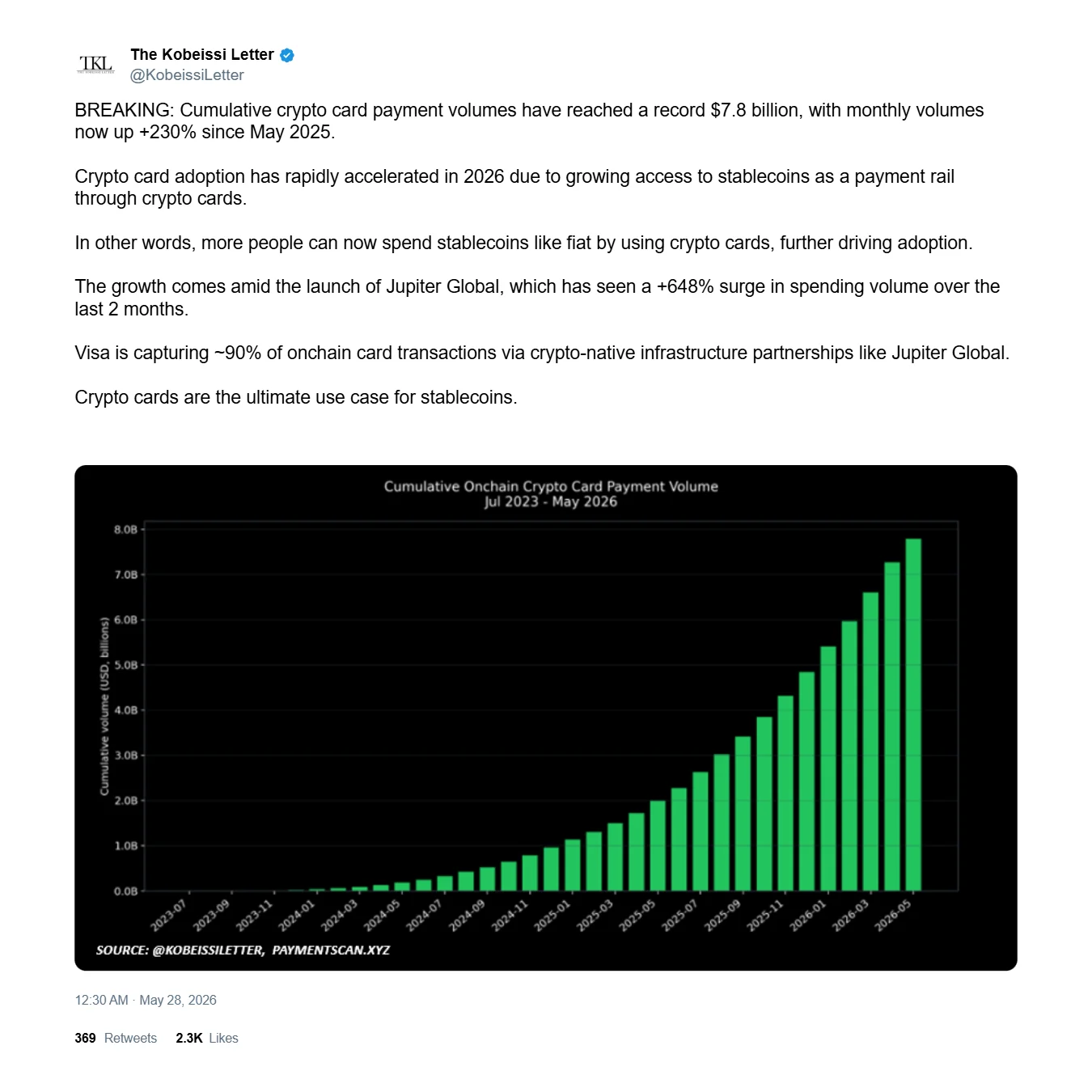
Separate transaction data showed crypto-card spending reached about $600 million per month, with $7.2 billion in cumulative on-chain card volume across 24 million transactions and 1.36 million wallets.
Visa processes about 90% of crypto-card transactions tied to stablecoin spending. USDT accounted for 62.5% of settled crypto-card volume, while Jupiter Global’s USDC-backed card recorded 660% month-over-month growth.
The Jupiter Card operates as a Visa debit card backed by USDC balances. Users deposit USDC, balances convert into U.S. dollars behind the card, and merchants receive fiat payments through standard payment terminals.
Visa also integrated with Jupiter Global from the Jupiter DEX on Solana, allowing users to spend liquidity directly through payment terminals without requiring merchants to accept stablecoins.
Stablecoins expand through existing payment infrastructure
Visa’s merchant acceptance network spans more than 175 million merchant locations. Existing compliance systems, fraud protections and checkout infrastructure allow stablecoin-linked cards to function through conventional payment systems instead of replacing them.
Bridge-enabled Visa stablecoin cards launched across 18 countries in March 2026, with expansion planned to more than 100 countries by the end of 2026. Argentina, Colombia and Mexico were among the first launch markets, with additional expansion planned across Asia-Pacific, Africa and the Middle East.
Phantom and MetaMask are distributing stablecoin-linked card products tied to existing payment rails. Consumers can spend stablecoin balances without requiring merchants to directly support crypto payments.
Visa’s stablecoin settlement pilot reached a $7 billion annualized run rate as of April 29, 2026, up 50% quarter over quarter across nine blockchains. Visa reported $14.2 trillion in payment volume during FY2025.
OKX transaction data showed grocery purchases accounted for about 26% of stablecoin-card transactions on its Europe Mastercard-linked card during January. Restaurant spending represented 18% of transaction volume, while online shopping represented 13%.
Stablecoin-linked card spending reached $4.5 billion during 2025, increasing 673% from 2024. McKinsey estimated B2B stablecoin payments at about $226 billion annually, representing roughly 60% of global stablecoin payment volume.
We’ve launched the all-new COIN360 Perp DEX, built for traders who move fast!
Trade 130+ assets with up to 100× leverage, enjoy instant order placement and low-slippage swaps, and earn USDC passive yield while climbing the leaderboard. Your trades deserve more than speed — they deserve mastery.
Stablecoins pressure banking and cross-border finance
Stablecoins are exerting greater pressure on correspondent banking, remittance infrastructure, FX intermediaries and bank deposits than on retail card networks.
Consumer stablecoin payments still move through Visa or Mastercard checkout infrastructure, while direct cross-border stablecoin settlement can bypass traditional banking intermediaries entirely.
Stablecoins also allow users to hold dollar balances outside traditional bank deposits. ECB officials warned stablecoins could weaken deposit stability, reduce bank-lending capacity and complicate interest-rate transmission.
Euro stablecoins account for 0.3% of total stablecoin supply.
Standard Chartered projected stablecoin supply could reach $2 trillion by the end of 2028. JPMorgan projected about $500 billion.
Current penetration rates would imply about $45 billion in annual crypto-card volume under the higher stablecoin-supply projection and about $11 billion under the lower projection.
A higher-adoption scenario involving expanded rewards programs and broader global rollout could push annual crypto-card spending toward $90 billion.
Mastercard announced plans to acquire BVNK for up to $1.8 billion. Mastercard also said consumers can spend stablecoins across more than 150 million Mastercard merchant locations.
A lower-growth scenario outlined for crypto-card spending projected annual growth slowing to about 25% as rewards normalize and compliance requirements tighten. That scenario would place annual crypto-card volume near $9 billion, with Visa’s market share moving toward 75%.
A higher-growth scenario projected annual crypto-card spending reaching about $18 billion, with about $16 billion routed through Visa-linked payment infrastructure.
FAQ
Why are crypto cards growing?
Stablecoins make crypto balances easier to spend without exposing merchants to direct token acceptance.
Which network dominates crypto-card transactions?
Visa processes about 90% of crypto-card transactions cited in the files.
What stablecoin leads settled crypto-card volume?
USDT accounts for 62.5% of settled crypto-card volume in the cited dataset.
Is Mastercard competing in stablecoin cards?
Yes. Mastercard is expanding stablecoin infrastructure and plans to acquire BVNK for up to $1.8 billion.
This article has been refined and enhanced by ChatGPT.


