




 USD
USD
CLARITY Act Faces Senate Vote as Final Draft Draws Broad Pushback

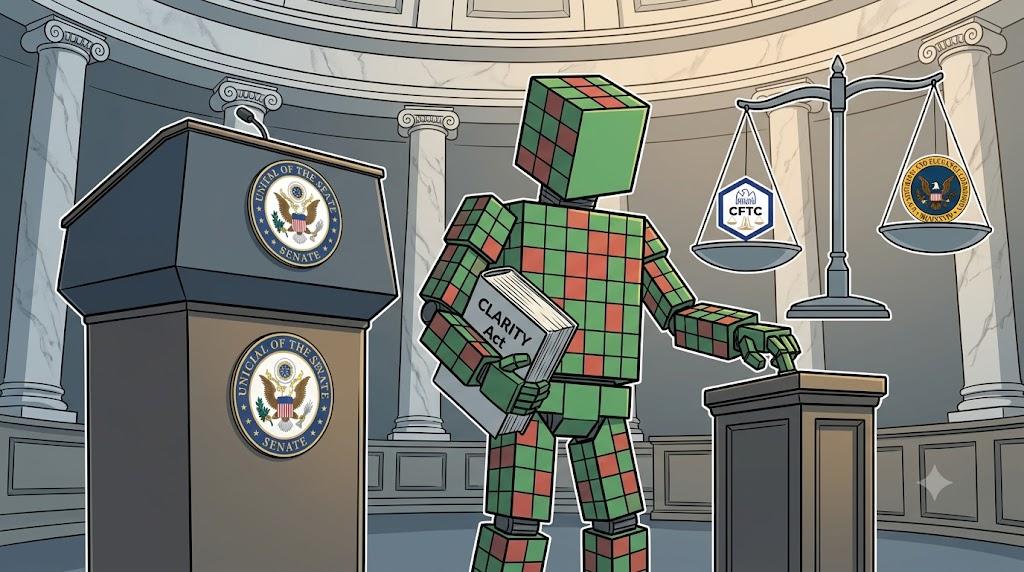
Ethics, stablecoin rewards, state enforcement and developer protections remain central disputes
TL;DR
- The Senate is set to hold a procedural vote on the CLARITY Act on September 15, 2026, after Republicans released a final draft exceeding 600 pages.
- The revised bill seeks to address disputes over President Donald Trump’s crypto interests, stablecoin rewards and software developer protections, but Democrats, banks and state attorneys general remain opposed to key provisions.
- The legislation needs 60 Senate votes to advance before an amendment process and additional votes, with enactment prospects still uncertain.
Trade smarter on Jupiter, Solana’s leading DEX built for fast execution and deep liquidity.
Swap tokens at competitive rates, route across multiple liquidity sources automatically, and access perpetuals, DCA, and advanced trading tools — all in one place!
The U.S. Senate is set to decide whether to advance the Digital Asset Market Clarity Act on September 15, 2026, after Republicans released a final draft that attempts to resolve major disputes over government ethics, stablecoin rewards and software developer protections. The procedural cloture vote is the legislation’s first full-Senate test and will determine whether lawmakers move into the next stage of consideration, where amendments and additional votes would follow.
Senate Republicans released the revised text late September 13 after months of negotiations over a bill intended to establish a comprehensive federal regulatory structure for the crypto industry. The legislation would give the Commodity Futures Trading Commission broader authority while also assigning jurisdiction to the Securities and Exchange Commission. The House passed its version more than a year earlier, but Senate negotiations repeatedly stalled over stablecoin rewards, software developer protections and ethics requirements.
Sen. Cynthia Lummis, R-Wyo., one of the bill’s central negotiators, urged lawmakers to advance the legislation. “The Clarity Act is right in front of us and this moment won’t come along again for years,” Lummis said. “Let’s take the win and get this done.”
Lummis traced the effort back to the Responsible Financial Innovation Act she developed with Sen. Kirsten Gillibrand in 2022. She said support for the legislation had expanded beyond crypto companies to institutions including Goldman Sachs and Fidelity, along with the National Fraternal Order of Police and the National Sheriffs’ Association.
The final draft incorporates extensive changes sought during negotiations. One characterization said it included 126 Democrat-pushed revisions, while another said it incorporated more than 100 changes requested by Democrats. White House crypto adviser Patrick Witt separately said Republicans had granted as much as 95% of requests from Democratic negotiators.
Lummis nevertheless accused some Democrats of continuing to raise new objections after receiving concessions. She said some lawmakers “simply won't get to yes, no matter what we put in the text,” and said Trump had agreed to “two historic ethics provisions” requested during the negotiations.
Republicans cannot advance the measure alone under the cloture threshold. One calculation said seven Democrats would be needed for the bill to move forward, while Republican Sens. Susan Collins and John Cornyn were also described as apparently undecided ahead of the vote.
TD Cowen’s Washington Research Group, led by managing director Jaret Seiberg, assigned a 25% probability that the legislation would become law during 2026. Seiberg cautioned against treating the Sunday draft as a completed bipartisan agreement. “This is not a negotiated deal. Democrats are being presented with the final product,” he said.
Even a successful cloture vote would not complete Senate consideration. Senators would move into a potential amendment period before additional votes, and final Senate approval would send the legislation back to the House. The House is not expected to be in session during the final two weeks of September and may not return before the November midterm elections, leaving possible final action for a post-election lame-duck session.
House Majority Whip Tom Emmer argued that lawmakers should move forward despite disagreements over the final language. “We can't afford to lose another year,” Emmer said, adding that even if lawmakers do not support every provision, “we've gotta get this thing done.”
Trump ethics language remains a central Democratic objection
The most politically contentious revisions concern Trump’s crypto-related business interests and the enforcement of conflict-of-interest rules. Trump’s crypto-linked wealth was described as reaching hundreds of millions of dollars through interests associated with World Liberty Financial, which is run by his sons, and his TRUMP memecoin.
An earlier July compromise would have prohibited covered public officials or employees and their spouses from issuing or sponsoring digital assets, but enforcement would have rested primarily with the Justice Department. Democrats objected to placing enforcement authority over the president within the executive branch.
The newest version gives state attorneys general a role in enforcing conflict-of-interest requirements and broadens restrictions covering public officials, including the president. Lummis said the rules would prohibit covered officials from sponsoring digital assets and could require them to divest digital-asset holdings or place them into a blind trust.
“If my Democratic colleagues are truly concerned about the president’s crypto investments, then passing this bill — not blocking it — is the way to address that,” Lummis said.
Witt said White House officials met with Trump on the Friday before the revised draft was released and discussed additional ethics restrictions. According to Witt, Trump accepted limits that could require investments to be moved into blind trusts and provide states with certain enforcement powers after being advised that the provisions could not be “weaponized” against him.
Witt said Trump personally approved the revised language and called the provisions “historic and unprecedented provisions.” He also said Democrats should recognize the scale of the concession: “I wouldn't want to be a Democrat that votes against these.”
Witt called the language the “strongest provision that would exist in federal ethics law.” The framework applies beyond the president, covering the vice president, members of Congress and federal judges.
State attorneys general, however, would not simply gain direct authority to prosecute federal officials under the revised structure. Witt said the framework would instead provide state officials with powers involving entities such as crypto exchanges listing prohibited assets and would allow legal action involving the U.S. attorney general.
Democratic staff on the Senate Banking Committee argued that the structure still left Trump’s political appointees with too much control over enforcement. “The bill contains only an empty provision allowing states to sue the Attorney General to try to force him to act,” they said. “It then allows Trump’s own Office of Government Ethics (OGE)—currently led by his hand-picked Acting Secretary of Labor—to issue a legal opinion unilaterally shutting down that lawsuit.”
Sen. Elizabeth Warren also rejected the ethics compromise, arguing that it would not adequately restrict Trump’s crypto interests. “We got the details of President Trump and Republicans’ quote ‘final offer’ on ethics, and it reads exactly like what you expect the most corrupt President in our history to bless: a weak fig leaf that will do nothing to stop him from making his next $1.4 billion in crypto profits,” Warren said.
Sens. Ruben Gallego and Angela Alsobrooks had previously said they would not support the CLARITY Act without adequate ethics language. Sen. Mark Warner also said the revised language remained insufficient. “There's been some movement. I don't think the ethics provision is near enough,” Warner said. “And again, it's frustrating because we've had these same three issues outstanding for six, eight weeks, and why this couldn't have been dealt with earlier? I’m really concerned.”
Democratic negotiators continued working on an alternative. Negotiators met in Senate Democratic Leader Chuck Schumer’s office on September 14, and Sen. Raphael Warnock said Republicans would receive a Democratic counteroffer that night.
Witt argued that any remaining resistance was increasingly political rather than substantive. “Whether or not we get 60 votes is going to be a political calculation, not a policy calculation because this truly is a bipartisan bill that is worthy of support,” he said.
He described the Republican proposal as the “best and final offer,” arguing that the White House and Republican negotiators had addressed the principal policy concerns raised during the process.
Banks reject stablecoin circuit breaker as insufficient
The revised CLARITY Act also attempts to resolve a long-running dispute over stablecoin rewards by giving the Treasury secretary authority to impose an 18-month “circuit breaker” if payment stablecoins cause substantial deposit outflows from community banks.
Treasury Secretary Scott Bessent said he would use that authority if necessary. “If stablecoins cause harm to community banks, I will not hesitate to use these tools to ensure they remain fully protected,” Bessent said. “Community banks are essential to U.S. economic performance and Main Street growth.”
Eight banking trade organizations, including the American Bankers Association, Bank Policy Institute and Independent Community Bankers of America, opposed the approach on September 14. The groups argued that Treasury intervention would occur only after substantial deposit flight had already taken place.
The banking organizations said the current drafting leaves potential pathways for stablecoin products to provide the economic equivalent of deposit interest. Their letter cited “critical concerns raised by banks of all sizes regarding the risk of deposit flight and diminished credit and lending associated with permitting yield on payment stablecoins.”
“The way the current legislative text is drafted provides loopholes and avenues for the prohibition to be easily evaded that would still allow interest and interest-like payments to be made on stablecoin balances,” the groups said.
The banking coalition called for the law to prohibit rewards and incentives that operate like deposit interest before harm occurs rather than rely on an emergency response. “Congress should address this risk upfront by ensuring the Clarity Act prohibits payment stablecoin rewards and incentives that function like deposit interest, rather than waiting for harm to banks, borrowers and communities before regulators are empowered to respond. Further technical refinements are needed to ensure that the text clearly and directly prohibits interest-like payments on payment stablecoins,” the groups said.
The organizations also framed their requested changes as compatible with digital-asset development. “With the targeted changes described above, we believe that this innovation can be pursued while also protecting the ability of banks to continue providing credit for America’s consumers, small businesses, and communities,” their letter said.
Witt rejected the banks’ core argument, calling concerns about stablecoin rewards driving deposit flight an “entirely hypothetical and speculative concern.”
“What more do you want?” Witt said after pointing to the new Treasury authority and the negotiations preceding the final draft. “If you oppose the Clarity Act because you just hate crypto, that's fine. Just say that.”
Developer protections were narrowed in final negotiations
Software developer protections remain another unresolved dispute. The Blockchain Regulatory Certainty Act is intended to create a civil safe harbor for non-custodial or non-controlling developers and clarify that developers who do not take control of customer funds are not automatically treated as money transmitters.
The revised text narrows money-transmission registration requirements for certain software developers and provides a civil safe harbor, but removes references to a federal criminal statute that had been part of protections against criminal prosecution.
Coin Center said the broader BRCA framework still represented progress but “stops short of resolving the essential criminal law issue” moving through the courts.
A crypto industry source said, “We are obviously very disappointed that critical protections for noncontrolling developers from misapplication of criminal law were removed.” Asked whether the issue warranted delaying the broader legislation, the source said “tbd,” while experts reviewed the revised wording.
A second crypto industry source took a different view, saying the industry disliked the revision but “we have to live with it.”
Emmer, an original cosponsor of the developer legislation, also raised concern about losing what he characterized as a criminal-law “safe harbor.”
Witt defended the remaining protections as “robust” and said the revisions reflected negotiations involving Sen. Catherine Cortez Masto, D-Nev. The final bill also adds Agriculture Committee guardrails governing affiliate trading and conflicts of interest.
State attorneys general warn federal preemption could weaken fraud enforcement
A separate bipartisan challenge comes from state attorneys general, led by New York Attorney General Letitia James, who urged senators to reject the bill over concerns that it would weaken states’ securities-registration and anti-fraud powers.
The coalition sent its letter to Senate Banking Committee Republican Chair Tim Scott and top Democrat Elizabeth Warren on September 14.
James said the bill would “muddy the waters” for state enforcement and potentially impair efforts to pursue crypto-related scams. “As written, the Clarity Act would embolden scammers and potentially strip attorneys general of our authority to protect our states’ investors and their wallets,” James said. “Together with my attorney general colleagues, I urge Congress not to pass the Clarity Act.”
The attorneys general specifically objected to provisions they said would allow the SEC to “preempt state registration authorities,” warning that the scope of federal preemption could generate legal challenges to state enforcement powers.
“This unprecedented grant of authority would not only apply to digital assets but would also broadly grant unilateral discretion to SEC to reset the scope of federal preemption, potentially upending the state securities regulatory regime,” the New York attorney general’s office said.
James had previously urged Congress to strengthen the legislation’s treatment of state authority, anti-money-laundering controls and ethics protections. Attorneys general from California, Illinois, Arizona, Kansas, Ohio and Wisconsin were among those identified as signing the latest letter.
James cited FBI data showing $11.4 billion in crypto-related fraud losses during 2025, up 22% from the previous year. States have brought more than 330 anti-fraud enforcement actions since 2017.
Banking groups and state attorneys general had raised substantially similar concerns with the Senate in July 2026, underscoring that the final-week objections reflect disputes that remained unresolved through months of negotiations.
Lummis warns rejection could push crypto business overseas
Lummis argued that blocking the legislation would not cause the crypto industry to “evaporate” but would instead push companies, capital and employment toward jurisdictions she identified as London, Singapore or Abu Dhabi.
She said such a shift could reduce U.S. regulatory reach over the industry and weaken authorities’ ability to prevent another FTX-like incident. Lummis also argued that offshore activity could create additional openings for foreign adversaries using crypto-related loopholes for money laundering.
“It is time for Democrats to put their money where their mouth is and join us in passing the Clarity Act… Let’s pass the Clarity Act now,” Lummis said.
Witt made a similar broader policy argument for federal legislation. “This bill is worth supporting; It's a bipartisan bill. We're trying to rectify a mistake that was made, which was trying to kill this industry,” he said.
Failure in Congress would not end federal crypto policymaking, Witt said. He pointed to existing authority held by the SEC and CFTC and said both agencies had “robust” rulemaking agendas.
“The agencies already have tremendous rulemaking authority,” Witt said. He added: “They've got a job to do one way or the other. There's still good news coming for the industry.”
The September 15 vote will therefore determine whether the Senate moves forward with the current compromise rather than settle the underlying policy disputes. A successful cloture vote would open the amendment process and further Senate votes before the legislation could return to the House.
This article has been refined and enhanced by ChatGPT.


