




 USD
USDCFTC Targets Prediction Markets as Kalshi Tightens Trading Controls

Kalshi perps hit major volume milestone while employment checks begin
TL;DR
- CFTC proposed new prediction-market rules as Kalshi expanded regulated perps.
- Kalshi began requiring employment disclosures for higher-risk markets.
- Kalshi said its perps crossed $1 billion in volume before public launch.
Trade smarter on Jupiter, Solana’s leading DEX built for fast execution and deep liquidity.
Swap tokens at competitive rates, route across multiple liquidity sources automatically, and access perpetuals, DCA, and advanced trading tools — all in one place!
Kalshi is expanding quickly in regulated prediction markets while the CFTC moves to define which event contracts can trade under federal law, with new rules proposed on June 10, 2026, and Kalshi introducing employment checks for traders in higher-risk markets.
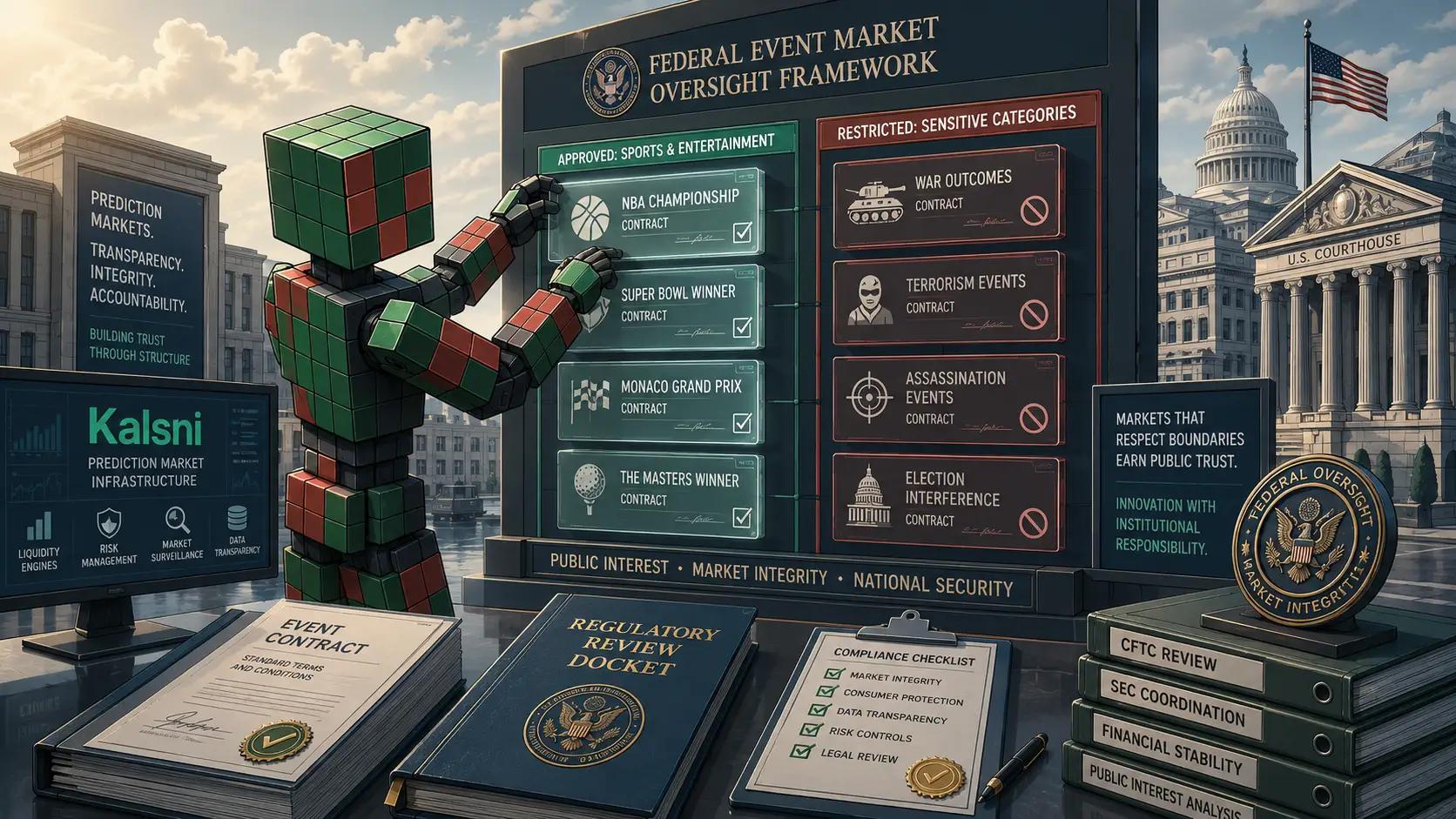
The CFTC proposed a rule package to clarify how federally regulated prediction-market contracts should be reviewed. The proposal supports a framework that lets some markets proceed while setting tighter scrutiny for contracts tied to terrorism, assassinations and war. Sports-related event contracts received a more favorable treatment, even as state regulators continue to argue that some prediction-market products resemble sports betting under local gaming laws.
Prediction markets allow users to trade on real-world outcomes, including tariff rates, elections, economic data, corporate developments, political events and entertainment outcomes such as which couple wins Love Island USA. The category gained major attention during the 2024 elections and is now described as being worth “tens of billions of dollars each,” making regulatory treatment more urgent as platforms grow.
CFTC Chair Michael Selig said the agency is trying to protect market integrity without blocking legitimate growth. “The CFTC will protect the integrity of our regulated markets without standing in the way of responsible innovation,” Selig said, adding that the proposal gives the Commission “a durable, transparent framework to identify the contracts Congress directed us to scrutinize while letting legitimate markets move forward.”
CFTC Draws Lines Around Sensitive Event Contracts
The proposed rule takes a different approach from an earlier Biden-era effort that had proposed restricting event contracts tied to gaming, war, terrorism and assassination because such contracts could be “contrary to the public interest.” That earlier proposal was scrapped earlier in 2026, leaving the new 267-page proposal as the agency’s latest attempt to define which contracts should face extra review.
The CFTC gave a terrorism-related example involving a contract asking whether the “Islamic State conducts an armed attack causing more than ten civilian deaths in Baghdad during June 2026.” The agency contrasted that with a contract asking whether the Transportation Security Administration implements better screening at certain airports, which the proposal said would not involve terrorism.
Sports contracts remain a major dividing line. The CFTC said those markets are not likely to “raise public interest concerns.” The agency also said, “The Commission observes that prediction markets have successfully listed for trading a wide variety of event contracts based on sports activities,” and added that certain characteristics of sports-related contracts would reduce the basis for finding them contrary to the public interest.
Selig, who was tapped by President Donald Trump to lead the CFTC, has asserted federal jurisdiction over prediction markets, including by challenging states in court. Trump has backed that approach, calling it “critically important” for the CFTC to have exclusive jurisdiction over prediction markets. Donald Trump Jr. is connected to the sector through an investment in Polymarket via venture capital firm 1789 Capital and also serves as a strategic advisor to Kalshi.
The CFTC released guidance in March 2026 outlining how exchanges should approach listing prediction-market contracts. The guidance emphasized that designated contract markets are the front-line regulators responsible for ensuring listed contracts are “not readily susceptible to manipulation” or abusive trading practices. Selig later wrote on X, “Rest assured, this will not be the last prediction market rulemaking as the agency continues to balance market integrity with responsible innovation.”
We’ve launched the all-new COIN360 Perp DEX, built for traders who move fast!
Trade 130+ assets with up to 100× leverage, enjoy instant order placement and low-slippage swaps, and earn USDC passive yield while climbing the leaderboard. Your trades deserve more than speed — they deserve mastery.
Kalshi Adds Employment Checks for Higher-Risk Markets
Kalshi introduced mandatory employment verification for some traders, saying the policy applies to markets it considers likely to face higher risks of insider trading and abuse. The company said the changes take effect immediately and follow recommendations from an independent Surveillance Audit Committee that reviewed its enforcement systems, monitoring tools and trading controls.
“For markets with heightened insider or manipulation risk, we now collect employment information before traders can participate,” Kalshi said. The company said the screening process is designed to identify people who may have access to material nonpublic information tied to an event or outcome.
Insider trading has become a central concern for prediction markets. The Justice Department arrested an active-duty U.S. Army soldier in April 2026 for allegedly using confidential information to place bets on Polymarket ahead of former Venezuelan President Nicolás Maduro’s capture earlier in the year. The Justice Department and the CFTC are also reportedly investigating former Rep. George Santos after Kalshi found suspicious trades tied to his attendance at President Donald Trump’s February State of the Union address.
A Yale and London Business School paper analyzing Polymarket trades from 2023 to 2025 found that only 3% of traders accounted for most price moves. The same study highlighted the case of a U.S. Army Green Beret arrested over $400,000 in Polymarket bets tied to the Venezuela raid to extract then-President Nicolas Maduro, in which he allegedly participated. A month after that arrest, a Google engineer was also arrested for alleged insider trading on Polymarket.
Kalshi said it blocked more than 100 potential insider trades in the first quarter using new screening tools. The company also said it opened more than 150 investigations, referred more than 20 cases to law enforcement and issued five disciplinary actions. Kalshi did not provide details about those cases, and the figures could not be independently verified.
Kalshi also announced a risk-scoring system that evaluates markets based on insider-trading risk, market importance, regulatory concerns and national-security implications. Markets viewed as carrying elevated manipulation risks could face tighter controls or be rejected from listing altogether. The platform also added whistleblower reporting tools that allow users to flag suspicious activity directly from individual markets.
Tim Meggs, CEO and co-founder of LO, a transparent market data infrastructure firm, said prediction markets have grown so rapidly that questions about their integrity are no longer theoretical. “Kalshi's move to require employment verification, risk-scored markets, and whistleblower tools highlights how the sector is starting to build the surveillance infrastructure to match its ambitions,” Meggs said. “That maturation matters as much as the volume numbers.”
Kalshi Perps Cross $1 Billion Before Public Launch
Kalshi perps crossed $1 billion in trading volume just one week after debut. The milestone was presented as evidence of strong demand for regulated perpetual products in the U.S. market. Kalshi became the first regulated platform allowed to offer perps in late May 2026.
Perpetuals allow traders to speculate on price exposure without owning the underlying assets. Before Kalshi’s approval, there was no regulated way for U.S. traders to gain exposure to the sector. John Wang, Kalshi’s Head of Crypto, said the platform’s perps reached a scale that took its prediction markets much longer to achieve.
“Took 1 week for Kalshi Perps to get to $1B, and we haven't even launched publicly yet. Prediction markets took 3.5 years to get to $1B,” Wang said. Kalshi said there are 1 million users on the waitlist for its perps market, suggesting broader access could increase activity once public launch begins.
Kalshi’s competitive challenge is whether its regulated perps can take market share from Hyperliquid, a decentralized venue known for crypto and commodities perps through HIP-3. Analysts cited in the source material had speculated that U.S. users likely use VPNs to access Hyperliquid, while Kalshi offers a regulated domestic alternative.
The trade-off is compliance friction. Hyperliquid has no strict KYC requirements like Kalshi, while Kalshi plans to restrict access unless traders share employment information. Robert J. Denault, Head of Enforcement at Kalshi, said the company views identity collection and market surveillance as central to its model.
“Market integrity is a more than just a lofty goal for us. It’s the reason we collect identification info from every trader, why we surveil our markets 24/7, and why we continue to expand our capabilities to prevent, detect, and punish misconduct,” Denault said.
Kalshi currently has only BTC and LINK perps approved, while 12 other perps are in the pipeline. Hyperliquid still offers a broader range of crypto pairs and commodities. The broader perpetual market has cooled sharply, with sector volumes dropping to $174 billion from a $1.2 trillion peak last October.
FAQ
What did the CFTC propose?
A framework to clarify which prediction-market contracts can trade under federal law.
What did Kalshi change for traders?
Kalshi began requiring employment information before some users can trade higher-risk markets.
Why does employment data matter?
Kalshi said it helps identify traders with access to material nonpublic information.
Which Kalshi perps are approved?
BTC and LINK perps are approved, with 12 others in the pipeline.
This article has been refined and enhanced by ChatGPT.


