




 USD
USD
CFTC Crypto Market Rules Enter White House Review After CLARITY Act Setback

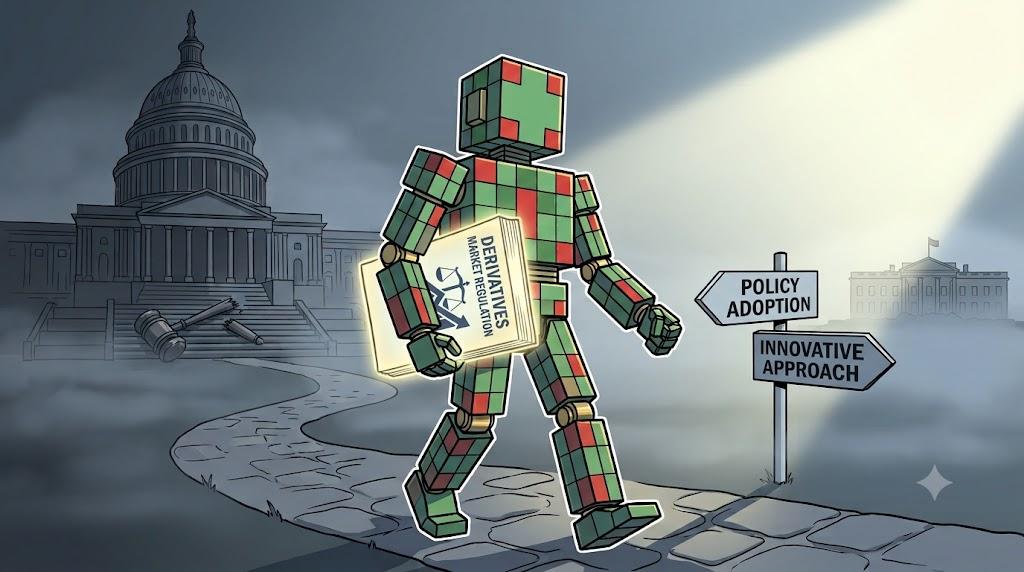
Regulators use existing authority as Congress stalls on broader digital-asset legislation
TL;DR
- The CFTC sent a crypto-market regulatory action to White House review after the Senate failed to advance the CLARITY Act.
- The action remains at the “prerule” stage and has not been formally proposed.
- CFTC Chair Michael Selig and SEC Chair Paul Atkins said their agencies would continue acting under existing authority.
Trade smarter on Jupiter, Solana’s leading DEX built for fast execution and deep liquidity.
Swap tokens at competitive rates, route across multiple liquidity sources automatically, and access perpetuals, DCA, and advanced trading tools — all in one place!
The U.S. Commodity Futures Trading Commission has moved a new crypto-market regulatory action into White House review as the agency pursues rules for digital-asset transactions and markets under its existing statutory authority following the Senate’s failure to advance the CLARITY Act.
The action, titled “Regulation Crypto Asset Transactions and Regulation Crypto Asset Markets,” was received by the Office of Information and Regulatory Affairs on September 17, 2026. OIRA lists the measure at the “prerule” stage, placing it early in the federal rulemaking process rather than at the stage of a formally proposed or final regulation. The review carries no legal deadline and is classified as not economically significant under the applicable Executive Order standard.
That classification generally applies to rules that are not expected to have an annual economic effect of $100 million or more or materially affect the economy, an industry sector, productivity, competition, employment, the environment, public health or safety, or state, local or tribal governments or communities.
The CFTC filing itself does not set out the substantive requirements of the planned regime. The regulatory process described for the action would send the draft back to the CFTC after White House Office of Management and Budget review for a Commission vote and public comment, followed by another vote before any rules could take effect.
CFTC prepares crypto market regime under existing authority
CFTC Chair Michael Selig had already outlined a possible path for agency action before the Senate setback. At the CFTC’s Innovation Advisory Committee conference on August 20, 2026, Selig said the agency was prepared to rely on its existing authority to establish a crypto asset market regime if the CLARITY Act stalled.
Selig said he had directed CFTC staff to consider rules allowing existing registrants and currently unregistered crypto exchanges to become a type of designated contract market called a “crypto asset market.” Under that structure, leveraged or margined crypto trading could be offered under CFTC oversight.
After the Senate vote, Selig said the agency was “locked in and ready to ship” crypto-market rules using its existing statutory authority. Another version of his statement quoted him as saying, “The CFTC is locked in and ready to ship its rules for the new frontier of finance.”
SEC Chair Paul Atkins likewise said the securities regulator would proceed “with or without legislation,” signaling that both federal market regulators intended to continue rulemaking and regulatory relief efforts despite the failure of Congress to advance the broader market-structure legislation.
Coinbase CEO Brian Armstrong also said regulators had sufficient authority to proceed. Armstrong wrote on September 15, 2026, that the SEC and CFTC had “the tools they need to create clear rules under existing authority” and said he expected the agencies to begin working on the issue “in earnest.”
“So clarity is coming to crypto regardless,” Armstrong wrote.
The chronology includes a timing conflict that should be preserved rather than reconciled. The Senate vote is identified as occurring on September 15, while another sequence describes Selig’s response as coming “following the vote on Wednesday” before subsequent agency actions. The dated agency actions that follow are identified separately below.
SEC opens temporary path for tokenized stock trading
The SEC moved forward with its own digital-asset initiative by issuing what Atkins called an “Innovation Exemption” for certain onchain tokenized-stock trading arrangements. The measure gives qualifying Tokenized Securities Venues, or TSVs, temporary conditional relief from the Exchange Act definition of an “exchange.”
Qualifying venues may facilitate onchain trading of certain tokenized National Market System stocks through permissioned automated market makers and liquidity pools. The exemption also provides conditional relief from the Exchange Act definition of “dealer” for some liquidity providers supplying tokenized NMS stock to those pools, including providers engaged in activities such as quoting prices to customers or committing capital.
The SEC’s conditions limit the number of stock symbols and trading volume that qualifying venues may handle. Tokenized NMS stocks must provide holders with the same rights and privileges as the corresponding traditional shares, while issuers must receive written notice and an opportunity to object when an unaffiliated third party tokenizes their shares.
Smart contracts used for qualifying tokenized stocks must be auditable and public and must operate on a public, permissionless distributed ledger. Venues must halt trading in a tokenized stock whenever trading in the underlying NMS stock is halted on its primary listing exchange and must publish disclosures covering their operations, trading activity and affiliate activity.
Atkins said on September 17, 2026, that the SEC was acting “within its statutory authority” to bring U.S. capital markets onchain. The exemption is temporary and conditional, with the relief set to expire five years after publication as the Commission considers more durable rulemaking.
CFTC extends relief to passive trading software providers
The CFTC also expanded regulatory relief for certain passive software providers that connect users to regulated derivatives markets. The agency’s Market Participants Division said staff would not recommend enforcement action against qualifying providers or relevant personnel for failing to register as an introducing broker or associated person of an introducing broker when all required conditions are satisfied.
The relief can apply to software interfaces, including some crypto-wallet interfaces, that allow users to view markets and submit orders directly to registered firms. Covered software may facilitate trading with registered futures commission merchants, introducing brokers and designated contract markets.
Qualifying software providers may market particular contracts and collect transaction-based fees while remaining eligible for the relief. Providers must remain passive, however, and cannot custody customer assets, generate buy or sell signals, or control how customer orders are routed or executed.
The no-action position also carries risk-disclosure, recordkeeping and applicable marketing-rule requirements. The treatment is intended to remain available until the CFTC adopts rules or guidance more directly addressing registration requirements for software developers.
The CFTC identified the broader passive-software position as Staff Letter 26-25. The agency said the approach was similar to relief previously issued through Staff Letter 26-09 but made the treatment available more broadly to qualifying providers.
Both the CFTC passive-software action and the SEC tokenized-stock exemption carry an explicit September 17 agency date. That creates another timing conflict with a description placing the CFTC no-action position on “Friday” and with a separate sequence saying both regulators acted “the following day” after Selig’s response to the Senate vote.
The CFTC’s White House submission, passive-software relief and the SEC’s temporary tokenized-stock framework represent separate regulatory actions. The broader CFTC crypto-market proposal remains in the early federal review process, while the agencies have already taken narrower steps under authorities they say are available without additional legislation.
This article has been refined and enhanced by ChatGPT.


