




 USD
USDCFTC Prepares Crypto Rules as CLARITY Act Faces Senate Test

Trump presses Congress while regulators develop an alternative market-structure path
TL;DR
- CFTC Chair Michael Selig said the agency is preparing crypto market-structure rules under existing authority if Congress fails to pass the CLARITY Act.
- President Donald Trump privately appeared “bullish” on the legislation after meeting crypto and traditional-finance executives at the White House.
- Ethics provisions, stablecoin rewards, illicit-finance concerns and the Senate vote threshold remain obstacles to passage.
Trade smarter on Jupiter, Solana’s leading DEX built for fast execution and deep liquidity.
Swap tokens at competitive rates, route across multiple liquidity sources automatically, and access perpetuals, DCA, and advanced trading tools — all in one place!
Commodity Futures Trading Commission Chair Michael Selig said the agency is preparing to establish a regulatory regime for crypto asset markets if Congress fails to pass the Digital Asset Market Clarity Act, while President Donald Trump is pressing lawmakers and industry executives to help move the legislation through the Senate. Selig said the CFTC would allow the bill time for a vote before moving swiftly on rules already being explored under the agency’s existing authority.
Selig laid out the fallback strategy on Aug. 20, 2026, during prepared remarks for the inaugural meeting of the CFTC’s Innovation Advisory Committee. He said the agency would continue working on crypto regulation even without congressional action and had already directed staff toward several initiatives, including market-structure rules, leveraged and margined crypto trading and protections for blockchain developers.
“We’re going to give CLARITY its breathing room for a vote, but if the Democrats cannot support a bipartisan work product, which reflects compromises from both sides of the aisle, and ultimately send a fair version of the bill to the President’s desk, then rest assured, I will direct CFTC staff to move swiftly to propose these new rules for the industry,” Selig said.
Selig said a Senate failure would prompt the CFTC to develop a “crypto asset market” regulatory category resembling the agency’s existing framework for designated contract markets, or DCMs. “To achieve this, I’ve directed the CFTC staff to begin exploring rules to codify a CFTC market structure for crypto assets using the agency’s existing authorities,” he said.
The CFTC chair also framed the fallback plan in explicitly political terms. “If Clarity continues to stall because of Democrat obstruction, the CFTC will utilize its existing authorities to begin establishing a regime for crypto asset markets,” Selig said. “We will heed President [Donald] Trump’s call to codify a future-proof digital asset market structure that cannot be undone by the crypto haters.”
Selig said staff had separately been directed to enable registered and non-registered entities to offer “crypto asset trading on a leveraged or margined basis.” He also instructed the agency to work with developers on regulations allowing them to “offer their protocols in a legal and compliant manner in the United States, future-proofing developer protections once and for all.”
Despite preparing an agency-led alternative, Selig said legislation remained the more durable route. “Passing Clarity is the surest way that we can prevent another Gary Gensler from running a rogue campaign of lawfare against the individuals and companies in this room today,” he said, referring to the former Securities and Exchange Commission chair.
SEC Chair Paul Atkins likewise emphasized legislation during a White House event with Trump. “The most important priority is for Congress to send the Clarity Act to your desk for your signature,” Atkins said. He has argued that legislation would provide greater permanence for crypto policy than regulatory action alone.
The SEC was also advancing its own rulemaking. The securities regulator proposed its first major crypto rule that week, known as Regulation Crypto Assets, aimed at allowing crypto startups and fundraising with fewer regulatory hurdles. The proposal could provide a safe-harbor policy shielding certain tokens from treatment as “investment contracts” and offer some exemptions for issuers.
The CFTC and SEC had previously issued a joint policy position defining different categories of digital assets and the regulatory buckets into which they should fall. That position was not adopted as a formal rule.
Senate passage still faces unresolved disputes
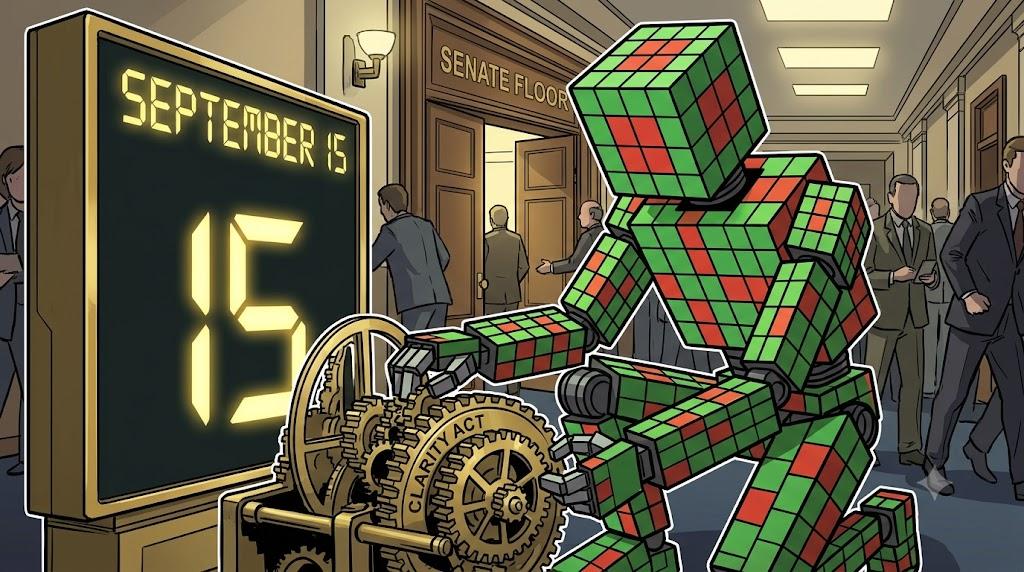
The CLARITY Act’s next major congressional test is scheduled for Sept. 15, when the Senate is expected to hold its first procedural vote on the legislation. The measure needs 60 votes to advance and would have to return to the House of Representatives before reaching Trump for final approval or a veto.
One assessment of the legislative calendar described a final three-week Senate window for the bill to secure the necessary support. Blockchain Association CEO Summer Mersinger separately referred to a five-week stretch between the filing of cloture and the eventual Senate vote as a critical period for the industry.
Several disputes remain unresolved. Lawmakers have been negotiating over stablecoin rewards and illicit-finance provisions, while questions surrounding Trump’s crypto interests have become a major ethics issue. His crypto wealth was described as having grown to hundreds of millions of dollars through interests linked to World Liberty Financial and his memecoin.
Trump agreed in July to an ethics provision barring public officials, government employees and their spouses from issuing or sponsoring digital assets. Enforcement under that version would rest with the Justice Department rather than state attorneys general, and the provision would expire in January 2029. Democrats criticized the language as insufficient.
Trump is also weighing a bipartisan proposal from Sens. Ruben Gallego, D-Ariz., and Thom Tillis, R-N.C. Their version would allow state attorneys general to enforce a prohibition on public officials and their spouses issuing or sponsoring digital assets. Whether the White House accepts that compromise has become one of the major outstanding questions around the legislation.
Trump said a “lot of Democrats” supported CLARITY, but the available information did not establish that enough senators had committed to passage.
Trump seeks industry feedback at White House
Trump’s legislative push intensified after a White House event on Aug. 19, 2026, followed by a smaller private Oval Office meeting with crypto and traditional-finance executives. During the public event, Trump called for a “fair version” of the CLARITY Act and said regulators were working to onshore Hyperliquid.
Trump also presented the legislation as part of a broader competitive strategy, urging Congress to act to keep the United States “ahead of China.”
A source familiar with the private Oval Office meeting said Trump was “bullish” about getting CLARITY done as the administration worked on a strategy to move the legislation through Congress.
Executives present at the preceding press conference included Nasdaq CEO Adena Friedman, Robinhood CEO Vlad Tenev, Kraken CEO Arjun Sethi, ICE CEO Jeffrey Sprecher, Coinbase CEO Brian Armstrong and Ripple CEO Brad Garlinghouse. The full attendance list for the subsequent Oval Office session was not established.
Chainlink co-founder Sergey Nazarov attended the private meeting and characterized it as productive. “The main discussion was really around Clarity and around just soliciting some basic feedback,” Nazarov said.
Nazarov said the conversation focused on the remaining legislative work and the senators whose support would be needed after lawmakers returned from recess. “What are the remaining open points? Who are the senators that need to come along? What’s the plan for when we get back from recess?” he said.
Nazarov said ethics was not discussed during the Oval Office session despite the issue’s importance to Senate negotiations. A strategic bitcoin reserve was raised, he said, though no next steps were provided during the discussion.
Trump’s existing reserve plan called primarily for using bitcoin already held by the U.S. government through criminal or civil forfeitures, alongside a separate digital asset stockpile.
Nazarov said the mix of traditional financial-market companies and crypto businesses at the White House was itself notable. “I think it’s notable that it wasn’t just startups and it wasn’t just institutions and it wasn’t just fintechs,” he said. “It was all the different groups together that matter.”
Mersinger said she was not part of the private Oval Office meeting, which she said consisted mostly of company CEOs, but pointed to the presence of Nasdaq and ICE alongside newer crypto markets at the broader event.
“So I thought it was a good kind of representation of where things are headed, where blockchain technology is really going to kind of be the underpinning of our markets going forward,” Mersinger said.
She also said the event increased momentum around the legislation. “It kind of brought additional energy to the industry that I think it needed going into this five-week stretch between when cloture is filed and when we are going to have a vote in the Senate,” Mersinger said.
Crypto Council for Innovation CEO Ji Kim also expressed optimism after the White House gathering. “What I’m seeing from my vantage point is a lot of important work being done,” Kim said. “People remain committed.”
Garlinghouse offered a similar public assessment. “This President’s incredible commitment to innovation and leadership around digital assets in the US has been profound,” he said in a post on X. “The future is bright.”
CFTC expands work beyond crypto market structure
Garlinghouse also addressed the Innovation Advisory Committee meeting, contrasting the current regulatory environment with the SEC’s previous approach.
“Ripple had the unfortunate reality of being at the center of the bullseye of the SEC’s lawfare in the previous administration,” Ripple Labs CEO Brad Garlinghouse said. “It suffices to say, my headline for today is: What a difference leadership makes.”
Garlinghouse said the earlier approach had pushed Ripple to hire and expand outside the United States. “I think we all can agree that the technologies represented at the tables here can make moving money faster, more efficient, and more accessible,” he said. “But we have to have clarity to unlock that potential responsibly.”
Former SEC Chair Gary Gensler repeatedly came up during the committee meeting as industry participants discussed the previous regulatory environment and the need for more durable rules.
Selig currently holds an unusually concentrated leadership position at the CFTC. He is the only Senate-confirmed commissioner serving on a commission designed to have five bipartisan members and has been solely responsible for directing the agency’s agenda since December.
Selig appeared at the committee meeting alongside Innovation Advisory Committee Chair Walt Lukken and Designated Federal Officer Michael Passalacqua. The committee also addressed artificial intelligence and prediction markets.
Prediction markets have become another major part of Selig’s agenda. The CFTC has asserted “exclusive jurisdiction” over the sector on the grounds that event contracts offered by the platforms qualify as “swaps.”
Selig has led litigation against state governments challenging that position, saying the CFTC intends to “defend our exclusive jurisdiction in court.” The disputes have involved companies including Kalshi and Polymarket.
The agency has already begun proposing prediction-market rules, and Selig said additional proposals are planned “to modernize the corporate rules and listing rules governing DCMs that list event contracts and institute consumer protection requirements.”
This article has been refined and enhanced by ChatGPT.


