




 USD
USDBitGo Cuts Workforce as Stablecoin and AI Focus Sharpens

Public crypto custodian moves to narrow priorities after listing
TL;DR
- BitGo is cutting nearly 15% of its workforce as it refocuses on security, trading, stablecoins, settlement and AI infrastructure.
- CEO Mike Belshe described the move as a one-time action, with no further reductions expected.
- The cut comes after BitGo’s public listing and amid questions over whether its revenue scale can translate into stronger profitability.
Trade smarter on Jupiter, Solana’s leading DEX built for fast execution and deep liquidity.
Swap tokens at competitive rates, route across multiple liquidity sources automatically, and access perpetuals, DCA, and advanced trading tools — all in one place!
BitGo is reducing nearly 15% of its workforce after going public, positioning the move as a one-time reset to focus the crypto custodian on security, trading, stablecoins, settlement and AI-powered infrastructure.
The timing places the cuts in BitGo’s first year as a public company, where its operating model is being measured against revenue growth, margins and profitability.
Mike Belshe, BitGo’s CEO, described the layoffs as a one-time action and said the company does not expect further reductions. Belshe said the ecosystem has changed and that BitGo needs to concentrate people and energy on fewer priorities. “To keep winning for our clients, we need to be sharper, more focused…” Belshe said.
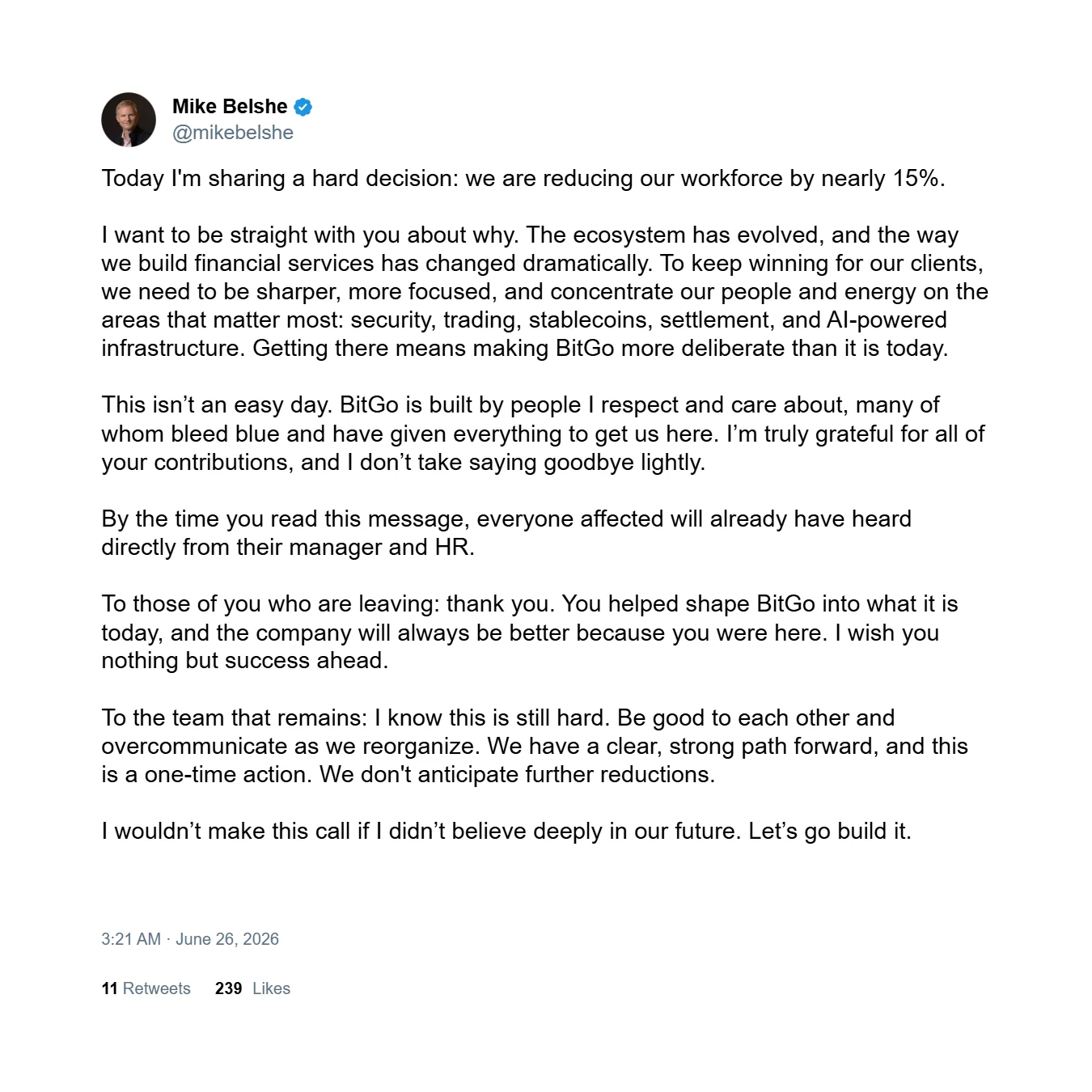
The reduction is estimated to affect about 85 roles, based on a headcount of about 565 full-time employees as of mid-2025. No department-by-department breakdown was provided.
We’ve launched the all-new COIN360 Perp DEX, built for traders who move fast!
Trade 130+ assets with up to 100× leverage, enjoy instant order placement and low-slippage swaps, and earn USDC passive yield while climbing the leaderboard. Your trades deserve more than speed — they deserve mastery.
Public listing raised pressure on margins
BitGo went public in January 2026 under the ticker BTGO, making the job cuts notable because they follow the company’s move into public-market scrutiny. BitGo priced its public-market debut at $18 per share in January, and the IPO raised $212.8 million while valuing the company at about $2.08 billion. The company listed on the NYSE under BTGO.
BitGo was named to the 2026 Fortune 500 in June 2026, debuting at No. 273 with $16.2 billion in 2025 revenue. The ranking showed the company had reached mainstream corporate scale, while the workforce reduction placed renewed attention on whether that scale could support stronger earnings.
The company’s 2025 results showed the tension between revenue and profitability. BitGo reported $32.4 million in adjusted EBITDA and a $14.8 million net loss for 2025. The loss was attributed partly to a decline in its Bitcoin treasury. Much of the company’s revenue was described as coming from low-margin digital asset sales.
Stablecoins are a central part of BitGo’s refocus. BitGo launched a stablecoin minting tool in April 2026 as part of its effort to expand stablecoin-related services. The move places the company deeper in issuance, settlement and institutional digital cash infrastructure rather than only custody.
BitGo also won a federal trust bank charter from the OCC in December. Public-company milestone materials said the Fortune 500 recognition followed the company’s January public listing and the December 2025 final OCC approval for BitGo Bank & Trust, National Association.
AI infrastructure is another named priority in the workforce reset. BitGo placed AI alongside security, trading, stablecoins and settlement, signaling that the company wants the reduction understood as an infrastructure modernization effort rather than only a cost-cutting measure.
Crypto firms reset staffing around AI and infrastructure
The broader crypto labor market has also seen workforce reductions in 2026, with companies linking cuts to AI efficiency, infrastructure shifts or post-boom cost discipline. BitGo’s move therefore sits within a wider industry pattern of crypto infrastructure firms trying to lower labor intensity while reallocating capital to more automated operations.
Coinbase was cited as a peer example, with a reduction of about 700 staff, or 14% of its workforce, in May 2026, tied to optimizing operations for the AI era. MARA Holdings was also cited as a peer example, with a workforce reduction of about 15% in April 2026, influenced by strategic shifts toward AI infrastructure.
BitGo has also gone through earlier staff reductions. The company executed a 12% workforce reduction in April 2020 during a broader company-wide reorganization, showing the latest cut is not its first headcount reset.
Thomas Braziel, founder of distressed-crypto firm 117 Partners, offered a skeptical assessment of BitGo’s cost structure. “BitGo is the highest cost operator for BTC storage on the planet,” Braziel said. His comment contrasted with BitGo’s stated focus narrative and pointed to operating-cost pressure around Bitcoin custody.
The unresolved details include the exact departments affected, severance terms, affected office locations and whether implementation has been completed. BitGo did not provide an updated post-layoff headcount in the available information, and no source stated that the reduction was finished.
The next earnings report was identified as the likely proof point for whether a leaner BitGo can turn scale into “real profit.” That question remains central because BitGo has reported large revenue, public-company status, a federal trust bank charter and Fortune 500 recognition while still facing scrutiny over margins and net profitability.
FAQ
How much of BitGo’s workforce is being cut?
Nearly 15%, implying about 85 affected roles based on the stated employee base.
What areas is BitGo prioritizing after the cuts?
Security, trading, stablecoins, settlement and AI-powered infrastructure.
Did BitGo expect more layoffs?
Mike Belshe described the move as one-time and said no further reductions were expected.
What remains unclear?
Affected departments, severance terms, office locations and completion status were not provided.
This article has been refined and enhanced by ChatGPT.


