


 USD

Apple Joins 59 Companies Opposing OKXICE Tokenized Stock Listings

SEC Exemption Faces Growing Pushback From Major U.S. Companies
TL;DR
- Apple, Home Depot and GE Vernova have joined companies opposing OKXICE's proposed tokenized stock listings, bringing total objections to 59.
- Alphabet, Amazon, Microsoft, Nvidia and Tesla are also among the objectors, with six Magnificent Seven companies rejecting the venue.
- SEC rules allow issuers to block individual tokenization venues without preventing them from pursuing blockchain-based securities elsewhere.
Trade smarter on Jupiter, Solana’s leading DEX built for fast execution and deep liquidity.
Swap tokens at competitive rates, route across multiple liquidity sources automatically, and access perpetuals, DCA, and advanced trading tools — all in one place!
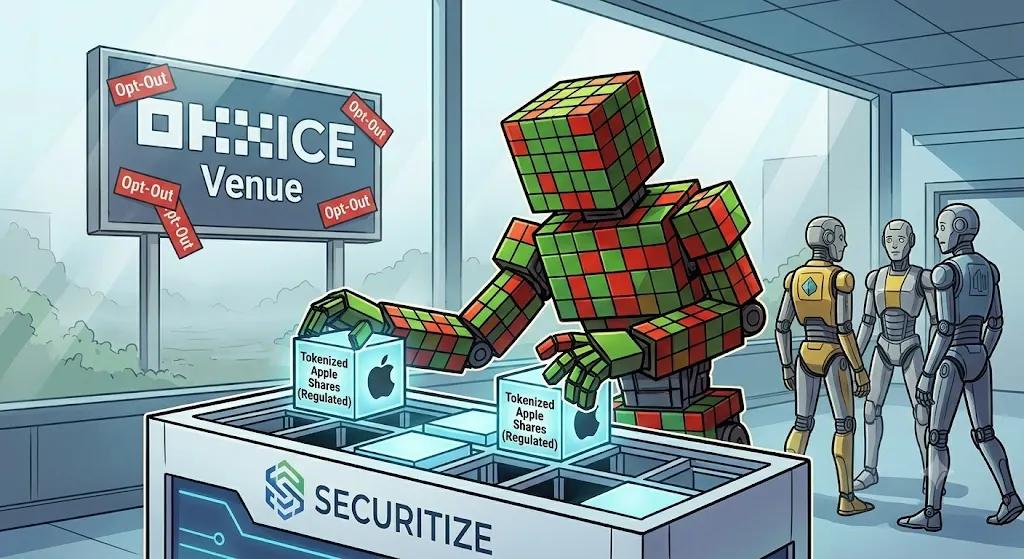
Apple, Home Depot and GE Vernova have objected to plans by OKXICE to list tokenized versions of their shares, bringing the total number of corporate objections to 59. The latest additions were identified in a November 4, 2026, post by journalist Eleanor Terrett, while OKXICE's November 3 public notice documented the growing list of companies rejecting inclusion on the platform.
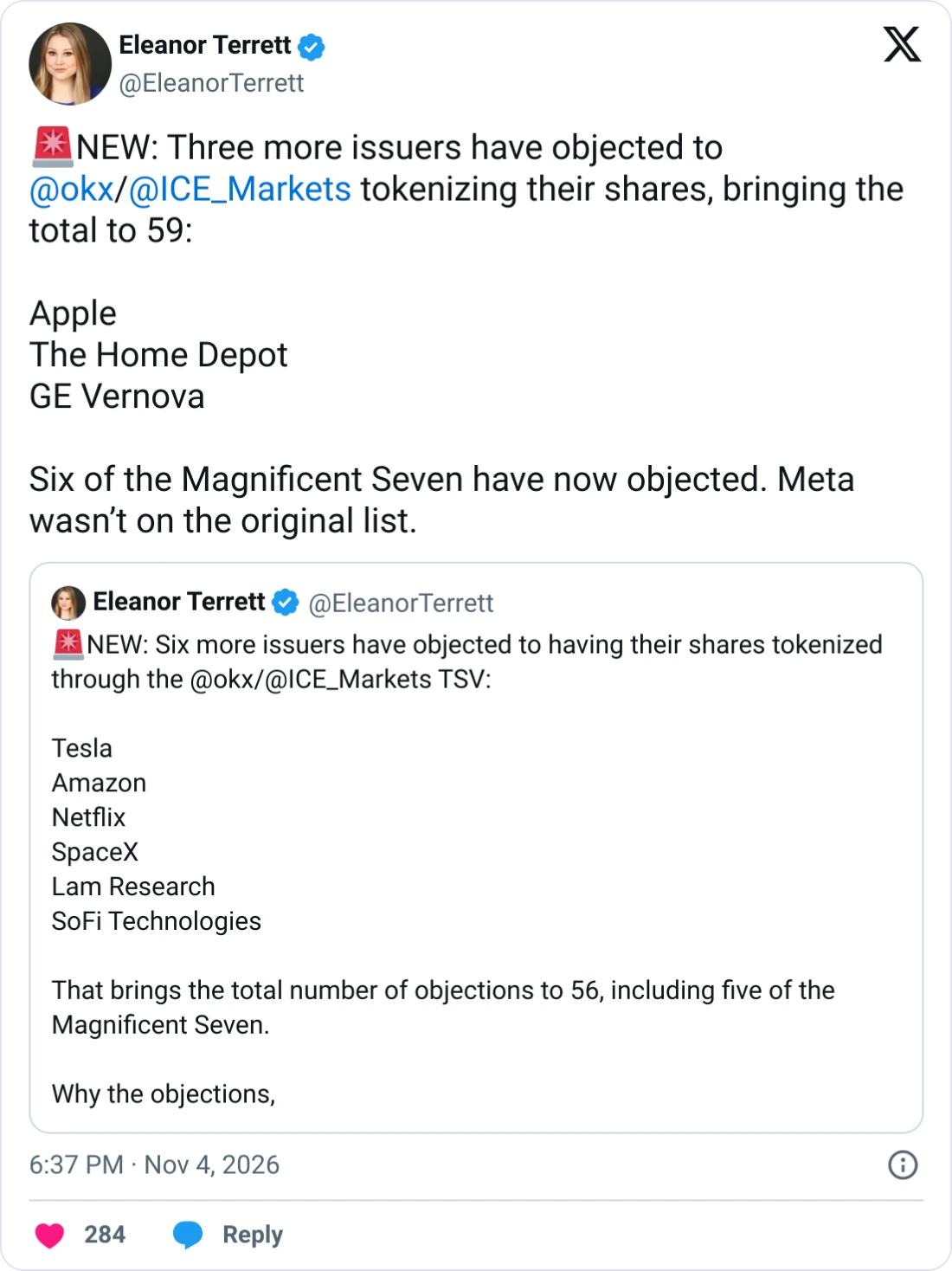
The objections have reached some of the largest U.S. technology and financial companies. Alphabet, Amazon, JPMorgan, Microsoft, Nvidia, Tesla and Walmart are among those opposing the proposed listings. Cisco Systems, Goldman Sachs and Qualcomm have also objected, adding to the resistance facing the tokenized securities venture.
Terrett highlighted the concentration of objections among major technology companies, writing: "Six of the Magnificent Seven have now objected. Meta wasn’t on the original list." Meta was the only member of the group absent from OKXICE's initial target list, while the other members have submitted objections.
How OKXICE's Corporate Objections Grew
OKXICE is a tokenization platform formed through a 50-50 joint venture between cryptocurrency exchange OKX and Intercontinental Exchange (ICE), the parent company of the New York Stock Exchange. The venture aims to offer tokenized versions of more than 60 U.S.-listed stocks, allowing securities to trade on blockchain infrastructure.
The planned OKXICE Tokenized Securities Venue (TSV) would support round-the-clock trading through Uniswap v4 liquidity pools on the XLayer blockchain. The platform is designed to operate under a regulatory exemption established by the U.S. Securities and Exchange Commission (SEC).
The first wave of objections emerged around October 17, when AppLovin, Applied Digital, Applied Optoelectronics, Broadcom, Cerebras Systems, CoreWeave, Rocket Lab, Verizon and UnitedHealth Group rejected proposed listings.
OKXICE subsequently told The Wall Street Journal that its plans to list tokenized shares of major U.S. companies, including the Magnificent Seven, remained on track despite the initial objections.
Resistance continued to expand over the following days. By October 23, the number of companies opting out had reached 22, with Microsoft and Alphabet joining a group that also included Arm Holdings, Intuit and Wells Fargo. IBM, Intel, Oracle and IonQ followed, increasing the total to 26.
Further objections from major companies, including Amazon and Tesla, preceded the latest additions. SpaceX was among the entities opposing inclusion on the platform, alongside The Home Depot, GE Vernova, JPMorgan Chase and Goldman Sachs.
How SEC Rules Allow Companies to Reject Tokenized Shares
The objections are taking place under a five-year SEC innovation exemption introduced in September 2026 and scheduled to run through September 2031.
The exemption permits qualifying tokenized securities venues to trade blockchain-based versions of listed stocks without registering as traditional exchanges. However, it also establishes a notification process intended to give issuers control over whether their shares can be included on a particular venue.
Under the framework, a venue seeking to tokenize an issuer's securities must deliver written notice at least 30 calendar days before trading begins. The issuer can then submit a written objection or consent during the response period. Companies that do not respond are treated as having consented.
An objection applies only to the venue receiving it. Companies must respond separately to notices from other platforms, and the SEC framework does not prevent issuers from creating their own blockchain-based securities.
The notice system has faced criticism from financial industry organizations and legal advisers.
Securities Industry and Financial Markets Association (SIFMA) President and CEO Kenneth E. Bentsen, Jr. urged the SEC to address concerns about the exemption in an October 19 letter.
"Getting the foundations right from day one is essential," Bentsen said.
Law firm Hunton Andrews Kurth raised separate concerns in an October 8 comment letter, warning that unsolicited cryptocurrency-related emails could be filtered into spam folders while physical notices might be overlooked in corporate mailrooms.
The firm urged the SEC to replace the default-consent approach with an affirmative approval requirement. It also proposed a public database identifying companies that object to tokenized listings.
The Common Sense Leadership Fund separately purchased a full-page advertisement in The Wall Street Journal's October 24-25 weekend edition, encouraging corporate executives to exercise their objection rights.
The advertisement cited differences in prices between trading venues, limited visibility into token ownership and potential liability "for anything that goes wrong."
Nasdaq, which plans to exclude its own shares from platforms operating under the exemption, declined to comment on claims that its representatives had encouraged listed companies to avoid OKXICE.
Tokenization Companies Respond as Overseas Trading Continues
The growing objections have prompted responses from companies pursuing regulated tokenized securities.
Securitize, which launched tokenized U.S. stocks on October 8 and whose shares are expected to trade on OKXICE, has challenged criticism of the regulatory framework.
Securitize CEO Carlos Domingo called the Common Sense Leadership Fund advertisement "misleading" in an October 26 post on X. Domingo criticized "offshore synthetics" and characterized the objections as favorable to companies pursuing regulated tokenization.
Securitize President Brett Redfearn separately told The Wall Street Journal that a company's objection to an individual venue should not be interpreted as a rejection of tokenization itself.
OKXICE co-chair Andrew Cuomo, the former New York governor, has acknowledged that issuers are likely to approach the technology skeptically. He has characterized the proposed platform as an initial step toward broader adoption.
The developments come as the tokenized stock market continues to expand. According to latest data, the market was worth approximately $3.5 billion as of October 15, compared with roughly $680 million at the beginning of the year.
Meanwhile, tokenized versions of Apple shares are already circulating outside the United States.
Kraken, Bybit and OKX's international trading platform are among the overseas venues offering third-party versions of Apple shares, with access restricted for U.S. residents.
Several products use different structures to provide exposure to Apple's stock. Backed Finance's AAPLx token operates on Solana and Ethereum with 1:1 custodial backing by shares. Ondo's AAPLon product provides tokenized exposure with automatic dividend reinvestment, while Backpack offers AAPL tokens that can be exchanged directly for underlying shares.
These overseas products are distinct from OKXICE's proposed U.S. venue. Apple's objection concerns tokenized trading on the particular platform, while existing foreign-market offerings operate through separate arrangements.
This article has been refined and enhanced by ChatGPT.


