




 USD
USDNYT Investigation Points to Adam Back as Leading Satoshi Candidate

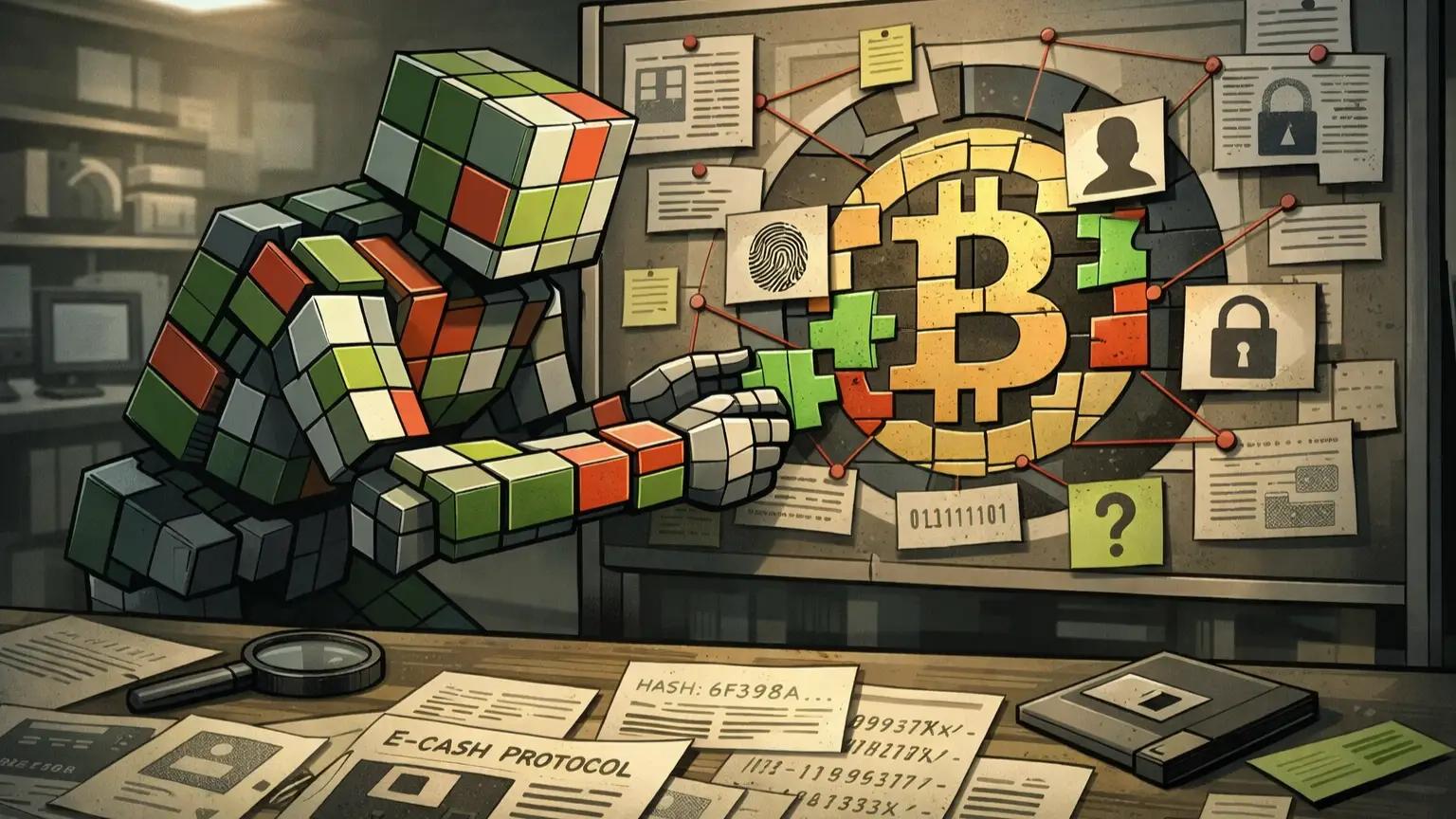
Adam Back denies claim as case remains circumstantial
TL;DR
- John Carreyrou’s New York Times investigation said Adam Back is the strongest known candidate for Satoshi Nakamoto.
- Adam Back denied being Satoshi and said he does not know who Satoshi is.
- No direct or undeniable evidence was presented to conclusively prove the claim.
We’ve launched the all-new COIN360 Perp DEX, built for traders who move fast!
Trade 130+ assets with up to 100× leverage, enjoy instant order placement and low-slippage swaps, and earn USDC passive yield while climbing the leaderboard. Your trades deserve more than speed — they deserve mastery.
John Carreyrou’s New York Times investigation said Adam Back is the strongest known candidate for Satoshi Nakamoto, but Adam Back denied being Bitcoin’s creator, and no direct proof was presented to conclusively identify him as Satoshi.
The case relies on a cluster of circumstantial indicators tied to Adam Back’s earlier work and activity. These include his invention of Hashcash, which Satoshi cited in the Bitcoin white paper, along with his early writing about privacy-preserving digital cash, distributed verification, scarcity, and systems not dependent on a bank or central intermediary. His participation in electronic cash discussions in the late 1990s and reported writing-pattern overlaps were also highlighted as aligning with Satoshi’s known communications.
Why the investigation focused on Adam Back
John Carreyrou examined cypherpunk archives and said Adam Back had described a digital cash architecture featuring sender and receiver privacy, distribution across many computers, built-in scarcity, and public verification. He also said that among individuals who hyphenated “proof-of-work,” only Adam Back overlapped with another Satoshi-related clue involving the Russian online currency WebMoney.
Timing and behavior were also part of the findings. Adam Back was described as relatively quiet during Bitcoin’s 2008–2011 formative period before becoming more active after Satoshi disappeared. John Carreyrou also wrote that Adam Back appeared visibly tense when his name was mentioned in an HBO documentary and later denied being Satoshi more than half a dozen times during an encounter in El Salvador.
Adam Back rejected the claim directly. He said he is not Satoshi and said John Carreyrou and Aaron van Wirdum were identifying “many interesting bitcoin analogs” in earlier decentralized ecash research. He also argued that his prolific posting created a statistical confirmation-bias problem because he was more visible than similarly minded peers. Adam Back added that he does not know who Satoshi is and said Bitcoin benefits from that anonymity because it helps the asset be viewed as “the mathematically scarce digital commodity.”
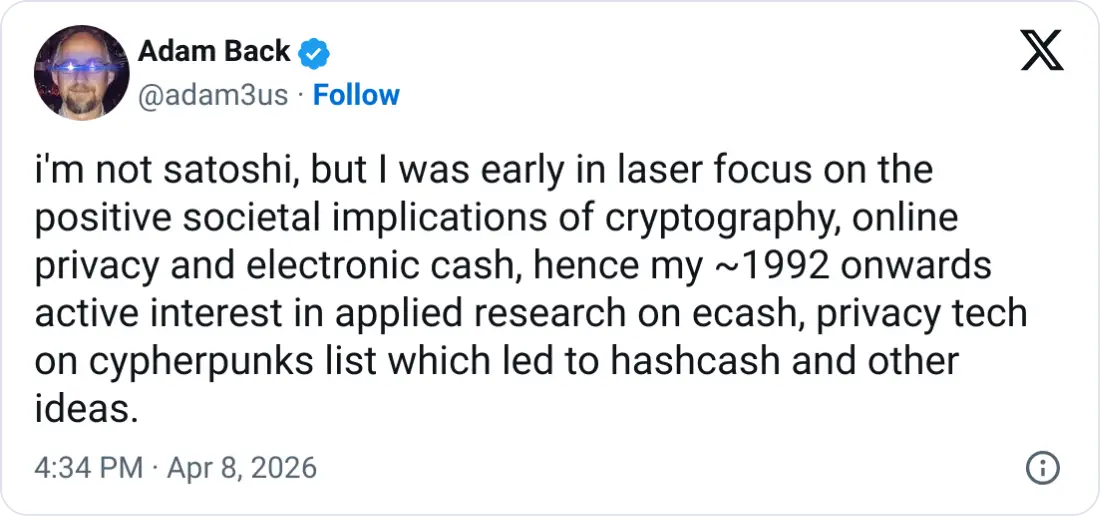
No direct evidence linking Adam Back to Satoshi was identified, and no undeniable proof was established, leaving the identity of Satoshi Nakamoto unresolved.
Long history of disputed Satoshi identifications
Efforts to identify Satoshi Nakamoto have spanned years and repeatedly produced competing claims without resolution. An HBO documentary that aired in October 2024 singled out Canadian software developer Peter Todd, pointing to a 2010 Bitcointalk thread where Todd corrected Satoshi on a technical point and suggesting it reflected Satoshi finishing his own thought. Todd denied the claim in a post on X.
Other figures frequently linked to Satoshi include Nick Szabo, Hal Finney, and Len Sassaman. Hal Finney was photographed running a 10-mile race in April 2009 at the same time Satoshi was sending emails and bitcoins to another recipient. Finney, who died of ALS in 2014, and Len Sassaman, who died by suicide in 2011, were both deceased when a message attributed to Satoshi appeared in August 2015, though its authenticity has been disputed.
Craig Wright, an Australian computer scientist, spent years claiming to be Satoshi. The High Court in London ruled in May 2024 that Wright lied “extensively and repeatedly,” used “clumsy forgeries” “on a grand scale,” and relied on “technobabble.” Wright later received a one-year suspended prison sentence in December 2024 for contempt of court after continuing lawsuits against Bitcoin developers.
Satoshi Nakamoto has not communicated publicly since an April 26, 2011 email and is believed to hold 1.1 million BTC, more than 5% of the total 21 million supply.
David Schwartz, Ripple's CTO Emeritus, asserts that the keys to Satoshi Nakamoto's one million Bitcoin are likely lost or destroyed, diminishing any future market risk from these dormant funds. In the wake of renewed speculation about Satoshi's identity, Schwartz emphasizes that the key issue isn't the creator's identity but the practical reality that these Bitcoins are effectively dead weight. He argues that after 17 years, the notion that anyone would willingly ignore a fortune worth $70-$80 billion is implausible.
Schwartz, previously considered a potential Satoshi candidate due to his cryptographic expertise, has stated he only became aware of Bitcoin in 2011. His perspective pushes the dialogue away from myth and back into the realms of mathematics and key security, reinforcing the notion that those Bitcoins will likely never affect the market again.
FAQ
Who was identified as the strongest candidate?
Adam Back.
Did Adam Back confirm the claim?
No. He denied being Satoshi.
What evidence supports the claim?
Circumstantial indicators including writings, timing, and technical overlap.
Is Satoshi’s identity confirmed?
No. It remains unresolved.
This article has been refined and enhanced by ChatGPT.


